Authorities in Southern California continued emergency operations Monday to prevent a potentially catastrophic explosion or toxic leak from a damaged chemical storage tank that forced tens of thousands of residents to evacuate across Orange County.
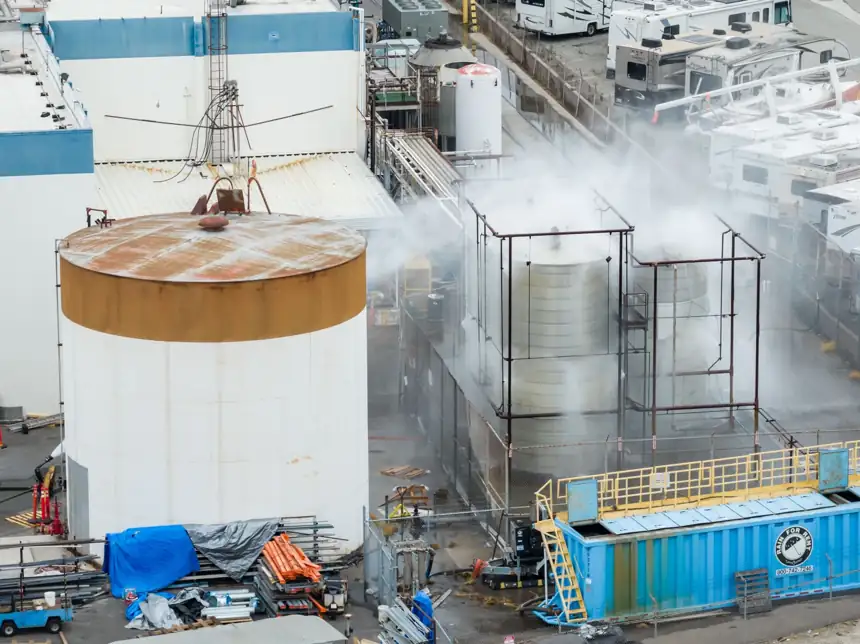
The crisis centers on an overheated tank at a GKN Aerospace facility in Garden Grove containing between 6,000 and 7,000 gallons of methyl methacrylate, a highly flammable chemical used in plastics manufacturing and aerospace production. Officials said the tank became unstable after overheating last week, creating fears of either a massive fireball explosion or a dangerous chemical release.
Mandatory evacuation orders covering roughly 50,000 residents remained in effect across parts of Garden Grove, Cypress, Stanton, Anaheim, Buena Park, and Westminster as firefighters and hazardous materials teams worked around the clock to stabilize the site.

Officials Monitor Tank for Signs of Failure
Emergency crews have been continuously spraying water onto the damaged tank to reduce temperatures and prevent pressure buildup inside the vessel.
Orange County Fire Authority officials said engineers recently discovered what appeared to be a crack in the tank, a development that may be reducing internal pressure and lowering the risk of a catastrophic blast. Authorities cautioned, however, that the danger has not been eliminated and that the tank could still fail unexpectedly.
“This is as real as it gets,” Orange County Fire Authority Division Chief Craig Covey told US media outlets, describing the situation as one of the most dangerous hazardous materials emergencies he had encountered.
Officials said temperatures inside the tank rose to approximately 100 degrees Fahrenheit despite ongoing cooling operations, raising concerns about a possible “thermal runaway” reaction capable of triggering an explosion.
Health and Environmental Risks Remain Under Scrutiny
Methyl methacrylate is classified as a hazardous and highly volatile chemical capable of causing respiratory irritation, nausea, headaches, skin burns, and eye injuries if released in large quantities.
■ Related News




Federal and local agencies including the Environmental Protection Agency deployed air monitoring systems around the evacuation zone. Authorities said no dangerous airborne contamination had yet been detected, though health officials warned prolonged exposure could still pose serious risks if a leak occurs.
Containment barriers and drainage systems were also established near the facility to prevent chemicals from entering waterways in the event of a spill.
Environmental experts noted that while the apparent crack in the tank may reduce the chance of a massive explosion, the chemical reaction inside the vessel could still create dangerous pressure conditions.
California Declares Emergency
California Governor Gavin Newsom declared a state of emergency over the incident and requested federal assistance to support local response operations.
State officials said emergency shelters, transportation assistance, and public health services were being expanded for displaced residents. More than a dozen schools temporarily suspended classes or outdoor activities due to the evacuation zone and ongoing safety concerns.
Emergency responders described the event as unprecedented because of the size of the tank, the instability of the chemical reaction, and the dense urban population surrounding the industrial site. Officials acknowledged they could not yet provide a timeline for when evacuees would be allowed to return home.
Company Faces Legal and Regulatory Pressure
The crisis has also triggered growing scrutiny of GKN Aerospace and its prior safety record.
Reports indicated the company previously settled environmental and workplace safety violations with California regulators for more than $900,000. Residents affected by the evacuation have already filed class-action lawsuits alleging negligence, property disruption, and emotional distress linked to the incident.
GKN Aerospace said in public statements that it was cooperating fully with local, state, and federal agencies while working to safely resolve the emergency.
The incident has renewed debate over industrial safety oversight in densely populated areas of California, particularly regarding facilities storing hazardous chemicals near residential neighborhoods and schools.