WASHINGTON — The U.S. Supreme Court on Friday rejected an emergency appeal from Virginia Democrats seeking to restore a voter-approved congressional map that could have strengthened the party’s position in the closely divided House of Representatives. The ruling leaves existing district boundaries in place for the 2026 midterm elections and marks another major development in the broader national fight over congressional redistricting.
The dispute emerged after the Virginia Supreme Court invalidated a constitutional amendment approved by voters in April that would have authorized new congressional districts favorable to Democrats. State justices ruled in a 4-3 decision that Virginia’s Democratic-controlled legislature violated procedural requirements by placing the amendment on the ballot after early voting had already begun.
Democratic lawmakers argued before the U.S. Supreme Court that federal election law defines Election Day itself — rather than the early voting period — as the decisive constitutional deadline. However, the nation’s highest court declined to intervene, issuing a brief order without explanation.

National Redistricting Battle Intensifies
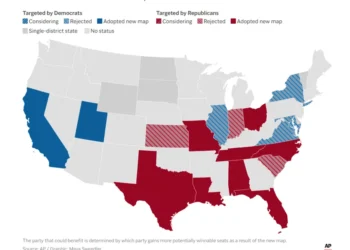
The Virginia case has become part of a wider nationwide struggle over congressional maps as both major political parties seek advantages ahead of the midterm elections. Republicans in several states, including Texas, Florida, and Louisiana, have pursued mid-decade redistricting efforts following recent Supreme Court decisions that weakened parts of the Voting Rights Act.
Political analysts noted that Virginia Democrats viewed the proposed map as a counterweight to Republican-backed redraws elsewhere in the country. The rejected plan could have shifted up to four congressional seats toward Democrats, potentially affecting the balance of power in Washington.
Virginia Governor Abigail Spanberger indicated earlier this week that the state would proceed with current congressional districts because of looming election administration deadlines, regardless of the Supreme Court’s decision.
Legal Questions Over Election Procedures
At the center of the case was whether Virginia lawmakers complied with constitutional procedures when advancing the ballot measure. Republicans who challenged the amendment argued that beginning the ballot certification process after early voting had started violated state constitutional requirements.
The Virginia Supreme Court agreed, concluding that the procedural defect invalidated the referendum despite voter approval. Democrats criticized the ruling, saying millions of voters had effectively been overruled after the election took place.
■ Related News




Legal experts said the U.S. Supreme Court generally avoids overturning state court interpretations of state constitutions, making the Democrats’ emergency appeal a difficult challenge from the outset.
Broader Political Implications
The decision is expected to reinforce Republican advantages in the ongoing national redistricting contest. Recent court rulings involving congressional maps in Southern states have already reshaped debates around race, voting rights, and partisan gerrymandering.
Observers say the Virginia ruling highlights how state-level procedural disputes can have significant national consequences in a narrowly divided Congress. With control of the House likely to remain highly competitive in 2026, redistricting battles are expected to continue across multiple states in the months ahead.