The 2026 Mount Everest climbing season has opened weeks later than usual after a massive unstable ice formation blocked the mountain’s main ascent route, intensifying international concerns over mountaineering safety, climate-related glacier instability and growing pressure on Nepal’s high-altitude tourism industry.
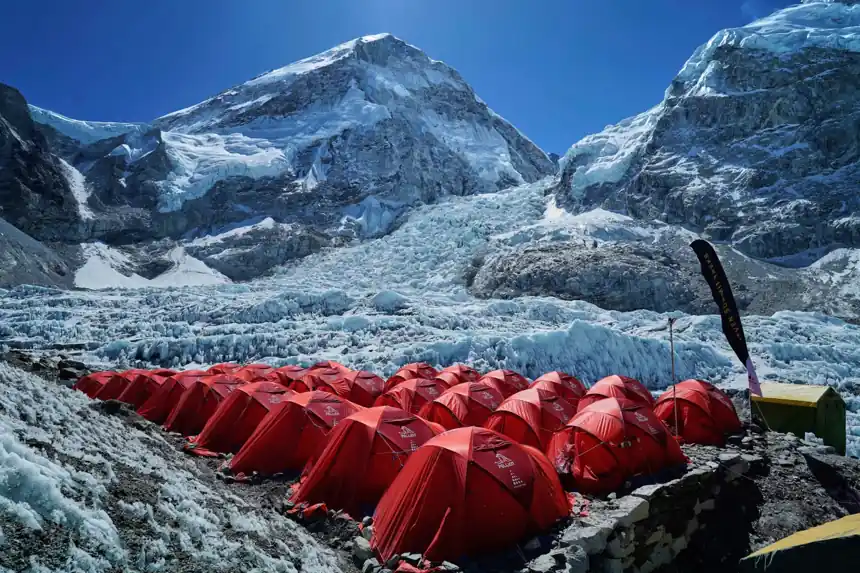
Despite escalating expedition costs and warnings from experienced guides, hundreds of climbers have continued preparations to attempt the world’s highest peak from Nepal’s southern route. According to reporting from The Associated Press and Reuters, roughly 464 foreign climbers and an equal number of Nepali guides are currently gathered at Everest Base Camp ahead of the narrow May weather window considered critical for summit attempts.
The delays were triggered by a towering unstable serac — a fractured block of glacier ice — hanging over the Khumbu Icefall, one of the most dangerous sections of the Everest climb. The route through the icefall was only reopened on April 29 after specialist Sherpa teams known as “Icefall Doctors” completed emergency path-setting operations under hazardous conditions.

Climate and Safety Risks Intensify on Everest Route
Mountaineering experts say the unusually dangerous ice conditions have reinforced concerns about how warming temperatures are reshaping Himalayan climbing routes.
The Sagarmatha Pollution Control Committee, the organization responsible for maintaining the Everest route, warned expedition teams that the serac contained multiple cracks and could collapse “at any time,” according to AP reporting. The revised trail now passes directly beneath the unstable ice structure, increasing exposure for climbers and Sherpa support teams moving supplies toward higher camps.
Veteran Austrian guide Lukas Furtenbach told reporters at base camp that the route this season was more exposed than in previous years. Expedition companies are reportedly reducing time spent in the Khumbu Icefall and relying on highly experienced Sherpa teams to monitor shifting glacier conditions.
The Khumbu Icefall has long been regarded as one of Everest’s deadliest sections due to moving ice towers, crevasses and avalanche threats. A collapsing serac triggered a deadly avalanche there in 2014 that killed 16 Nepali guides, one of the worst disasters in Everest climbing history.
Economic Pressures Fail to Slow Demand
The difficult conditions have not significantly reduced international demand for Everest expeditions, despite higher travel costs and increased climbing permit fees imposed by Nepal.
■ Related News

Industry operators cited by AP said participation from Western climbers has declined compared with previous years, while demand from Asian climbers has continued rising. Analysts say the shift reflects broader changes in global adventure tourism markets as affluent travelers from Asia expand their presence in high-altitude expeditions.
Nepal’s economy remains heavily dependent on mountain tourism revenue, particularly during the short Everest climbing season. Reuters reported that authorities issued more than 400 Everest permits this spring, each costing foreign climbers approximately $15,000 before guide services, logistics and oxygen expenses are added.
Additional geopolitical complications have also reshaped the season. China has kept the Tibetan side of Everest closed this year, forcing all climbers to attempt the summit through Nepal’s southern route and increasing concerns over congestion during the limited summit weather period.
International Debate Grows Over Everest Sustainability
The delayed opening of the route has renewed wider international debate over the long-term sustainability of commercial climbing on Everest as environmental risks increase.
Scientists and environmental groups have repeatedly warned that rising temperatures in the Himalayas are accelerating glacier melt and destabilizing ice formations across the region. During a 2023 visit to Nepal, António Guterres warned that Himalayan glaciers were melting at alarming rates with potentially devastating regional consequences.
Mountaineering observers say the current season may become a critical test of how expedition companies and Nepalese authorities adapt to increasingly volatile mountain conditions while managing crowding risks and maintaining climber safety.
With summit attempts expected to intensify over the coming weeks, expedition teams are closely monitoring weather patterns and glacier movement as climbers move toward higher camps on the mountain.