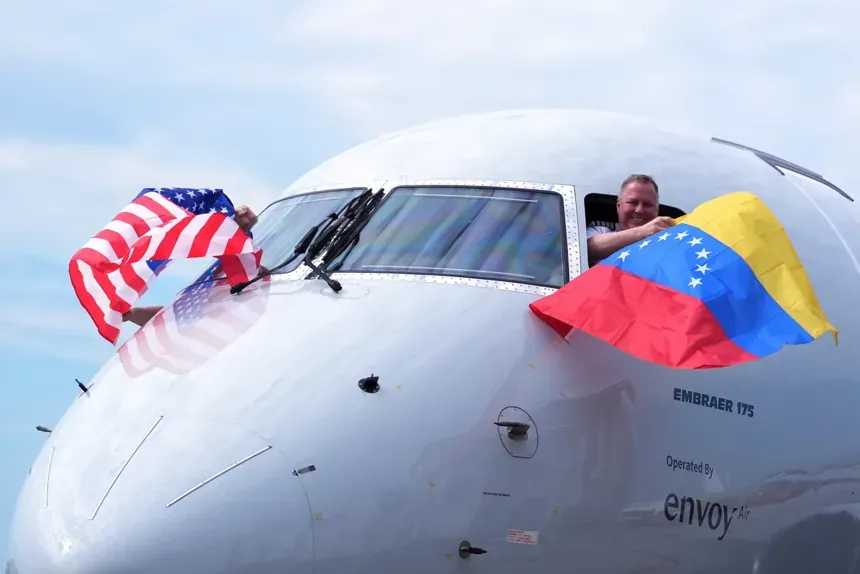
A direct commercial flight between the United States and Venezuela has landed in Caracas for the first time in seven years, marking a significant step in the normalization of relations between the two countries and reopening a key channel for travel and commerce.
The flight, operated by American Airlines subsidiary Envoy Air, departed Miami and arrived in Caracas on Thursday, restoring nonstop service that had been suspended since 2019 due to security concerns and diplomatic breakdowns.
According to reporting from The Associated Press, the resumption follows a series of rapid political developments, including the reopening of the U.S. embassy in Caracas and the restoration of full diplomatic ties between Washington and Venezuelan authorities.

Diplomatic Reopening Drives Aviation Breakthrough
The restart of direct flights reflects a broader diplomatic thaw after years of strained relations. U.S. authorities had imposed an indefinite suspension on flights in 2019, citing safety concerns amid Venezuela’s political crisis.
Recent policy shifts—including decisions by the administration of Donald Trump to reopen Venezuelan airspace—have paved the way for renewed connectivity. Officials told Reuters that the move is part of wider efforts to reestablish economic and political engagement with Caracas following months of geopolitical realignment.
The development is also linked to broader changes in Venezuela’s political landscape earlier this year, which prompted Washington to recalibrate its approach toward the country.
Economic and Mobility Links Reconnect
The return of direct air service is expected to significantly improve mobility for Venezuelan diaspora communities and facilitate business travel between the two countries. For years, passengers were forced to rely on indirect routes through third countries, increasing costs and travel times.
Airline officials indicated that demand is being driven by both family reunification and commercial opportunities, particularly in sectors such as energy and mining. A second daily flight between Miami and Caracas is scheduled to begin later in May, reflecting expectations of sustained demand.
■ Related News

Passengers on the inaugural flight described the moment as a major breakthrough, highlighting the social and economic importance of restoring direct connections between the two nations.
Strategic Implications for Regional Engagement
The resumption of flights signals a broader shift in U.S. policy toward Latin America, where Venezuela has long been a focal point of diplomatic tension. Analysts say the move could open pathways for increased trade, investment, and political dialogue, while also reshaping regional dynamics.
Officials cited by Reuters noted that the restored air link is part of a wider effort to reintegrate Venezuela into international economic systems, potentially encouraging further reforms and cooperation.
However, some observers caution that while the reopening of travel routes marks progress, deeper structural and political challenges in Venezuela remain unresolved.
International Outlook and Future Developments
The return of direct flights represents a tangible outcome of renewed diplomatic engagement, but its long-term impact will depend on sustained political stability and continued cooperation between Washington and Caracas.
As additional flights are introduced and restrictions continue to ease, policymakers and businesses will be closely watching whether the reopening translates into broader economic recovery and regional integration.
For now, the restored air corridor stands as a visible sign of shifting geopolitical dynamics in the Americas—linking two countries that, until recently, had been largely disconnected both diplomatically and logistically.