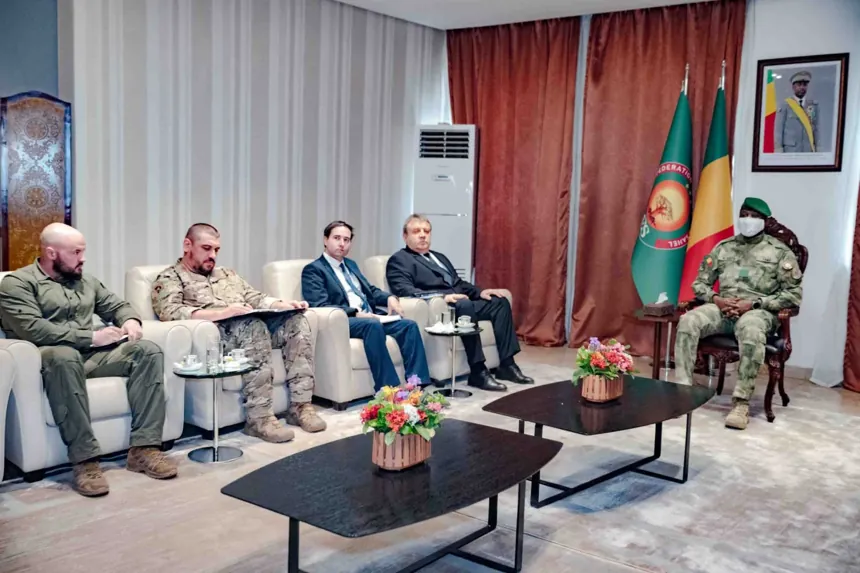
Mali’s military leader Assimi Goïta has met Russia’s ambassador in Bamako following a wave of coordinated militant attacks that Moscow has described as an attempted coup, underscoring deepening security and geopolitical strains in the West African state.
The meeting took place at the presidential palace in the capital, marking Goïta’s first public appearance since the weekend offensive that struck multiple cities, including Bamako’s airport and military installations, according to reporting by The Associated Press.
Russia, a key security partner of Mali’s junta, said its Africa Corps forces helped repel the assault and framed the attacks as a destabilization attempt involving thousands of fighters.

Coordinated Attacks Expose Fragile Security Landscape
The weekend violence involved a coordinated offensive by al-Qaida-linked militants and Tuareg separatists, targeting strategic locations across central and northern Mali, including the garrison town of Kati and the city of Kidal.
Authorities said the attacks resulted in significant casualties, including the death of Mali’s defense minister, Gen. Sadio Camara, while also forcing temporary withdrawals from key northern positions.
The scale of the operation highlighted the growing operational coordination between insurgent groups with differing ideological goals but shared opposition to the Malian military government and its foreign allies.
Russia Reasserts Military Partnership With Junta
During the meeting, Goïta and Russian Ambassador Igor Gromyko reportedly discussed continued military cooperation, with Moscow reaffirming its support for Mali’s counterinsurgency efforts.
Russia’s Defense Ministry characterized the violence as a failed coup attempt and claimed its forces, alongside Malian troops, had prevented wider instability.
■ Related News

The Africa Corps, Russia’s restructured military presence in Mali following the withdrawal of Wagner Group elements, remains central to Moscow’s expanding influence across the Sahel region.
Junta Leadership Defends Security Response
In a televised address following the meeting, Goïta vowed continued military operations against insurgent groups, stating that security operations would persist until armed factions were fully neutralized.
He also suggested that foreign actors were supporting the attackers, reflecting long-standing accusations by Mali’s leadership of external interference in domestic instability.
The government has not released detailed casualty figures or confirmed full territorial control in affected regions, leaving the extent of the damage unclear.
Regional Instability and Expanding Conflict Fronts
The attacks are among the most significant in Mali in recent years and reflect a broader escalation of violence across the central Sahel, where jihadist insurgencies and separatist movements have increasingly overlapped.
The United States Embassy in Bamako issued a security advisory during the unrest, warning of possible militant movements within the capital and disruptions to public services.
Analysts say the convergence of insurgent groups and external military backing for the junta is reshaping conflict dynamics in the region, raising concerns over prolonged instability and fragmented territorial control.
Strategic Stakes for Russia and West Africa
Mali has become a central hub for Russia’s expanded security footprint in Africa following the withdrawal of French and United Nations forces in recent years.
For Moscow, the survival and stability of Mali’s junta is tied to its broader influence strategy in the Sahel, where it seeks to position itself as a primary security partner amid declining Western engagement.
For Mali, however, reliance on external military support underscores the challenges of containing a multi-front insurgency that continues to expand in both scale and coordination.
Outlook: Intensifying Conflict With Uncertain Control
With insurgent groups demonstrating increased coordination and Russian forces deeply embedded in counterinsurgency operations, Mali faces an increasingly complex security environment.
The latest attacks—and the Kremlin’s framing of them as an attempted coup—signal a further tightening of military alliances and a widening confrontation between state-backed forces and non-state armed actors.
As operations continue, both Bamako and its international partners are confronting an unstable and evolving conflict landscape with no immediate resolution in sight.