TOKYO — Japan has raised a precautionary alert following a powerful 7.7-magnitude earthquake that struck off its northern coast, warning of a slightly increased risk of a larger “mega-quake” in the coming days, in a development closely watched across the seismically active Asia-Pacific region.
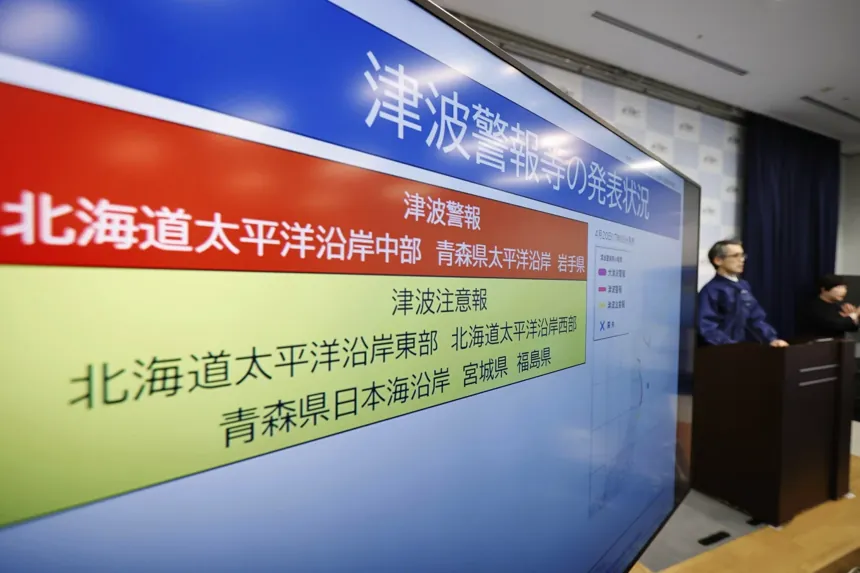
The quake, which hit near the Sanriku coastline on April 20, triggered a temporary tsunami warning and prompted evacuations across multiple prefectures. Officials said the advisory reflects a rise in the probability of a major earthquake to about 1%—ten times higher than normal levels—though authorities stress this is not a prediction of an imminent disaster.
Regional Stability Tested by Elevated Seismic Risk
Japanese authorities moved quickly to contain immediate risks, issuing tsunami alerts that were later downgraded after waves of up to 80 centimeters were recorded along parts of the northeastern coast.

According to reporting from The Associated Press, the Cabinet Office and the Japan Meteorological Agency issued a rare advisory urging residents in more than 180 coastal municipalities to review evacuation plans and emergency supplies.
Prime Minister Sanae Takaichi called on residents to remain vigilant while continuing daily activities, emphasizing preparedness rather than panic as the government activated emergency response systems.
The earthquake, occurring at a shallow depth of roughly 19 kilometers, was strong enough to disrupt transport networks, including temporary suspension of high-speed rail services, while evacuation advisories affected more than 170,000 people across northern regions.
International Monitoring Intensifies Across Pacific
While Japan reported only minor injuries and no significant structural damage, the event has drawn close monitoring from regional and international agencies due to its location along the Pacific “Ring of Fire,” one of the world’s most active seismic zones.
No abnormalities were reported at nuclear facilities, a key concern for international observers given the legacy of past disasters.



Global early warning systems and neighboring countries tracked the tsunami risk, though no wider regional threat materialized and alerts were lifted within hours.
Strategic Preparedness Becomes Central Focus
The advisory marks the latest in a series of government warnings following strong offshore earthquakes, underscoring Japan’s strategy of risk communication rather than prediction. Officials reiterated that the elevated probability—from 0.1% to 1%—remains low but significant enough to justify increased readiness.
Experts note that such advisories are designed to prompt immediate preparedness actions, including securing evacuation routes and emergency supplies, particularly in coastal regions vulnerable to tsunami impact.
The quake also revived memories of the 2011 disaster, reinforcing Japan’s emphasis on rapid response systems and public awareness as core pillars of disaster mitigation.
Future Risk Outlook Under Close Watch
Seismologists warn that aftershocks and further seismic activity remain possible in the coming days, though the likelihood of a significantly larger quake remains uncertain.
Japan’s response highlights a broader global challenge: balancing public caution with scientific uncertainty in high-risk regions. For international observers, the situation serves as a reminder of the persistent vulnerabilities across earthquake-prone economies in the Asia-Pacific.