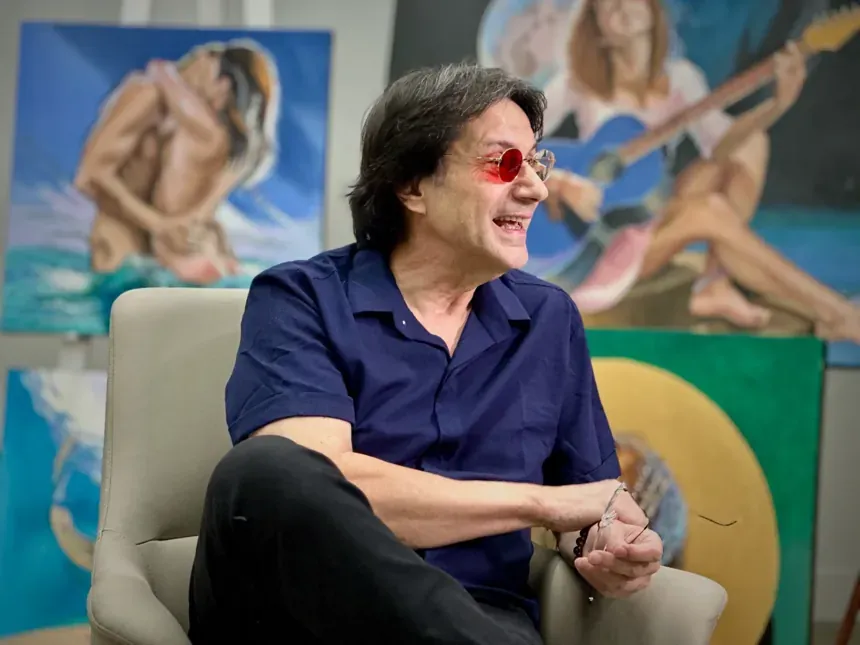
DORAL, Florida — Fernando Dávila, a Colombian-born painter living in the United States, has turned a lifelong visual limitation into a defining artistic strength, building a career centered on vibrant, expressive works despite being colorblind. His story, highlighted in reporting by The Associated Press, traces a journey from childhood struggle in Colombia to international recognition in the art world.
The 72-year-old artist recalls being unable to distinguish colors as a child, once failing a school drawing assignment after painting donkeys red — a result of his colorblindness rather than artistic intent. Now based in Florida, Dávila has become an established figure whose works have been exhibited across South America, Europe, and the United States.
His experience reflects both the challenges and adaptations associated with color vision deficiency, a condition that affects perception of certain hues, particularly reds and greens. Despite these limitations, Dávila has developed a distinctive artistic style that embraces contrast, texture, and emotional expression over strict color accuracy.

Early Struggles Shape Artistic Identity
Dávila’s early years were marked by frustration in formal art education, where misunderstanding of his condition initially led to academic setbacks. Growing up in Colombia, he spent much of his early artistic life working in monochrome, avoiding color altogether due to the difficulty of distinguishing shades.
According to The Associated Press, he did not fully transition into color painting until adulthood, after experimenting with tools designed to assist color perception.
These early constraints, however, later became central to his creative development, shaping a style that relies heavily on composition and emotional tone rather than conventional color accuracy.
Technology Opens a New Artistic Dimension
A turning point in Dávila’s career came in the mid-1980s, when he began using specially designed glasses created by an ophthalmologist in New York. The lenses help enhance contrast between colors, allowing him to perceive a broader range of shades than he otherwise could.
While not restoring full color vision, the technology significantly expanded his artistic possibilities, enabling him to move beyond black-and-white work and explore more complex visual compositions.




Dávila has described the experience as transformative, comparing it to gaining access to a previously hidden dimension of visual expression.
International Recognition and Artistic Legacy
Over the decades, Dávila’s work has gained international attention, with exhibitions spanning multiple continents and inclusion in major art markets. His paintings often feature romantic imagery and landscapes, with recurring use of blue tones as a compositional base.
He has also received formal recognition from Colombia’s Congress for his contributions to the arts, reflecting his cultural significance beyond the canvas.
Art analysts note that his work stands out not because it compensates for colorblindness, but because it reinterprets visual perception through a uniquely personal lens — one shaped as much by limitation as by creativity.
A Perspective on Color and Perception
Despite his success, Dávila continues to describe color as something both essential and elusive. His work reflects a persistent desire to engage with a full spectrum he cannot fully perceive, a tension that has become central to his artistic identity.
His story has drawn attention within the broader art community as an example of how physical limitations can reshape, rather than restrict, creative expression.
As his career continues in Florida, Dávila’s journey underscores a broader artistic truth: that perception is not only a biological function, but also a deeply personal interpretation of the world.