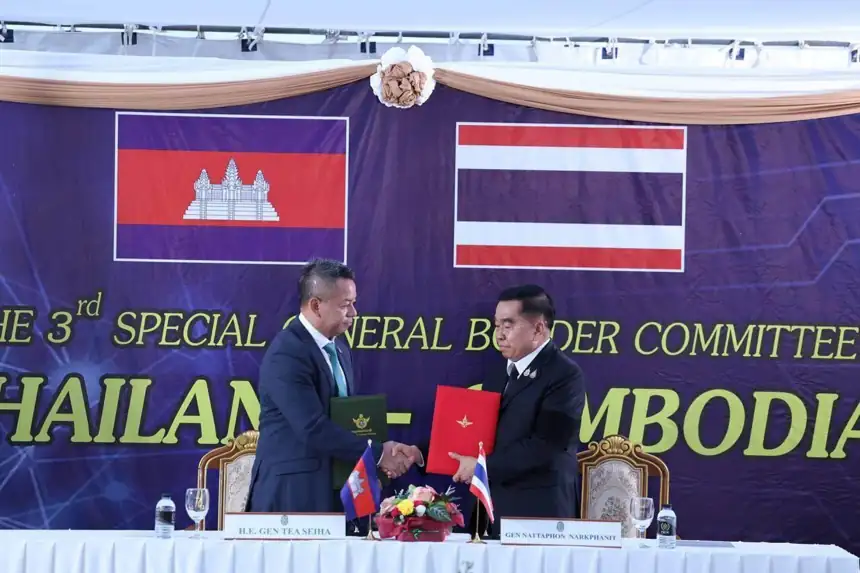
BANGKOK — Thailand and Cambodia have signed a new ceasefire agreement to end intensified border fighting, marking a renewed attempt to stabilize one of Southeast Asia’s most sensitive territorial disputes. The Thailand Cambodia ceasefire, confirmed by reporting from The Associated Press, took effect immediately and seeks to halt military escalation following weeks of deadly confrontations.
The agreement, signed by defense officials from both countries at a border checkpoint, includes provisions to stop troop movements and prevent military use of airspace along contested areas. The deal is seen as a critical step toward restoring stability in a region that has experienced repeated flare-ups tied to longstanding territorial claims.
Analysts say the renewed ceasefire carries broader regional implications, particularly for the Association of Southeast Asian Nations (ASEAN), which has sought to prevent localized conflicts from undermining wider regional security frameworks.

Regional Stability Tested by Renewed Thailand Cambodia Ceasefire
The Thailand Cambodia ceasefire follows weeks of heavy fighting that included artillery exchanges and airstrikes, with Thailand reported to have conducted aerial attacks on Cambodian positions during the escalation.
According to The Associated Press, the agreement prohibits further military deployments and aims to reduce the risk of miscalculation along the disputed frontier. The conflict had intensified earlier in December, despite previous ceasefire arrangements that failed to hold, underscoring the fragility of earlier diplomatic efforts.
Security analysts note that the absence of a robust monitoring mechanism has historically complicated enforcement, raising questions about whether the latest agreement can achieve sustained calm.
Humanitarian and Security Pressures Mount
The fighting has had significant humanitarian consequences, with casualties reported on both sides and large-scale civilian displacement. Hundreds of thousands of residents have been forced to flee border areas, highlighting the urgency of securing a durable ceasefire.
The agreement includes confidence-building measures such as the planned repatriation of Cambodian soldiers held by Thailand after a 72-hour compliance period, reflecting efforts to rebuild trust between the two governments.




Officials say these steps are intended to create conditions for displaced populations to return and for basic services in affected regions to resume.
International Mediation Efforts Gain Momentum
The ceasefire has drawn support from international stakeholders, including regional actors and major powers that have encouraged restraint and dialogue. Previous mediation efforts involving Malaysia and broader diplomatic pressure from global partners have played a role in bringing both sides back to negotiations.
Diplomatic observers suggest that sustained engagement from ASEAN and external partners will be essential to ensure compliance and prevent renewed hostilities. The involvement of multiple actors reflects the strategic importance of maintaining stability in mainland Southeast Asia.
Strategic Stakes for Southeast Asia
The Thailand Cambodia ceasefire highlights the continued sensitivity of border disputes rooted in historical territorial claims. While the latest agreement may reduce immediate tensions, underlying disagreements over demarcation remain unresolved.
Experts say the long-term success of the ceasefire will depend on whether both sides can translate temporary de-escalation into structured negotiations addressing core territorial issues. Without such progress, the risk of renewed conflict is likely to persist.
For regional stakeholders, the agreement serves as a test of ASEAN’s capacity to manage intra-regional disputes and maintain security cohesion. The coming weeks—particularly the initial compliance period—are expected to be critical in determining whether the ceasefire can evolve into a more durable peace framework.