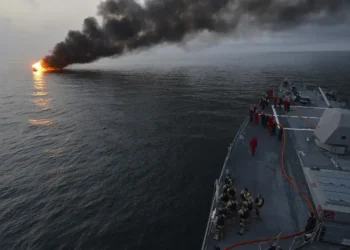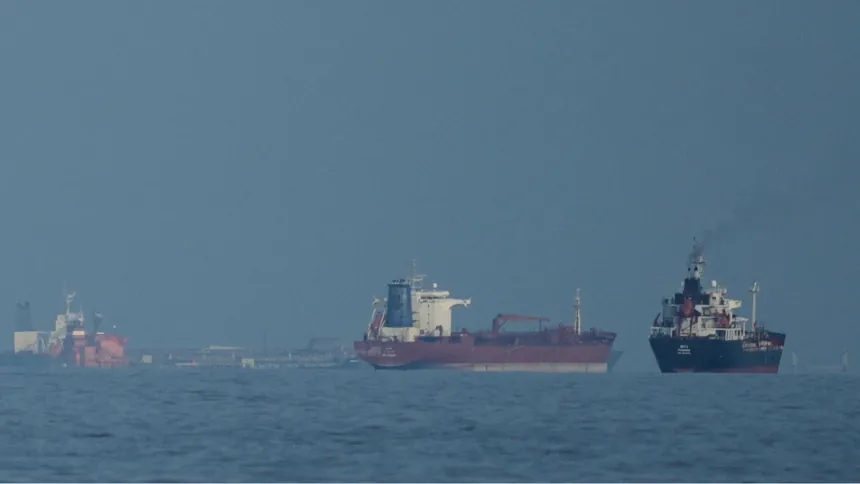
The United States’ maritime blockade of Iranian trade routes is already reshaping commercial traffic in the Gulf, with multiple sanctioned and Iran-linked vessels turning back under US Navy warnings, a development that has sharply escalated international pressure on Tehran while heightening concerns over the security of the Strait of Hormuz. The move matters far beyond the region because the chokepoint handles a significant share of the world’s seaborne oil exports, making any disruption an immediate issue for energy markets, insurers, and major importing economies.
In the first 48 hours of enforcement, ships departing Iranian ports or suspected of carrying sanctioned cargo have reportedly halted, reversed course, or gone dark on public tracking systems as naval forces expanded interdiction efforts into the Gulf of Oman. Reporting from The Associated Press indicates that US forces are using both AIS vessel data and military intelligence methods to distinguish ships connected to Iranian trade from neutral commercial traffic, a distinction that has become central to the blockade’s legal and diplomatic fallout.
Diplomatic Pressure Builds Around Maritime Access
The dominant international angle is now international sanctions pressure, as Washington’s sea interdictions increasingly function as an enforcement arm of its broader economic campaign against Iran. What began as a military move has rapidly evolved into a test of whether secondary sanctions, shipping compliance, and naval power can jointly restrict Tehran’s export capacity without triggering wider regional conflict.

Officials familiar with the operation said at least 10 vessels complied with US warnings and turned around, illustrating how the blockade is extending the reach of sanctions enforcement from banking and insurance systems into real-time maritime navigation. For global readers, the broader implication is that shipping companies, commodity traders, and Gulf port operators are being forced into immediate risk reassessments, with freight costs and war-risk premiums expected to rise if the standoff persists.
Regional Stability Tested as Tehran Signals Retaliation
Iran has responded by warning that Gulf trade routes could face broader disruption if its own maritime access remains constrained, raising the risk that commercial shipping beyond Iranian ports may also be affected. The warning has alarmed regional governments that depend on uninterrupted tanker flows through Hormuz, especially Gulf producers whose export routes rely on the same narrow passage.
Analysts tracking vessel movements note that even ships not bound for Iranian ports are now facing delays, route changes, and heightened scrutiny, a sign that the blockade’s deterrent effect is spreading across the wider Gulf shipping ecosystem. This matters strategically because even limited uncertainty in Hormuz can amplify volatility in crude prices, LNG supply contracts, and downstream refining operations in Asia and Europe.
Economic Fallout Spreads Beyond the Gulf
The economic consequences are already becoming global. Energy traders are closely watching whether Iranian storage limits force production slowdowns, which could tighten supply conditions even if other Gulf producers continue shipping normally. The possibility of prolonged export restrictions on Iranian oil is also prompting renewed focus on alternative supply corridors and strategic petroleum reserves among major consumer states.
Financial Times-style market analysis would likely focus on the second-order effects: insurance repricing, tanker availability constraints, rerouting costs, and renewed inflationary pressure tied to shipping fuel and petrochemical feedstocks. Those pressures could spread quickly into European manufacturing, Asian import bills, and broader commodity markets if the blockade remains in place through the coming weeks.
■ Related News



Strategic Stakes Rise for International Mediation
The next phase will likely depend on whether diplomatic intermediaries can create a maritime carveout for neutral or humanitarian cargo before the blockade hardens into a longer-term confrontation. International mediation efforts involving regional powers are expected to intensify as states seek to prevent the shipping crisis from spilling into a broader Gulf security emergency.
For the global foreign desk, the key forward-looking issue is whether maritime coercion succeeds in forcing renewed negotiations or instead entrenches a cycle of retaliation that destabilizes one of the world’s most critical trade corridors. Either outcome carries implications well beyond Iran and the United States, touching energy security, freedom of navigation, and the durability of sanctions as a tool of statecraft.