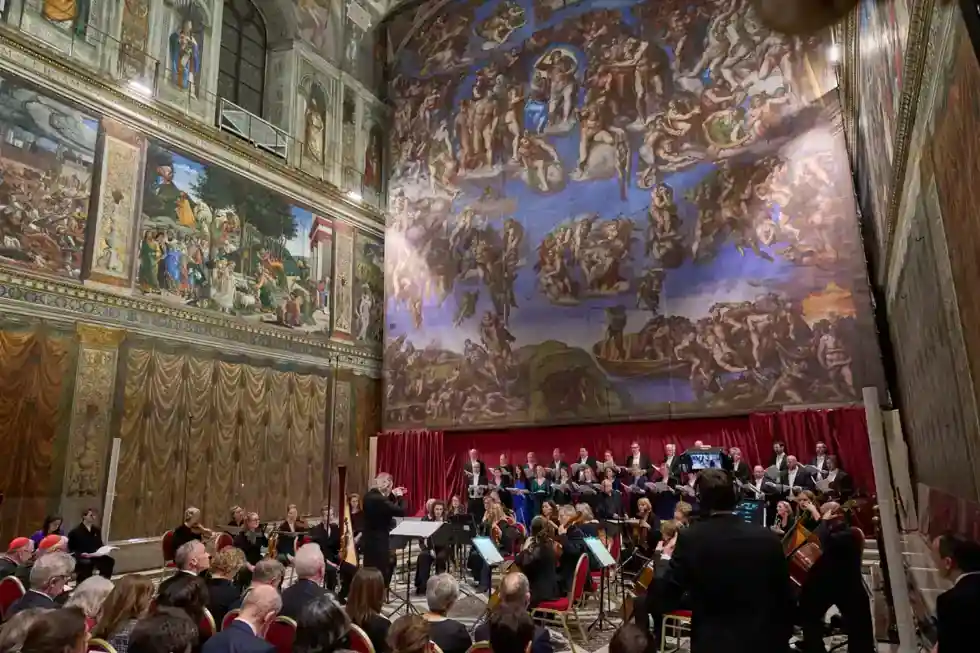
VATICAN CITY — A rare private concert inside the Sistine Chapel is drawing attention not only for its artistic significance but for what it signals about the Vatican’s evolving approach to cultural engagement and global religious communication.
According to reporting by The Associated Press, the invite-only event featured the premiere of “Angels Unawares,” a large-scale oratorio exploring biblical encounters with angels. The performance, attended by select international guests, underscores how the Vatican is increasingly using high-profile artistic events to connect faith narratives with wider global audiences.
While concerts are occasionally staged within the chapel, access for media and the public remains highly restricted, reinforcing the symbolic weight of this particular event.

Cultural Diplomacy Through Sacred Art Expands Vatican Outreach
The performance reflects a broader strategy where religious institutions leverage cultural expression to extend influence beyond traditional worship settings. By hosting a contemporary composition within one of Christianity’s most iconic spaces, the Vatican positions itself at the intersection of heritage and modern artistic dialogue.
Composed by James MacMillan and commissioned by the Genesis Foundation, the 70-minute work blends scriptural themes with orchestral and choral storytelling. Its staging inside the chapel—beneath the frescoes of Michelangelo—created a layered artistic experience combining visual and musical theology.
Observers note that such events serve a dual purpose: reinforcing tradition while signaling openness to contemporary forms of expression.
Language Choice Highlights Shift Toward Global Accessibility
A notable element of the concert was its use of English-language texts, a departure from the Latin historically associated with Vatican liturgy and music.
Cardinal Vincent Nichols, Archbishop of Westminster, emphasized that English allows broader comprehension across diverse audiences. This reflects a wider institutional recognition that language plays a critical role in expanding the reach of religious messaging in an increasingly interconnected world.



The performance featured British choir The Sixteen alongside Britten Sinfonia, reinforcing the event’s orientation toward English-speaking audiences. Analysts suggest that such choices align with demographic realities and the Vatican’s interest in maintaining relevance across global communities.
Exclusive Access Raises Questions About Religious Engagement Models
Despite its outward-facing cultural message, the event’s exclusivity highlights ongoing tensions between accessibility and tradition within major religious institutions.
Attendance was limited to around 200 invited guests, including political figures and international dignitaries, with strict prohibitions on recording or photography. This controlled environment underscores the Vatican’s continued emphasis on preserving the sanctity and exclusivity of certain spaces—even as it seeks broader engagement.
The balance between openness and restriction remains a defining challenge for institutions navigating modern expectations of transparency and inclusivity.
Artistic Themes Reflect Broader Interfaith Resonance
The oratorio’s focus on angels—figures present across multiple religious traditions—introduces an interfaith dimension to the event. Nichols noted that angelic imagery resonates across belief systems, potentially allowing the work to transcend strictly Christian audiences.
This thematic choice suggests a subtle effort to frame religious narratives in more universally accessible terms, aligning with broader trends in interfaith dialogue and shared symbolic language.
Analysts point out that such framing may help religious institutions engage audiences who identify culturally or spiritually, even if not institutionally affiliated.
Broadcast Plans Signal Expansion Beyond Elite Audiences
Although the live event was highly exclusive, its upcoming broadcast on BBC radio points to a wider dissemination strategy. By transitioning from a closed-door performance to a public broadcast, the Vatican effectively bridges the gap between elite cultural experience and mass audience access.
This hybrid model—exclusive presentation followed by broad distribution—illustrates how religious institutions are adapting to modern media ecosystems while maintaining traditional hierarchies of access.
Forward Outlook: Religion, Culture, and Global Influence
The Sistine Chapel concert highlights a broader shift in how religious institutions engage with the public—through culture, language, and controlled accessibility.
As global audiences become more diverse and less institutionally tied to organized religion, such strategies may play an increasingly important role in shaping religious relevance. The Vatican’s approach suggests an awareness that influence today is as much cultural and communicative as it is doctrinal.
Whether this model strengthens long-term engagement or reinforces perceptions of exclusivity will likely shape future debates about the role of religion in a rapidly evolving global society.