BEIRUT (Journos News) – Lebanon’s renewed war is no longer defined solely by front lines and military exchanges. As the Eid al-Fitr holiday approaches, the country is confronting a deepening humanitarian strain that is testing both domestic resilience and international response capacity.
According to reporting by The Associated Press, more than one million people have been displaced in recent weeks as hostilities between Israel and the Iran-backed Hezbollah movement intensified, triggering widespread bombardment across southern Lebanon and parts of Beirut. The timing—coinciding with the final stretch of Ramadan—has sharpened the social and economic toll.
For many displaced families, the immediate concern is no longer the observance of religious traditions, but the basic conditions of survival.

Humanitarian Capacity Stretches Toward Breaking Point
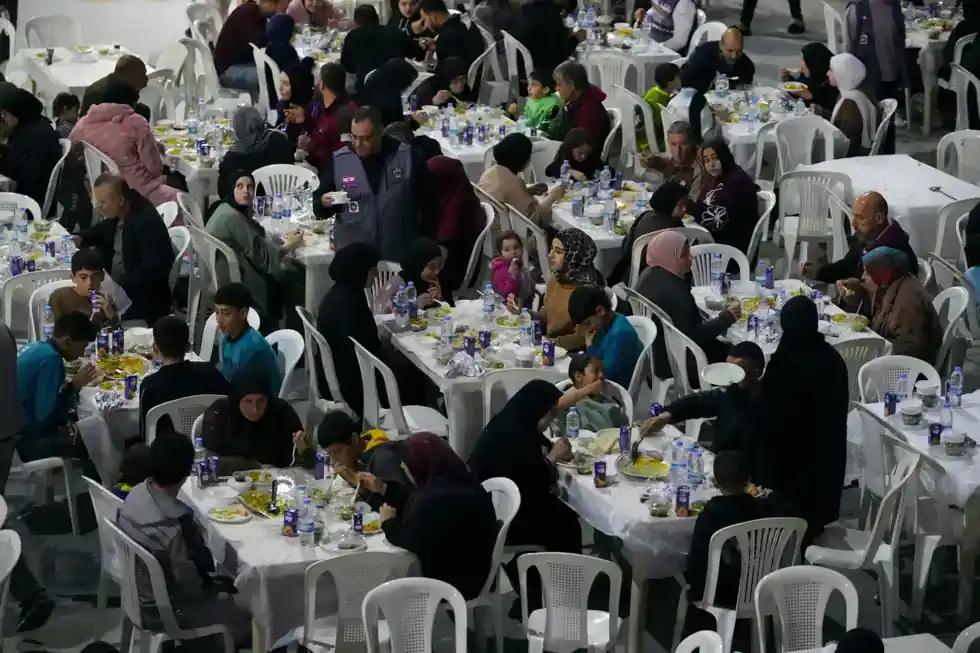
Shelters across cities such as Sidon and Beirut are operating under mounting pressure, as schools, public buildings, and informal spaces absorb large numbers of displaced civilians. Aid groups warn that existing infrastructure is struggling to keep pace with the scale of need.
As Basma Alloush of the International Rescue Committee noted in field accounts, many families have been forced into precarious arrangements, with only a portion of the displaced population able to access formal shelters. Others remain in vehicles, improvised tents, or overcrowded homes of relatives.
The strain is particularly visible during Ramadan, a period typically marked by communal gatherings and structured daily routines. Displacement has disrupted those rhythms entirely, replacing them with uncertainty and logistical hardship.
Funding Gaps Signal Emerging Aid Shortfall
Beyond immediate shelter constraints, international agencies are raising concerns about declining financial support compared to previous crises.
Carl Skau of the United Nations World Food Program warned that donor fatigue and competing global priorities are beginning to affect response efforts. While the agency has delivered more than half a million meals since early March, officials caution that sustained operations will depend on renewed funding commitments.



This emerging gap introduces a structural risk: humanitarian operations may struggle to scale in parallel with displacement trends, particularly if conflict persists or intensifies.
The result is a widening mismatch between needs on the ground and available resources—an imbalance that could define the next phase of the crisis.
Recurring Displacement Undermines Social Stability
For many Lebanese families, the current upheaval is not an isolated event but part of a recurring cycle. Previous waves of displacement—most recently during hostilities that eased under a fragile ceasefire in late 2024—have left communities with limited capacity to recover.
This repetition is eroding resilience at both household and national levels. Families that once relied on savings, social networks, or temporary relocation strategies are now confronting diminishing options.
Aid workers report growing exhaustion among displaced populations, with recovery periods between crises shrinking. The cumulative effect is a population increasingly vulnerable to prolonged instability.
Economic Strain Limits Civilian Coping Mechanisms
The economic dimension of the crisis is becoming more pronounced as displacement disrupts livelihoods and reduces access to income.
Families report being unable to afford basic items traditionally associated with Eid, including clothing and food. Small acts of normalcy—such as preparing meals or purchasing goods for children—have become financially out of reach for many.
Local businesses and volunteers have stepped in to provide limited relief, distributing meals and essential supplies. However, these efforts, while symbolically significant, remain insufficient relative to the scale of need.
This economic compression is reinforcing dependency on aid at a time when funding uncertainty is already increasing.
Regional Conflict Expands Civilian Impact
The escalation reflects broader regional dynamics, with Hezbollah’s involvement in the wider Iran-linked conflict triggering intensified Israeli military responses. The resulting displacement underscores how regional confrontations are translating into immediate civilian consequences within Lebanon.
As the conflict evolves, the humanitarian dimension is increasingly intertwined with strategic calculations. Civilian displacement is not only a byproduct of military operations but a factor that could influence political and diplomatic trajectories.
The risk is that prolonged instability in Lebanon may further complicate already fragile regional balances.
Eid Approaches Under Conditions of Uncertainty
As Eid al-Fitr nears, displaced families face a stark divergence from the holiday’s traditional meaning. Instead of marking renewal and communal celebration, the period is unfolding under conditions of uncertainty, constrained mobility, and limited resources.
Some shelters have attempted to recreate elements of Ramadan traditions, introducing modest decorations or shared meals. Yet these efforts highlight, rather than offset, the scale of disruption.
The coming weeks will likely test not only the durability of humanitarian operations but also the willingness of international actors to re-engage at scale.
Absent a shift in funding and conflict dynamics, Lebanon’s displacement crisis risks deepening further—transforming a seasonal moment of reflection into a prolonged phase of humanitarian strain.