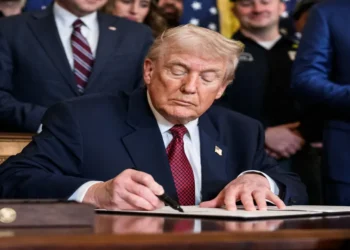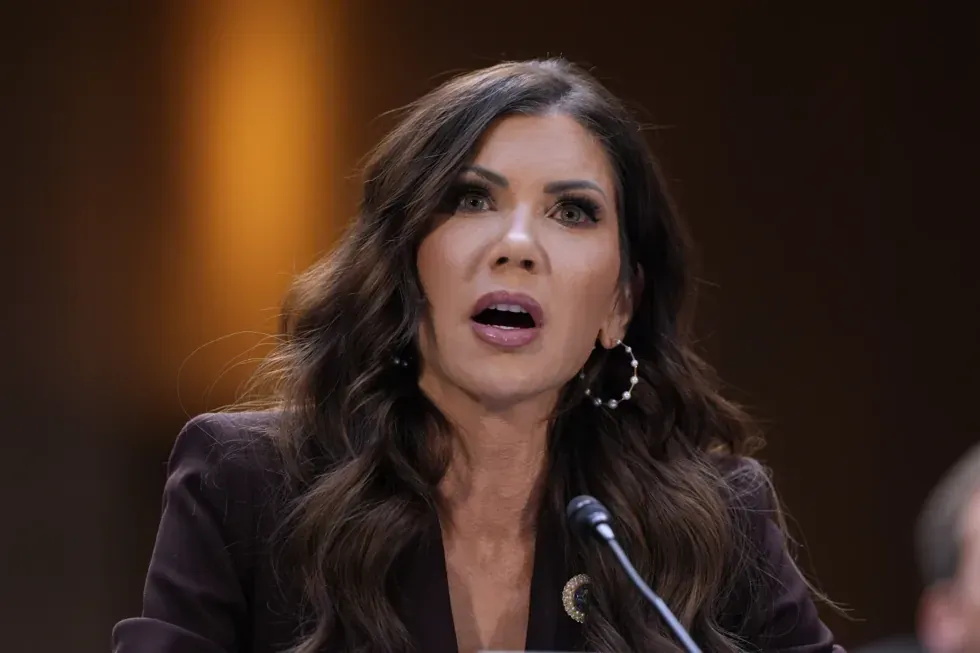
WASHINGTON (Journos News)— President Donald Trump dismissed Homeland Security Secretary Kristi Noem on Thursday, intensifying political scrutiny surrounding the administration’s immigration crackdown and the management of the federal government’s third-largest department.
The move follows days of congressional criticism directed at Noem’s leadership of the United States Department of Homeland Security and comes as lawmakers continue to debate funding and oversight of the agency responsible for enforcing the administration’s immigration agenda.
Trump said he would nominate Markwayne Mullin, a Republican senator from Oklahoma, to lead the department. The announcement was made on social media after Noem faced intense questioning from both Republicans and Democrats during hearings on Capitol Hill earlier in the week.

The leadership change introduces fresh uncertainty for immigration policy at a moment when the administration’s enforcement strategy has become a central political issue in Washington and across several major U.S. cities.
Leadership Pressure Builds Inside Homeland Security
Trump publicly praised Noem’s work even as he confirmed her departure, saying she had delivered “numerous and spectacular results” in strengthening border enforcement.
At the same time, the president announced that Noem would be reassigned to a newly created diplomatic role focused on regional security initiatives in the Western Hemisphere.
Shortly after the announcement, Noem appeared at a law-enforcement event in Nashville, where she delivered prepared remarks but did not directly address her removal from the Cabinet position.
In a later social media statement, she thanked Trump for the new role and defended her record leading DHS, saying the department had achieved “historic accomplishments” aimed at strengthening national security.


White House press secretary Karoline Leavitt said the administration would work with the Senate to confirm Mullin “as soon as possible,” calling him highly qualified to lead the department.
Congressional Scrutiny Intensifies Over Immigration Strategy
Noem’s tenure had come under mounting pressure in recent months as lawmakers examined the administration’s immigration enforcement tactics and internal spending decisions at DHS.
During hearings on Capitol Hill, members of both parties questioned a $220 million public messaging campaign encouraging migrants in the United States without legal status to leave voluntarily.
According to Reuters, Trump said in an interview Thursday that he had not personally approved the campaign, contradicting testimony in which Noem told lawmakers the president had been informed about the initiative in advance.
The issue added to broader political tensions surrounding the administration’s immigration enforcement operations, which have frequently involved large-scale arrests and high-visibility raids in major cities.
Political Fallout From Minneapolis Enforcement Clash
Political pressure intensified following a controversial enforcement operation earlier this year in Minneapolis, where two protesters were shot and killed during a confrontation with immigration enforcement officers.
Noem initially described the individuals involved, Renee Good and Alex Pretti, as aggressors during the incident. Video recordings and witness accounts later raised questions about that characterization, prompting sustained criticism during congressional testimony.
The clash became a flashpoint in the national debate over the administration’s immigration policy and contributed to broader scrutiny of DHS operations in cities including Los Angeles and Chicago.
Local officials were among those welcoming the leadership change. Minneapolis Mayor Jacob Frey reacted to the news on social media, while Chuck Schumer, the Senate Democratic leader, also signaled approval of Noem’s departure.
Funding Battles and Oversight Disputes Add Pressure
The leadership change comes amid a broader political dispute over funding and operational authority at DHS.
Lawmakers have been locked in negotiations over immigration enforcement spending, and the department has recently experienced a prolonged shutdown affecting parts of its workforce.
According to people familiar with the discussions, Senate Republicans privately suggested to Democrats during negotiations that Noem’s potential removal might help ease tensions and allow funding talks to move forward.
Democratic lawmakers, however, reportedly viewed the situation differently, arguing that replacing the department’s leadership did not fundamentally alter the administration’s immigration strategy.
Confirmation Fight Looms for Mullin
If confirmed, Mullin would assume control of a department responsible for implementing some of the administration’s most politically sensitive policies, including immigration enforcement and border security.
Under federal law governing executive branch vacancies, Mullin could serve in an acting capacity while the Senate considers his nomination.
Speaking shortly after Trump’s announcement, the senator said he did not know how quickly the confirmation process might proceed but emphasized his close working relationship with the president.
“The president and I are good friends,” Mullin told reporters following a Senate vote. “We look forward to working closer with the White House.”
Immigration Agenda Faces Next Political Test
The leadership transition arrives at a pivotal moment for the administration’s immigration strategy, which has relied heavily on high-profile enforcement operations often documented on social media and in televised coverage.
Several of those operations were overseen by Border Patrol official Gregory Bovino, who had been elevated under Noem’s leadership to coordinate crackdowns in multiple major cities.
Supporters inside law enforcement defended her tenure. Bovino told The Associated Press that Noem was “the best Secretary I ever worked for,” praising her support for enforcement personnel.
But critics argue the leadership change may do little to alter the broader direction of immigration policy.
Advocacy groups such as America’s Voice say the policy agenda itself remains the central political issue rather than the individual leading the department.
Political Outlook for Immigration Policy
With Senate confirmation looming for Mullin and lawmakers continuing to debate immigration funding, the leadership shift could reshape congressional negotiations in the months ahead.
The new nominee will inherit a department at the center of national political debate — balancing enforcement priorities, disaster response responsibilities, and oversight from both parties on Capitol Hill.
How Mullin navigates those pressures may determine whether the administration can stabilize its immigration strategy or faces further political confrontation as the policy debate intensifies.