Millions of people across India and the global diaspora are marking Holi festival 2026, a Hindu spring celebration that blends religious observance, seasonal transition and public festivity. The festival, rooted in ancient mythology, symbolizes the victory of good over evil while also signalling the end of winter in South Asia.
Observed in India, Nepal and diaspora communities worldwide, Holi has evolved into both a spiritual and social event, reflecting patterns of migration, urbanization and cultural exchange.
Religious Origins and Seasonal Meaning
Holi’s origins lie in Hindu mythology, particularly the legend of Prahlad and Holika. According to scripture, Holika attempted to kill her nephew Prahlad for his devotion to the god Vishnu, but she perished in flames while he survived.

The ritual of lighting bonfires on the eve of Holi—known as Holika Dahan—symbolizes the destruction of evil. Religious scholars note that the timing of the festival aligns with the full moon of the Hindu month of Phalguna, marking the arrival of spring and agricultural renewal across northern India.
The festival is also associated with the divine love of Radha and Krishna, figures central to devotional Hindu traditions. Celebrations in Mathura and Vrindavan, towns linked to Krishna’s early life, draw thousands of pilgrims annually.
Public Celebration and Social Ritual
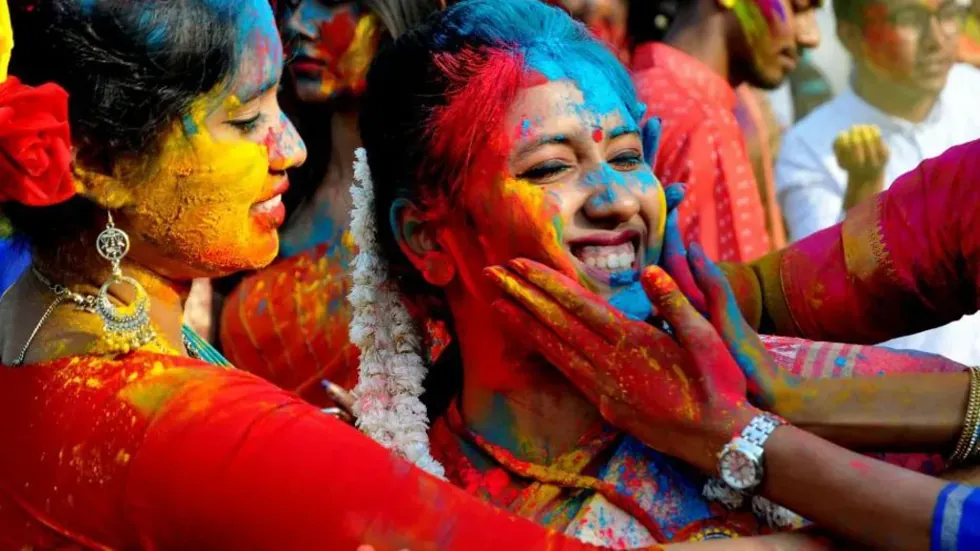
Holi is widely recognized for its vibrant use of coloured powders, known as gulal, which participants smear on family, friends and even strangers. Streets in many Indian cities transform into communal gathering spaces where people throw coloured powder and water while music plays.
Music—ranging from traditional folk songs to contemporary Bollywood tracks—plays a central role. Children often use water dispensers and toy pistols to spray coloured water, reinforcing the festival’s playful atmosphere.
Food traditions also form part of the celebration. A milk-based drink known as thandai, sweetened with nuts and spices, is commonly consumed, alongside regional sweets prepared specifically for the occasion.
■ Related News



Sociologists note that festivals such as Holi function as social equalizers, temporarily dissolving class and age barriers in public spaces. However, urban authorities in several Indian cities have in recent years emphasized safety, water conservation and environmentally friendly colour use.
Diaspora and Global Observance
While Holi is most widely celebrated in India, it is also observed in Nepal, where a Hindu majority population marks the occasion with public gatherings and colour throwing.
Beyond South Asia, diaspora communities in Europe, North America and Southeast Asia have integrated Holi into multicultural calendars. In some global cities, the festival has taken on hybrid forms, blending traditional religious rituals with public cultural events that attract diverse participants.
Cultural analysts suggest that Holi’s international visibility reflects broader migration patterns and the global influence of Indian cinema and digital media. Research from migration studies indicates that diaspora festivals often serve dual roles: preserving cultural identity while fostering cross-cultural engagement.
Cultural Continuity in a Changing Society
As India continues to urbanize and modernize, festivals such as Holi remain significant markers of continuity. According to anthropological research, collective rituals tied to agricultural cycles and mythology help sustain shared identity across generations.
At the same time, environmental debates have emerged around synthetic colours and water consumption during celebrations. Civic groups and educational institutions increasingly promote natural pigments and responsible practices.
Holi festival 2026 therefore illustrates more than a seasonal celebration. It underscores the resilience of ritual in contemporary society, the adaptability of tradition in urban contexts, and the expanding global footprint of South Asian cultural life.