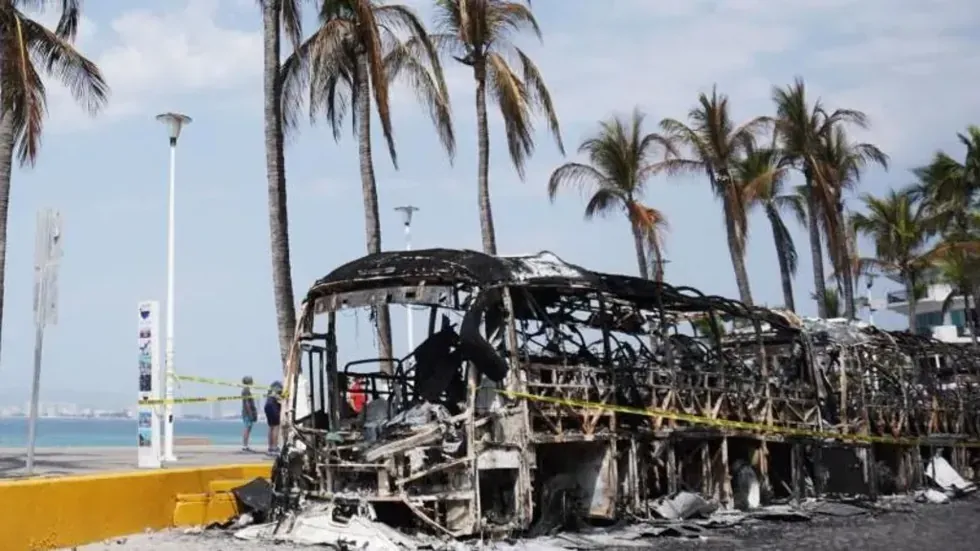
Mexico’s western city of Guadalajara is navigating a fragile calm after a wave of violence linked to the powerful Jalisco New Generation Cartel (CJNG) shook the region. Burned-out vehicles, scorched highways and shuttered businesses mark the aftermath of coordinated attacks that followed reports of the killing of the cartel’s leader, Nemesio Oseguera Cervantes, widely known as “El Mencho.”
The unrest has revived long-standing questions about Mexico’s security strategy and comes at a sensitive moment for Guadalajara, which is scheduled to host matches during the 2026 FIFA World Cup. While federal authorities insist the situation is stabilizing and that there is no threat to international visitors, some residents and local officials remain unconvinced.
The events underscore a persistent tension in Mexico’s fight against organized crime: whether targeting cartel leaders weakens criminal networks — or instead triggers new cycles of violence.

Charred Streets and Shuttered Shops
Driving into Guadalajara days after the attacks, the signs of destruction remain visible. Blackened car frames line parts of the highway, and patches of melted asphalt mark where vehicles were set ablaze. Several convenience stores were looted or damaged, according to local accounts.
Security forces — including army units and National Guard patrols — have increased their presence across the metropolitan area. Their convoys circulate through main roads and residential neighborhoods, a visible attempt to reassure the public.
Yet daily life has not fully resumed. Many small businesses temporarily closed, schools suspended classes, and residents limited travel. Even with troops deployed, foot traffic in parts of the city has been lighter than usual.
The violence followed reports that “El Mencho,” the longtime head of the CJNG, had been killed. Mexican authorities have not publicly confirmed those reports. The CJNG, designated by the United States as a transnational criminal organization, has built a reputation over the past decade for highly coordinated and public displays of force, particularly in its home state of Jalisco.
Government Response: “No Risk” to Visitors
President Claudia Sheinbaum addressed the unrest in her daily press briefing, describing a return to “peace and tranquillity” in much of the country and praising the work of security forces.
■ Related News



She said there was “no risk” to visitors expected for the 2026 World Cup and that authorities were putting in place “all the guarantees” necessary to safeguard fans and teams.
Guadalajara is one of several Mexican host cities for the expanded 48-team tournament, which will be jointly staged by Mexico, the United States and Canada. The competition is expected to draw hundreds of thousands of international visitors to Mexican venues.
World Cup security in Guadalajara has therefore become a focal point of official messaging. Federal authorities have stressed coordination between local police, the National Guard and the military in preparation for the event.
FIFA President Gianni Infantino, speaking to reporters in Colombia earlier this week, said he was “very reassured” about Mexico’s preparations. “Everything is good. It’s going to be spectacular,” he said, according to Agence France-Presse.
A Community Divided
For many residents, however, the memory of the attacks is still fresh.
Anwar Montoya, owner of a recently opened café in the city, chose to reopen despite concerns. As a new entrepreneur, he said closing indefinitely was not financially viable. While he described the day of the violence as “strange and difficult,” he said he wanted to provide a safe space for customers.
On a recent morning, most of his terrace tables were occupied by young patrons working on laptops or talking quietly. The outward normality contrasts with the unease that lingers in conversation.
Local lawmaker Mariana Casillas, a left-wing parliamentary deputy from Jalisco, said the latest events are part of a pattern that has repeated itself since Mexico intensified its campaign against drug cartels in 2006 under then-President Felipe Calderón.
“This is not a new scenario,” she said, arguing that the focus on capturing or killing top cartel figures often leads to violent power struggles within criminal groups.
The “Kingpin Strategy” Debate
Mexico’s approach — often described as the “kingpin strategy” — has centered on dismantling cartels by removing their leaders. Security analysts say the tactic has produced mixed results.
Deborah Bonello, managing editor of the think tank Insight Crime, said that in past cases, removing a dominant figure has sometimes triggered internal disputes and splintering.
“When you take out a major leader, there’s a struggle to take control in that vacuum,” she said. “That can result in new outbreaks of violence as rival factions compete.”
Mexico has recorded tens of thousands of disappearances and homicides since 2007, when federal forces were deployed in large numbers to combat organized crime. According to official data, the vast majority of reported disappearances have occurred since that period. Human rights groups say many cases involve forced recruitment, abduction or killings linked to criminal groups.
Casillas argues that beyond security operations, deeper social issues — including poverty, lack of opportunity and weak local institutions — also need sustained attention.
World Cup Amid Unresolved Crises
The convergence of high-profile sporting ambitions and unresolved security concerns has sharpened public debate in Jalisco.
Some residents welcome the international attention and potential economic boost associated with the World Cup. Others question whether hosting global events should take precedence over addressing what Casillas describes as “very painful crises,” including violence and the plight of families searching for missing relatives.
For its part, the federal government maintains that preparations are proceeding as planned and that the city is capable of hosting international fans safely.
As Guadalajara moves forward, the tension between reassurance and apprehension remains palpable. Burned vehicles may eventually be cleared and storefronts repaired, but the broader question — whether Mexico can break recurring cycles of cartel violence — continues to shadow both daily life and the promise of global celebration.
Source: BBC – Threat of further violence looms after Mexican cartel rampage