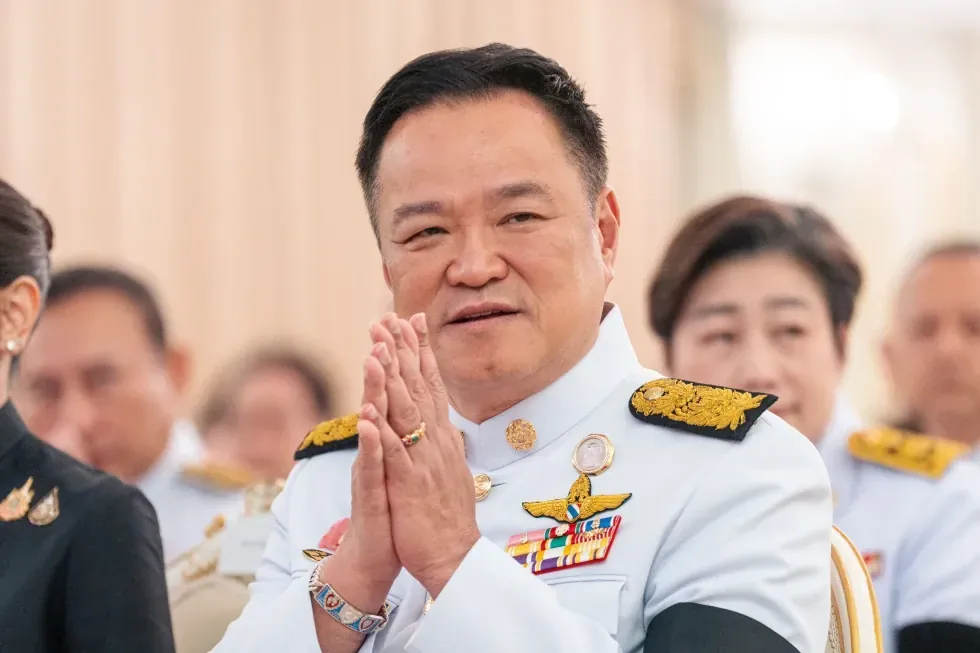
BANGKOK (Journos News) – Thailand’s parliament has been formally dissolved, triggering a general election that must be held early next year, as the country faces renewed armed clashes along its border with Cambodia. The decision places the government in caretaker mode at a moment of heightened military tension and political uncertainty.
Prime Minister Anutin Charnvirakul sought and received royal approval from Maha Vajiralongkorn, with the dissolution taking effect upon publication in the Royal Gazette on Friday. The move sets a constitutional timeline requiring elections within 45 to 60 days, during which Anutin will lead a caretaker administration with limited powers.
The announcement comes as fighting escalates in a long-running border dispute with Cambodia, complicating both the political transition and Thailand’s economic outlook.

Short tenure, fragile coalition
Anutin has served as prime minister for just three months, having succeeded Paetongtarn Shinawatra, who left office after a year amid controversy linked to earlier border tensions. His ascent followed a parliamentary vote in September, where he secured backing from the opposition People’s Party in exchange for pledges to dissolve parliament within four months and support a referendum on drafting a new constitution.
The constitutional reform issue has long been contentious. The People’s Party, which advocates progressive changes, has pushed to replace a charter enacted under military rule with one drafted by an elected constituent assembly. Political analysts have noted that debates over constitutional amendments have repeatedly unsettled coalition alignments in recent years.
Tensions escalated this week when lawmakers from Anutin’s Bhumjaithai Party backed a bill to amend the constitution in a manner that opposition leaders argued violated the spirit of the September agreement. In response, the People’s Party prepared to initiate a no-confidence motion.
The prospect of such a vote appears to have accelerated the decision to dissolve parliament. As news of the pending move spread late Thursday, opposition figures said they hoped Anutin would still honor his commitment to hold a constitutional referendum.
The People’s Party currently holds the largest number of seats in the House of Representatives and is widely viewed as a leading contender in the upcoming election.
■ Related News

Conflict on the border
The political transition unfolds against the backdrop of intensified combat between Thailand and Cambodia. The two countries have a history of disputes along sections of their shared border, and fighting that flared earlier this year has now resumed on a larger scale.
Thai authorities reported that about two dozen people have been killed in the latest round of clashes, with hundreds of thousands displaced on both sides. The Thai military estimated that 165 Cambodian soldiers had died, though Phnom Penh has not confirmed casualty figures.
Anutin has adopted a firm stance, stating that Thailand will continue military operations until its sovereignty and security are assured. In recent public remarks, he framed the conflict as a defense of territorial integrity, echoing language that has resonated with segments of the electorate.
The renewed violence has also drawn international attention. U.S. President Donald Trump said he expects to speak with leaders from both countries and expressed confidence that he could help broker a ceasefire. During earlier fighting in July, Washington had signaled that trade privileges could be reconsidered if hostilities continued.
Anutin confirmed that he had spoken by phone with Trump and reiterated Thailand’s position that military action would persist until Cambodia no longer posed what he described as a threat to Thai sovereignty.
Domestic pressures and political calculus
The timing of the dissolution has prompted debate among analysts. In recent weeks, Anutin’s government faced criticism over severe flooding in southern Thailand that claimed more than 160 lives, as well as scrutiny over alleged links between political figures and online scam networks.
Napon Jatusripitak, a Bangkok-based political analyst, said Anutin had leveraged renewed border tensions to project a hard-line, nationalist image. That narrative, he suggested, has for now overshadowed domestic controversies.
Similarly, Purawich Watanasukh, a political scientist at Bangkok’s Thammasat University, observed that the conflict may have shifted public attention away from economic and governance challenges. Dissolving the House at this juncture, he noted, allows the ruling party to campaign during a period when national security dominates the public agenda.
Thailand’s economy, already facing headwinds from sluggish growth, could be further affected if external trade measures are imposed amid diplomatic friction. The caretaker government, restricted from approving a new budget, will have limited capacity to implement new fiscal initiatives during the campaign period.
Path to the polls
Under Thailand’s constitution, the Election Commission must now organize a nationwide vote within the mandated 45-to-60-day window. Political parties are expected to intensify campaigning once the election date is formally announced.
While the immediate focus remains on the border conflict, the election will also test competing visions for Thailand’s constitutional future and civil-military balance. Voters will be asked to weigh national security concerns against calls for structural reform and economic management.
For now, Thailand enters a familiar but delicate phase: a caretaker administration overseeing both a military standoff and an electoral transition. How these parallel developments unfold in the coming weeks may shape not only the next government, but also the country’s broader political trajectory.
Source: AP News – Thailand’s parliament is dissolved for a new election early next year