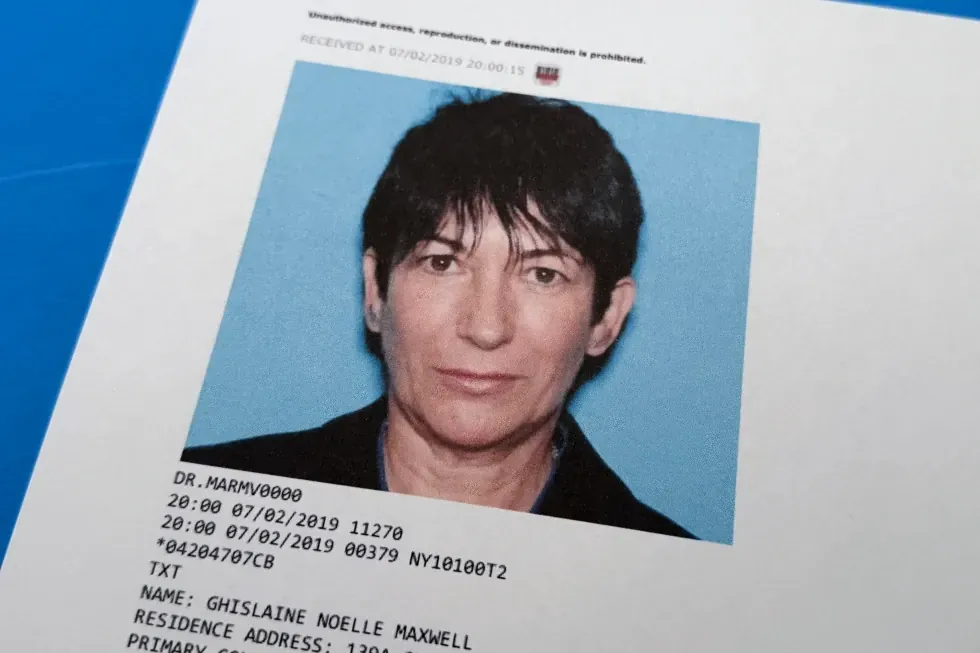
NEW YORK (Journos News) – Ghislaine Maxwell is seeking to block the public release of tens of thousands of court documents linked to the late financier Jeffrey Epstein, arguing that a recently enacted federal transparency law is unconstitutional. The move sets up a new legal confrontation over access to records tied to one of the most scrutinized sex trafficking cases in recent U.S. history.
In filings submitted late Friday in federal court in Manhattan, Maxwell’s lawyers asked a judge to prevent the disclosure of roughly 90,000 pages of material stemming from a civil defamation lawsuit brought nearly a decade ago by the late Epstein accuser Virginia Giuffre. The U.S. Justice Department has requested that secrecy orders covering the files be lifted.
The dispute reflects broader tensions between public demands for transparency in the Epstein case and longstanding judicial practices designed to protect sensitive court records. It also underscores how the fallout from Epstein’s crimes continues to reverberate years after his death.

Legal challenge to the Epstein Files Transparency Act
At the center of the latest filings is the Epstein Files Transparency Act, a law passed by Congress in December requiring the release of millions of documents related to investigations into Epstein and his associates.
Maxwell’s attorneys, Laura Menninger and Jeffrey Pagliuca, contend that the statute infringes on the constitutional separation of powers by directing courts to open records that were previously sealed under judicial authority. In their court submission, they argued that Congress cannot override a court’s responsibility to manage and protect its own files.
“Congress cannot, by statute, strip this Court of the power or relieve it of the responsibility to protect its files from misuse,” the lawyers wrote. They added that under the Constitution, neither Congress nor the executive branch may intrude upon judicial authority to resolve disputes and manage court records.
The Justice Department has not publicly responded to the latest motion. Its earlier request sought to lift secrecy requirements on materials generated during the civil case brought by Giuffre against Maxwell.
Scope of the documents
The documents at issue include transcripts from more than 30 depositions, along with financial and personal information concerning Maxwell and others. Maxwell’s legal team maintains that prosecutors obtained the materials during their criminal investigation into her, even though they were subject to protective orders in the civil case.
■ Related News




Some portions of the evidence exchanged during the year-long litigation between Giuffre and Maxwell have already been made public following a federal appeals court ruling. However, lawmakers have pressed for broader disclosure, arguing that only about half of the known Epstein-related documents have been released so far, many with redactions.
Justice Department officials have said they have made public all documents that can be released without judicial authorization. Certain materials remain sealed pending court approval.
The renewed debate over transparency has drawn criticism from some victims, who say that previously released documents exposed their names and personal details while the identities of alleged abusers were redacted. The balancing of privacy, due process and public interest has become a recurring issue in the aftermath of Epstein’s prosecution.
Background on Epstein, Maxwell and Giuffre
Jeffrey Epstein was arrested in 2019 on federal sex trafficking charges involving underage girls. He died by suicide in a federal jail in New York while awaiting trial. His death intensified public scrutiny of his network of associates and of the justice system’s handling of earlier allegations.
Maxwell, a British socialite and longtime associate of Epstein, was convicted in December 2021 on charges of helping recruit and groom teenage girls for sexual abuse. She was sentenced to 20 years in prison. In 2024, she was transferred from a federal prison in Florida to a low-security prison camp in Texas after participating in interviews with Deputy Attorney General Todd Blanche.
Virginia Giuffre, one of Epstein’s most prominent accusers, filed a defamation lawsuit against Maxwell in 2015, alleging that Maxwell had falsely labeled her claims as lies. The case was later settled. Giuffre also brought a civil suit in 2021 against Prince Andrew, now known as Andrew Mountbatten-Windsor, alleging that Epstein trafficked her to him when she was 17. He denied the allegations, and the lawsuit was settled in 2022 without an admission of liability.
In a memoir published after her death last year, Giuffre wrote that prosecutors told her they chose not to include her allegations in Maxwell’s sex trafficking trial to avoid distracting the jury.
Maxwell, now 64, recently declined to answer questions from members of the U.S. House Oversight Committee during a deposition conducted via video from prison. Through her lawyer, she said she would be prepared to “speak fully and honestly” if granted clemency.
Continuing scrutiny
The release of additional Epstein-related documents in recent weeks has led to further disclosures about decades of alleged abuse involving women and teenage girls. Lawmakers from both major U.S. political parties have called for greater transparency, citing public interest in understanding how Epstein was able to operate for so long.
Legal analysts note that the constitutional arguments raised by Maxwell’s attorneys could have implications beyond the Epstein case, particularly concerning Congress’s authority to mandate the unsealing of court records. Federal judges will now have to weigh those arguments against legislative intent and longstanding principles favoring public access to judicial proceedings.
For now, the decision rests with the Manhattan federal court, which must determine whether the documents will remain sealed or become part of the public record. The outcome will shape the next chapter in a case that continues to test the boundaries between privacy, accountability and the public’s right to know.
Source: AP News – Ghislaine Maxwell fights release of more Epstein documents, calling disclosure law unconstitutional