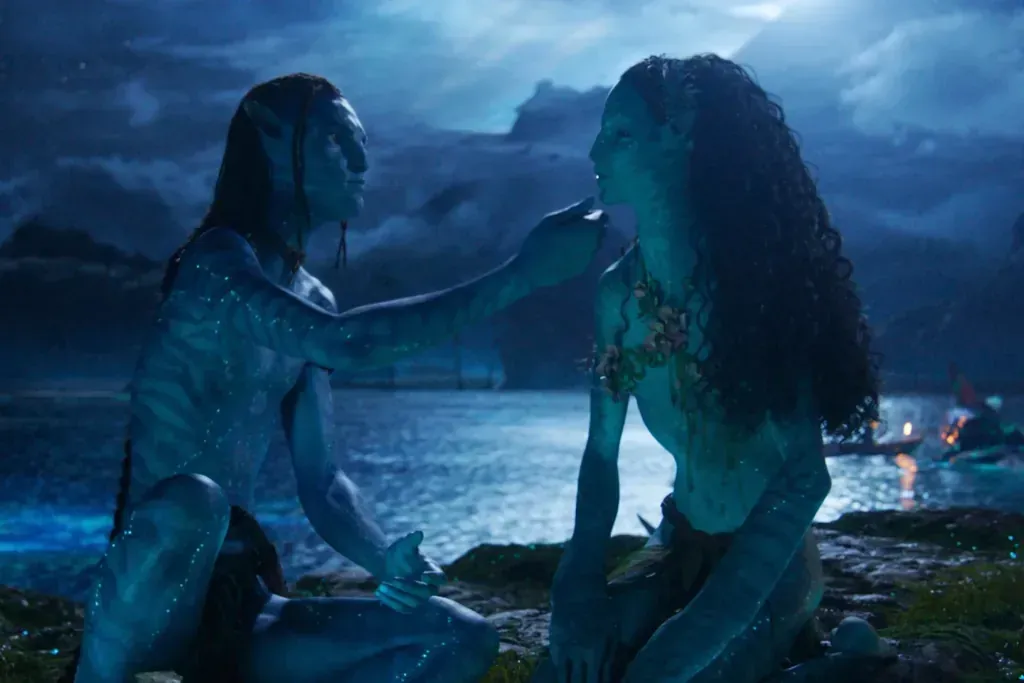
James Cameron’s long-running journey back to Pandora continues with Avatar: Fire and Ash, a visually imposing third chapter that deepens the saga’s central conflicts while raising fresh questions about how much narrative weight its world can still carry. Released nearly two decades after the original Avatar, the film once again prioritizes immersion and scale, offering audiences an extended stay in Cameron’s meticulously constructed universe.
At more than three hours, Fire and Ash is the longest Avatar film to date. It follows the aquatic-focused The Way of Water and shifts attention toward a new cultural and political fault line on Pandora, introducing a rival Na’vi faction and intensifying the struggle between Indigenous life and human colonization. The result is a film that feels both expansive and insular, rich in craft but constrained by familiar storytelling patterns.
The Avatar: Fire and Ash release underscores Cameron’s continued belief in cinema as a sensory experience first and a narrative one second. While the technology remains formidable, the film also highlights the franchise’s enduring challenge: translating spectacle into lasting emotional impact.
A franchise built on immersion
From its beginning, Avatar has been less a traditional franchise than an environment audiences are invited to inhabit. Cameron has long framed the series as an exercise in total immersion, combining cutting-edge performance capture with a fully imagined ecosystem shaped by bioluminescence, ecology, and conflict.
That ambition remains central to Fire and Ash. The film arrives alongside renewed behind-the-scenes emphasis on how its effects were achieved, a reminder that Cameron’s process is rooted in human performance rather than artificial intelligence. Yet the sense of technological novelty that defined the 2009 original has inevitably softened as visual effects standards have advanced across the industry.
What remains distinctive is Cameron’s commitment. The Avatar films continue to function as vessels for his long-standing preoccupations: environmental destruction, militarism, human arrogance, and the possibility of coexistence across cultures. At their strongest, they create a dreamlike space where those ideas play out on an operatic scale.
A darker turn on Pandora
Fire and Ash opens in the aftermath of the climactic battle that ended The Way of Water. The Na’vi and their seafaring allies, the Metkayina clan, are rebuilding while salvaging human weapons that sank to the ocean floor. Those weapons soon become a source of moral tension when a new adversary emerges.
The film introduces the Mangkwan, also known as the Ash People, a rival Na’vi clan defined by aggression and fire. Their leader, Varang, played by Oona Chaplin, brings a volatile presence to the story and quickly aligns with the human military forces still seeking control of Pandora. Stephen Lang returns as Colonel Miles Quaritch, whose partnership with Varang strengthens the human–Na’vi alliance driving the film’s central conflict.
The Mangkwan storyline adds urgency and unpredictability, marking a shift from the family-centered tone of the previous installment. It also reframes the long-running struggle as one that is no longer simply human versus Na’vi, but Na’vi against Na’vi, with human technology amplifying the stakes.
Familiar characters in altered states
At its core, Fire and Ash remains focused on characters who exist between worlds. Spider, portrayed by Jack Champion, is the human son of Quaritch who has grown up among the Na’vi. Dependent on breathing equipment to survive Pandora’s atmosphere, Spider becomes the subject of intense interest after a discovery suggests he may be able to breathe unassisted, a development with major implications for human settlement.
Jake Sully, played by Sam Worthington, continues to navigate life as a former human who has fully embraced Na’vi existence. His relationship with Neytiri, portrayed by Zoe Saldaña, comes under strain as the threat of renewed human warfare deepens. The film allows those tensions to seep into domestic spaces, suggesting that the larger conflict is reshaping even the most intimate bonds.
The most complex figure remains Quaritch. Though he leads the military effort to dominate Pandora, he appears increasingly at ease in his Na’vi body and environment. His reactions to human language and attitudes toward the planet hint at internal conflict, even as his actions remain ruthless. The film suggests that transformation, not conquest alone, is the deeper question at the heart of the story.
Scale versus substance
Visually, Fire and Ash delivers what audiences expect from Cameron: sweeping landscapes, intricate creature design, and action sequences engineered with meticulous care. The use of high frame rate technology adds to the film’s clarity and immediacy, though it also contributes to a sense of artificiality that some viewers may find distancing.
Narratively, the film revisits ideas that have defined the series from the outset. Ethical questions about weapon use, environmental exploitation, and coexistence recur, now filtered through the added complexity of inter-Na’vi conflict. Yet after nearly nine hours across three films, the emotional depth of the characters remains limited, a criticism that has followed the franchise since its inception.
Despite their box office success, the Avatar films have often been described as leaving a lighter cultural footprint than other blockbusters of similar scale. Fire and Ash does little to alter that perception, functioning more as a continuation of Cameron’s vision than as a standalone dramatic milestone.
A belief in the world he built
Still, Cameron’s conviction is unmistakable. Few filmmakers have committed so fully, or for so long, to a single imagined world. Fire and Ash may test audience patience with its length and familiar rhythms, but it also reflects a filmmaker continuing to pursue the same dream that first drew him to Pandora decades ago.
Whether the remaining planned installments move the story toward greater emotional resonance remains an open question. For now, Fire and Ash stands as both a testament to cinematic ambition and a reminder of its limitations.
Avatar: Fire and Ash, released by 20th Century Studios, opens in theaters on Dec. 19. The film is rated PG-13 for intense sequences of violence and action, bloody images, strong language, thematic elements, and suggestive material. Running time: 195 minutes.
This article was rewritten by JournosNews.com based on verified reporting from trusted sources. The content has been independently reviewed, fact-checked, and edited for accuracy, neutrality, tone, and global readability in accordance with Google News and AdSense standards.
All opinions, quotes, or statements from contributors, experts, or sourced organizations do not necessarily reflect the views of JournosNews.com. JournosNews.com maintains full editorial independence from any external funders, sponsors, or organizations.
Stay informed with JournosNews.com — your trusted source for verified global reporting and in-depth analysis. Follow us on Google News, BlueSky, and X for real-time updates.