CHICAGO (Journos News) – The death of the Rev. Jesse Jackson at 84 closes a chapter in American civil rights history that stretched from the assassination of Martin Luther King Jr. to the era of Barack Obama. His influence was neither linear nor uncontested, but it was persistent. The question his career leaves behind is not simply what he achieved, but how he altered the possibilities of political power for Black Americans and other marginalized groups.
Jackson’s public life spanned more than five decades, crossing phases of protest politics, corporate engagement, electoral ambition, and international diplomacy. Emerging from the Southern Christian Leadership Conference orbit in the 1960s, he built an independent platform that fused the rhetoric of the Black church with institutional negotiation. Through Operation PUSH and later the Rainbow/PUSH Coalition, he moved between street demonstrations and boardrooms, seeking to translate moral pressure into structural change.
His passing invites a broader assessment. How did Jackson’s model of activism differ from King’s? What did his presidential campaigns reveal about American political limits in the 1980s? And how did his blend of protest and pragmatism shape later leaders — including Obama — without fully resolving the inequality he argued was “America’s unfinished business”?

From movement heir to independent power broker
Jackson’s proximity to King in the mid-1960s gave him immediate historical weight. He was present in Memphis in April 1968 when King was assassinated, an event that he said left a lasting imprint. In the aftermath, Jackson positioned himself as a carrier of King’s economic justice agenda, particularly through Operation Breadbasket, which pressured companies to hire Black workers and expand supplier diversity.
Yet Jackson’s trajectory diverged from King’s in important ways. King’s leadership was grounded in mass mobilization tied to federal civil rights legislation. Jackson, by contrast, operated in an era when landmark laws — the Civil Rights Act and Voting Rights Act — were already enacted but socioeconomic disparities persisted. His strategy shifted toward leveraging consumer power and political negotiation rather than solely legislative change.
In 1971, he broke with the Southern Christian Leadership Conference to form Operation PUSH (People United to Save Humanity), later merging into the Rainbow/PUSH Coalition. The “Rainbow” concept broadened civil rights politics into a multiracial coalition that included labor, farmers, women, and the poor. This framing anticipated later coalition-based electoral strategies, suggesting that demographic diversity could translate into political leverage if organized effectively.
The effectiveness of this approach remains debated. Supporters argue that Jackson compelled corporations to adopt more inclusive hiring and procurement policies. Critics viewed some campaigns as transactional or symbolic. The available record suggests both dynamics were present: measurable gains in corporate commitments, alongside periodic criticism that structural economic inequality proved more resistant than rhetorical victories implied.
The presidential campaigns: symbolic breakthrough or structural shift?
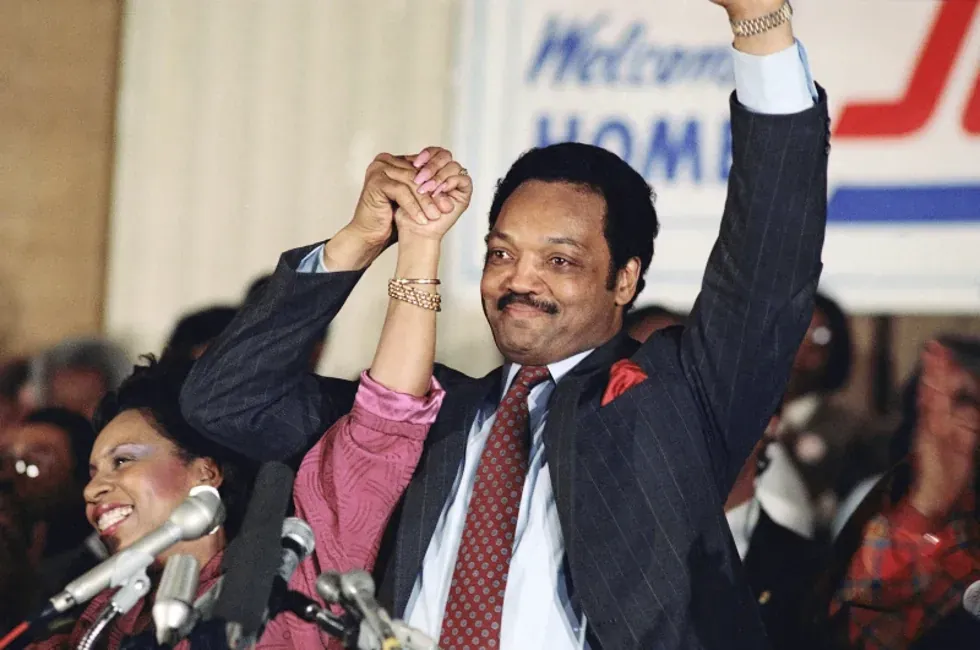
Jackson’s two Democratic presidential bids in 1984 and 1988 marked a turning point in modern U.S. politics. In 1988, he won 13 primaries and caucuses, an unprecedented showing for a Black candidate at the time. While he did not secure the nomination, his performance altered assumptions about the boundaries of national electability.




Compared with earlier civil rights leaders who avoided or rejected national candidacies, Jackson framed his campaigns as an extension of movement politics into institutional power. His slogan, “Keep hope alive,” was both aspirational and strategic — signaling inclusion rather than confrontation. By the late 1980s, he was attracting not only Black voters but segments of white progressives, farmers in the Midwest, and labor constituencies.
Still, his campaigns exposed structural constraints. Party leadership remained wary of his ideological positioning, and demographic coalition-building faced geographic limits. Political scientists later observed that Jackson’s success in primaries did not automatically translate into majority support in the broader electorate. The gap underscored enduring racial polarization in voting behavior during that period.
Yet historical hindsight complicates the narrative. Obama later acknowledged that Jackson’s campaigns “laid the foundation” for his own. While the political climates of 1988 and 2008 differed substantially, Jackson’s national viability demonstrated that a Black candidate could compete credibly for the presidency. In that sense, his campaigns expanded the imagination of possibility even if they did not immediately transform electoral arithmetic.
Rhetoric as instrument and liability
Jackson’s oratory — rooted in the cadences of the Black church — was central to his influence. Rhythmic slogans and moral framing translated complex policy concerns into accessible language. This communication style allowed him to bridge grassroots activism and televised politics, particularly in an era of expanding cable news.
However, rhetorical boldness sometimes produced controversy. His 1984 remarks referring to New York as “Hymietown,” a derogatory term for its Jewish population, required a public apology and strained alliances. Later comments during Obama’s 2008 campaign cycle generated further criticism. These episodes illustrate the risks inherent in high-visibility activism: moral authority can amplify both solidarity and missteps.
Analytically, such controversies did not erase Jackson’s structural contributions, but they complicated coalition-building. They also reflected generational tensions within civil rights politics, as leadership styles evolved from confrontational protest to broader electoral pragmatism.
Diplomacy beyond borders
Jackson’s activism extended internationally, where he leveraged moral credibility to negotiate prisoner releases. In 1984, he secured the release of U.S. Navy Lt. Robert Goodman from Syria. He later facilitated the freedom of foreign nationals during the Gulf crisis and negotiated the release of Americans detained in Yugoslavia in 1999.
These efforts did not always align neatly with U.S. foreign policy priorities, and some officials viewed freelance diplomacy with caution. Yet the tangible outcomes — the return of detainees — provided evidence that moral persuasion combined with political access could yield practical results.
His receipt of the Presidential Medal of Freedom from President Bill Clinton in 2000 formalized recognition of that influence. The award underscored a transition: from insurgent activist to institutional elder.
Health, endurance, and symbolic presence
In later years, Jackson faced serious health challenges, including Parkinson’s disease and progressive supranuclear palsy. Despite diminished mobility and speech, he continued appearing at demonstrations and public events, including during the Black Lives Matter era.
His presence at protests and political conventions suggested continuity rather than reinvention. Unlike younger activists who framed racial justice through social media–driven mobilization, Jackson embodied an older tradition of clergy-led public advocacy. That continuity offered symbolic reassurance to some and highlighted generational change to others.
The contrast is instructive. Contemporary movements often emphasize decentralized leadership and intersectionality. Jackson’s model was more centralized and personality-driven. Each approach reflects its historical context — one shaped by the mass-meeting tradition of the 1960s, the other by digital-era organizing.
Economic justice as “unfinished business”
Perhaps the most consistent thread in Jackson’s career was economic inequality. He frequently argued that legal equality had not translated into economic parity. Corporate campaigns, voting rights advocacy, and educational equity efforts were tied to this broader thesis.
Data from federal agencies and independent research institutions have continued to show racial wealth gaps decades after civil rights legislation. While those disparities cannot be attributed to any single policy failure, they lend context to Jackson’s claim that freedom without economic access remains incomplete.
His framing avoided purely symbolic triumphalism. Even during moments widely seen as historic — such as Obama’s election — Jackson described outcomes as relief rather than final victory. That caution aligns with empirical evidence showing incremental progress alongside persistent structural disparities.
Legacy in context
Assessing Jackson’s legacy requires separating measurable outcomes from symbolic impact. Measurable gains include corporate hiring commitments, expanded voter registration drives, diplomatic interventions, and electoral breakthroughs in Democratic primaries. Symbolically, he sustained a national conversation about dignity and inclusion through decades when civil rights coverage ebbed and flowed.
At the same time, critics argue that structural inequalities remain entrenched, raising questions about the limits of movement-to-institution transitions. The endurance of racial wealth gaps and periodic voting rights disputes indicates that activism alone cannot guarantee systemic transformation.
Historical comparison clarifies his role. King’s era centered on dismantling de jure segregation. Jackson’s era grappled with de facto inequality within formally equal institutions. The challenges differed, and so did the tools required. Jackson’s strategy — coalition politics, economic leverage, and electoral participation — reflected that shift.
A movement that outlived its founder
Jackson once described his life’s work as tearing down walls so others could pass through. Whether those openings have produced durable structural change remains subject to ongoing debate. What is clear is that he helped redefine the boundaries of American political participation during a transitional period between the civil rights generation and the post–civil rights electorate.
His death marks the passing of one of the last nationally prominent figures directly linked to King’s inner circle. It also prompts reflection on the durability of movement politics in an era of polarization and institutional distrust.
If Jackson’s central argument was that equality remains incomplete, contemporary data and political contestation suggest that the debate he sustained is far from settled. His career did not conclude the civil rights project; it reframed it for a different political landscape.
In that sense, his legacy is less a finished chapter than an ongoing question about how moral activism translates into structural power — and how enduring that translation can be across generations.
Source: AP News – The Rev. Jesse Jackson, who led the Civil Rights Movement for decades after King, has died at 84