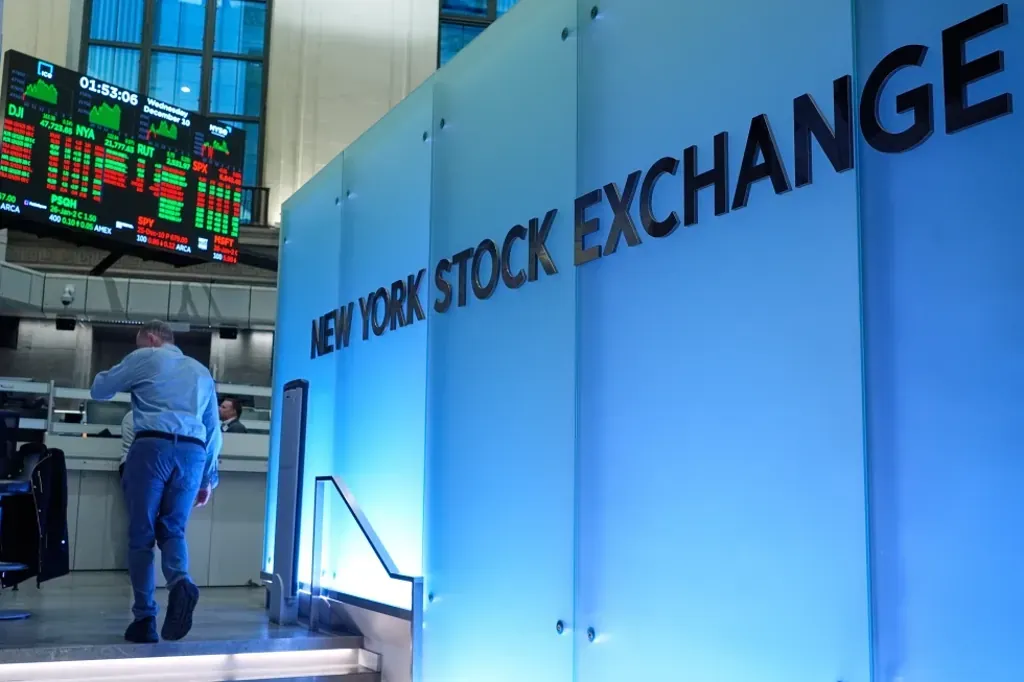
U.S. stocks hovered near record levels on Tuesday as investors digested a fresh round of mixed economic data that did little to clarify the path for interest rates. Conflicting signals on jobs, consumer demand, and pricing pressures kept markets largely rangebound, even as Treasury yields edged lower.
Wall Street mixed data keeps markets near record levels
U.S. stocks traded cautiously on Tuesday, with major indexes hovering near their recent highs as Wall Street assessed mixed signals on the health of the economy. The data offered little clarity on whether slowing growth or persistent inflation will dominate the Federal Reserve’s policy thinking in the months ahead.
The S&P 500 was nearly flat in morning trading, sitting just below the all-time high it set last week. The Dow Jones Industrial Average slipped by about 43 points, or 0.1%, while the Nasdaq Composite edged 0.3% higher, supported by gains in select technology stocks.
Markets have been sensitive to economic releases as investors look for clearer guidance on where interest rates may be heading in 2026, after a prolonged period of elevated borrowing costs.
Jobs data sends mixed signals
A closely watched labor report helped set the tone for the session. The data showed the U.S. unemployment rate rose to its highest level since 2021, suggesting some cooling in the job market. At the same time, employers added more jobs than economists had forecast, complicating the picture.
The conflicting signals initially pushed Treasury yields lower, reflecting expectations that a softening labor market could prompt the Federal Reserve to prioritize growth risks over inflation. That move, however, proved short-lived, with yields later stabilizing as traders reassessed the broader implications.
The labor market has remained one of the Fed’s key reference points. While hiring has slowed from its post-pandemic pace, job growth has generally remained strong enough to support consumer spending.
Consumer demand shows resilience
Adding to the mixed outlook, a separate report suggested underlying strength in consumer demand. An indicator tracking revenue growth at U.S. retailers showed stronger-than-expected gains in October, pointing to continued willingness among consumers to spend despite higher prices and borrowing costs.
Retail resilience has been a recurring theme in recent months, supported by rising wages and still-solid household balance sheets. Economists, however, remain cautious about how long that strength can last if inflation remains elevated and credit conditions tighten further.
Together, the labor and retail data underscored the challenge facing policymakers and investors alike: an economy that is slowing in some areas while remaining stubbornly firm in others.
Inflation concerns remain front and center
Interest rate expectations remain a dominant force on Wall Street, with investors keenly focused on whether inflation is easing fast enough to justify future rate cuts. A key inflation report due Thursday is expected to show that consumer prices continued to rise faster than policymakers would prefer.
Early signals on pricing pressures were already unsettling markets on Tuesday. A preliminary report from S&P Global indicated that average selling prices charged by businesses climbed at one of their fastest rates since mid-2022.
At the same time, the survey showed overall business activity growth slowing to its weakest pace since June, highlighting the tension between cooling demand and rising costs.
Tariffs cited as a driver of higher prices
According to Chris Williamson, chief business economist at S&P Global Market Intelligence, tariffs are increasingly being blamed for renewed price pressures.
“Higher prices are again being widely blamed on tariffs, with an initial impact on manufacturing now increasingly spilling over to services to broaden the affordability problem,” Williamson said in the report.
The comments reflect growing concern among economists that trade-related costs could add another layer of inflation at a time when policymakers are trying to ensure price stability without pushing the economy into recession.
Treasury yields ease slightly
In the bond market, Treasury yields edged lower after fluctuating earlier in the session. The yield on the benchmark 10-year Treasury slipped to 4.16% from 4.18% late Monday, while the two-year yield fell to 3.48% from 3.51%.
The two-year yield is closely watched as a gauge of expectations for Federal Reserve policy. Its modest decline suggested that traders still see a possibility of looser monetary policy ahead, even as inflation risks persist.
Bond market volatility has mirrored uncertainty in equities, with investors reacting swiftly to each new data point.
AI-linked stocks remain volatile
Artificial intelligence-related stocks continued to swing sharply, reflecting both enthusiasm and skepticism about the long-term payoff from massive corporate spending on the technology.
Oracle rose about 1%, and Broadcom added roughly 0.7%, recovering some ground after steep losses last week. Both companies had reported quarterly profits that exceeded analysts’ expectations, but their shares were previously pressured by concerns over valuations.
In contrast, CoreWeave, a company that rents access to high-end AI chips, fell 2.4%. The decline highlighted lingering questions about whether the surge in AI investment will deliver productivity gains and profits sufficient to justify the costs.
Company-specific moves shape trading
Outside the technology sector, individual corporate updates also influenced market direction. Pfizer shares fell 3.3% after the pharmaceutical giant issued a profit forecast for 2026 that came in below some analysts’ expectations.
Pfizer said it expects revenue next year to range between $59.5 billion and $62.5 billion, broadly in line with forecasts, but investors focused on the longer-term outlook as the company navigates patent expirations and shifting demand.
Kraft Heinz shares rose 0.6% after the company announced that Steve Cahillane, most recently chief executive of Kellanova, will take over as CEO on Jan. 1. The move comes ahead of Kraft Heinz’s planned split into two companies, expected in the second half of 2026.
Cahillane is set to lead the business that will retain iconic brands such as Heinz, Philadelphia, and Kraft Mac & Cheese.
Global markets trend lower
Stock markets outside the United States largely moved lower, reflecting regional economic concerns and expectations for tighter monetary policy.
In Japan, the Nikkei 225 fell 1.6% after preliminary factory data showed manufacturing activity contracting slightly. Investors widely expect the Bank of Japan to announce an interest rate increase later this week, a move that would mark a further shift away from its long-standing ultra-loose policy stance.
South Korea’s Kospi dropped 2.2%, while stocks fell 1.5% in Hong Kong and 1.1% in Shanghai, weighed down by concerns over growth and global trade.
European markets also declined, mirroring the cautious tone seen in Asia and underscoring the interconnected nature of global financial markets.
Markets await clearer direction
With stocks near record levels, investors appear reluctant to make bold moves without clearer signals on inflation and interest rates. The coming days’ economic data, particularly on consumer prices, are likely to play an outsized role in shaping market sentiment.
For now, Wall Street remains in a holding pattern, balancing optimism about corporate earnings and consumer resilience against persistent concerns over inflation and monetary policy.
This article was rewritten by JournosNews.com based on verified reporting from trusted sources. The content has been independently reviewed, fact-checked, and edited for accuracy, neutrality, tone, and global readability in accordance with Google News and AdSense standards.
All opinions, quotes, or statements from contributors, experts, or sourced organizations do not necessarily reflect the views of JournosNews.com. JournosNews.com maintains full editorial independence from any external funders, sponsors, or organizations.
Stay informed with JournosNews.com — your trusted source for verified global reporting and in-depth analysis. Follow us on Google News, BlueSky, and X for real-time updates.