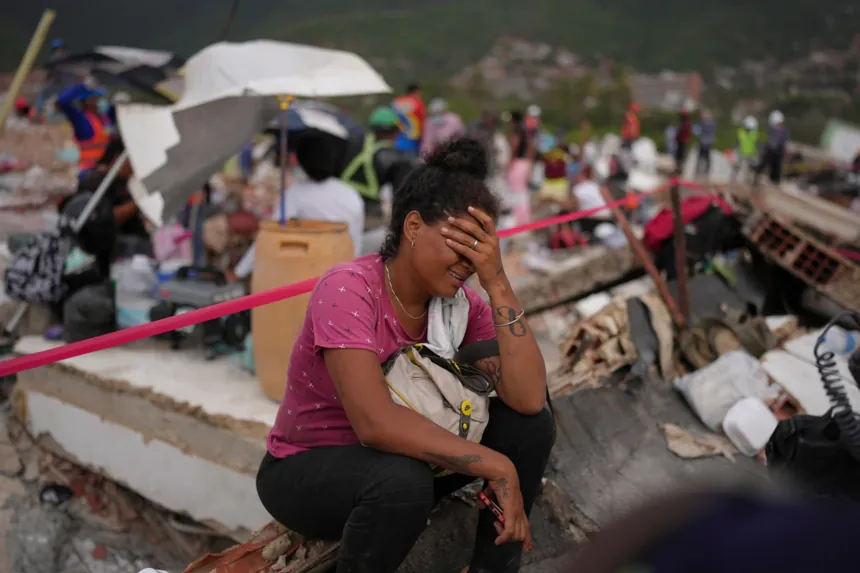
CARACAS, Venezuela – Doctors in Venezuela are warning that the aftermath of the powerful June 24 earthquakes could trigger a worsening public health emergency as hospitals struggle with severe shortages, thousands of displaced residents remain in overcrowded shelters, and the risk of infectious disease continues to rise, The Associated Press reported.
Officials say the twin earthquakes killed at least 2,295 people and injured more than 11,000. Thousands of survivors remain without reliable access to clean water or adequate sanitation, conditions aid organizations say could fuel additional deaths in the coming days and weeks if left unaddressed.
Health System Faces Mounting Pressure
Medical workers say the immediate challenge is shifting from treating traumatic injuries to preventing infections among patients exposed to unsafe conditions following the disaster.

Eugenio Cova, head of the trauma unit at Hospital del Oeste Dr. José Gregorio Hernández in Caracas, said doctors expect infections to become an increasingly serious complication as survivors remain exposed to poor sanitary conditions. While trauma cases continue to arrive, he warned that untreated wounds and prolonged exposure increase the likelihood of serious medical complications.
Aid organizations also expressed concern about disease outbreaks in heavily affected communities.
Veronique Durroux, spokesperson for the U.N. humanitarian agency for Latin America and the Caribbean, said hot weather, damaged infrastructure, poor waste disposal, and extensive debris create favorable conditions for vector-borne diseases and other public health risks.
International Relief Efforts Expand
The United States has deployed 900 military personnel to assist relief and rescue operations, according to Steven McLoud, a spokesperson for U.S. Southern Command.
The military has repaired an earthquake-damaged runway at Venezuela’s main international airport serving Caracas, allowing humanitarian flights to resume, while naval assets have been positioned offshore to support evacuation and relief operations. McLoud said an additional 100 personnel from the U.S. State Department have also joined the response.

The Trump administration has committed $300 million in assistance through humanitarian organizations and the United Nations. However, the estimated material damage exceeds $6.7 billion, according to satellite analysis by the U.N. Development Program.
International rescue efforts have also expanded, with 50 teams from multiple countries—including Ecuador and Israel—joining search-and-rescue operations. Rescue crews continue to locate survivors, including a toddler found Tuesday after spending six days trapped beneath collapsed structures.
Longstanding Healthcare Challenges Exposed
The earthquakes have intensified pressure on a healthcare system that had already been weakened by years of economic hardship, underfunding, and the departure of medical professionals.
More than 7.7 million Venezuelans have left the country since 2013, when Nicolás Maduro assumed office during a prolonged economic downturn marked by mismanagement, corruption, and falling oil prices. Medical associations estimate that a significant share of Venezuela’s physicians and nurses were among those who emigrated.
Dr. Huníades Urbina, a board member of Venezuela’s pediatrics association, said the country has roughly half the physicians recommended under World Health Organization standards. He also cited a 2025 national survey showing shortages exceeding 30% of emergency medical supplies and more than 70% of operating room supplies across public hospitals.
According to Urbina, many hospital laboratories are operating only on a limited basis, restricting diagnostic capabilities as patient numbers continue to increase.
Hospitals Struggle to Treat Earthquake Victims
Doctors say hospitals are running short of critical orthopedic equipment, infection-control materials, and other essential medical supplies needed to care for victims with crush injuries.
Cova said his hospital lacks screws, plates, and medicated gauze required for orthopedic procedures. Some surgeries are being performed in makeshift operating areas because portions of the hospital building remain inaccessible following possible structural damage. Medical staff have also turned to social media to request donations of urgently needed supplies.
Government officials said 38 hospitals nationwide sustained damage or were otherwise affected by the earthquakes.
Jaime Lorenzo, director of United Doctors of Venezuela, said the country’s shortage of ambulances forces many injured patients to reach hospitals in pickup trucks rather than emergency vehicles. He also warned that hospitals could soon experience another surge of patients as displaced residents lose access to medications used to manage chronic illnesses such as diabetes, asthma, and hypertension.
Questions Surround Disaster Response
The government’s handling of the disaster has drawn increasing public criticism as rescue operations continue and thousands of people remain missing.
Videos circulating on social media appeared to show security personnel removing personal belongings from collapsed buildings, although The Associated Press reported that it could not independently verify the footage.
The Interior Ministry announced Wednesday that four police officers had been dismissed and detained for allegedly exploiting rescue and humanitarian operations.
Families continue searching for missing relatives, with one independent digital database listing more than 40,600 people as unaccounted for as of Wednesday.
During a briefing, Gen. Francis Donovan, head of U.S. Southern Command, rejected accusations that acting President Delcy Rodríguez was politicizing the relief effort. Donovan instead said decades of neglect had significantly complicated the government’s response to a disaster of such magnitude.
Rescue operations remain underway as authorities continue assessing the full humanitarian impact and medical needs following one of Venezuela’s deadliest natural disasters in recent history.
Tags: Venezuela, Caracas, Earthquake, Humanitarian Crisis, Public Health, Hospitals, Healthcare, United Nations, U.S. Southern Command, Delcy Rodríguez, Nicolás Maduro, Disaster Response