SYDNEY (Journos News) — Australia is in shock after a mass shooting at a Hanukkah celebration on Sydney’s Bondi Beach killed at least 15 people, including a child, authorities said. Officials described the attack as antisemitic terrorism carried out by a father and son, an act that shattered a sense of safety in a country where gun violence is rare.
As a result, the shooting has reignited national debate over extremism, public security, and hate crimes.
Sydney Hanukkah shooting stuns the nation
The violence erupted early Sunday evening at Bondi Beach, one of Australia’s best-known public spaces. Hundreds had gathered to mark the start of the eight-day Hanukkah festival.
According to police, the gunmen opened fire shortly after 6:45 p.m. Panic spread quickly as beachgoers ran for cover near the shoreline.
By Monday morning, authorities confirmed at least 15 deaths. Victims ranged in age from 10 to 87. Meanwhile, at least 42 people remained hospitalized, several in critical condition.
Police shot and killed a 50-year-old man at the scene. His 24-year-old son survived the attack and remains under police guard in hospital.
Prime Minister Anthony Albanese condemned the shooting in strong terms. He called it “an act of pure evil” and “an act of antisemitism.”
“Bondi Beach stands for joy, families, and celebration,” Albanese said. “Now, what happened here has forever changed that meaning.”
A Jewish celebration becomes a crime scene
The shooting took place during “Chanukah by the Sea,” a public event designed for families. Activities included children’s games, face painting, and a small petting zoo.
Chabad of Bondi organized the gathering. The group is part of a global Orthodox Jewish movement that hosts holiday events worldwide.
Chabad later confirmed that one of the victims was Rabbi Eli Schlanger. He served as an assistant rabbi and helped organize the event.
In addition, Israel’s Foreign Ministry confirmed the death of an Israeli citizen. French President Emmanuel Macron also said a French national, Dan Elkayam, was among those killed.
Australian authorities have not released an official list of victims. They cited ongoing investigations and family notifications. However, local media reported that Alexander Kleytman, a Holocaust survivor, also died in the attack.
Fear, chaos, and moments of bravery
Witnesses described scenes of confusion and terror. As shots rang out, people dropped their belongings and ran across the sand.
Television footage showed swimmers fleeing the water. Other videos appeared to show two men in black firing long guns from a footbridge above the beach.
At the same time, one bystander intervened. In a widely shared clip, the man tackled and disarmed one of the attackers until police arrived.
New South Wales Premier Chris Minns identified him as Ahmed al Ahmed, a local fruit shop owner. Minns praised his actions.
“He is a genuine hero,” the premier said. “He acted without hesitation in extreme danger.”
Survivors describe the horror
Among the injured was Arsen Ostrovsky, a lawyer who recently moved from Israel to Australia. He suffered a bullet graze to the head.
From his hospital bed, Ostrovsky said the scenes defied belief.
“What I saw was an absolute bloodbath,” he said. “Bodies were everywhere. I never imagined this in Australia.”
Another witness, Lachlan Moran from Melbourne, said the gunfire lasted several minutes.
“People dropped everything and ran,” he said. “There was crying everywhere. It was terrifying.”
Police investigation raises questions
New South Wales Police Commissioner Mal Lanyon said security services had previously known one of the attackers. However, authorities had no intelligence warning of an imminent attack.
For now, police say they are not searching for additional suspects.
Investigators also found two improvised explosive devices at the scene. Bomb disposal teams later rendered them safe. Lanyon described the devices as crude and manually triggered.
Meanwhile, police recovered six firearms from a property linked to the older gunman. That discovery has intensified questions about how the weapons were obtained.
Gun violence remains rare nationwide
The Sydney Hanukkah shooting is Australia’s deadliest mass shooting in nearly 30 years.
After the 1996 Port Arthur massacre, Australia enacted sweeping gun reforms. These included a national buyback program and strict licensing rules.
Since then, mass shootings have become extremely rare. Most recent deadly incidents involved family violence or isolated extremist acts.
In 2022, six people died during a shootout between police and religious extremists in Queensland.
Following the Bondi Beach attack, Premier Minns said the government would “almost certainly” review gun laws once investigations conclude.
Antisemitism again in focus
More broadly, the attack comes amid a sharp rise in antisemitic incidents nationwide.
According to the government’s Special Envoy to Combat Antisemitism, Jillian Segal, reports of antisemitic acts more than tripled over the past year. These included assaults, threats, and vandalism.
Sydney and Melbourne house about 85% of Australia’s Jewish population. In recent months, those cities have seen synagogues attacked and homes defaced.
Although authorities have not linked those incidents directly to the Bondi Beach shooting, community leaders warn that the broader climate matters.
Australia’s Jewish population stands at roughly 117,000 people.
Domestic and global condemnation
Prime Minister Albanese called for unity and support for Jewish Australians.
“Australians will stand together,” he said. “No one should face hatred alone.”
At the same time, some political critics and Israeli officials accused the government of acting too slowly on antisemitism. Australian officials rejected claims that foreign policy decisions fueled domestic violence.
International leaders reacted swiftly. King Charles III said he and Queen Camilla were “appalled and saddened.” United Nations Secretary-General António Guterres said his “heart is with the Jewish community worldwide.”
U.S. Secretary of State Marco Rubio also condemned the attack, saying antisemitism “has no place in this world.”
A nation seeks answers
As investigators continue their work, Australia faces difficult questions about extremism, security, and social cohesion.
For many Australians, the attack shattered long-held assumptions about public safety. For Sydney’s Jewish community, the pain remains raw.
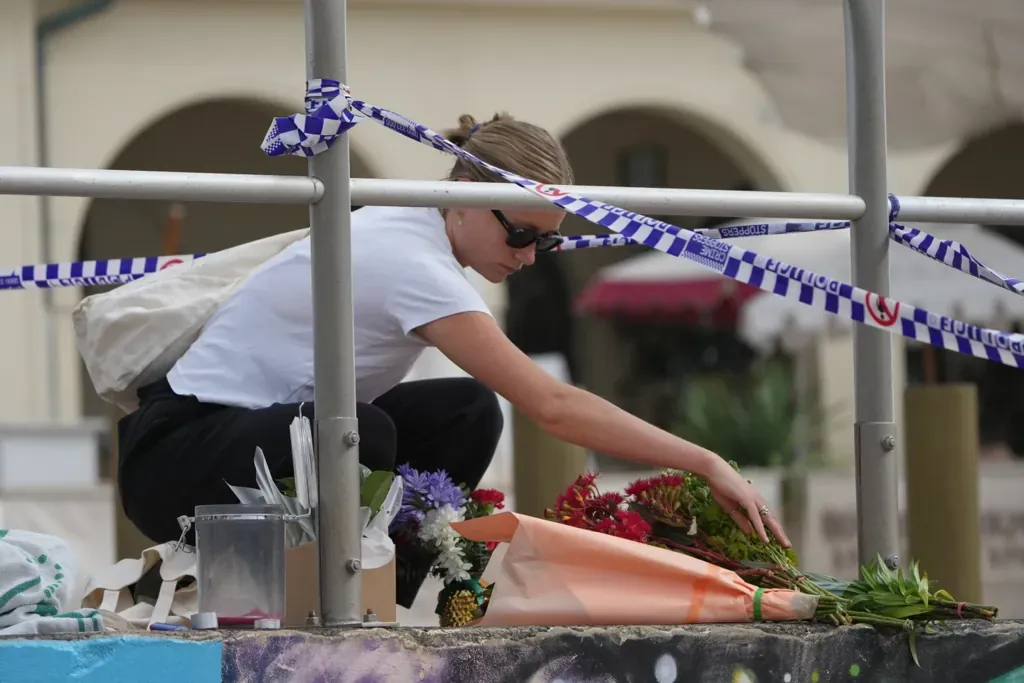
Along Bondi Beach, flowers, candles, and handwritten notes now line the sand — marking a place where celebration turned into tragedy.
This article was rewritten by JournosNews.com based on verified reporting from trusted sources. The content has been independently reviewed, fact-checked, and edited for accuracy, neutrality, tone, and global readability in accordance with Google News and AdSense standards.
All opinions, quotes, or statements from contributors, experts, or sourced organizations do not necessarily reflect the views of JournosNews.com. JournosNews.com maintains full editorial independence from any external funders, sponsors, or organizations.
Stay informed with JournosNews.com — your trusted source for verified global reporting and in-depth analysis. Follow us on Google News, BlueSky, and X for real-time updates.