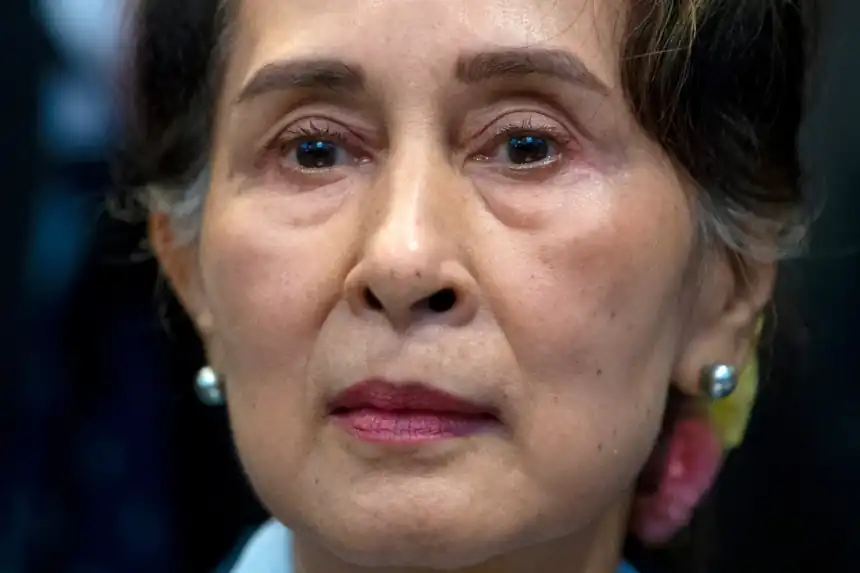
Myanmar’s military authorities have transferred detained former leader Aung San Suu Kyi from prison to house arrest, a move that carries international diplomatic implications as pressure mounts for political reconciliation in the conflict-stricken country.
State media confirmed that Suu Kyi, who has been held since the military seized power in February 2021, was relocated from a prison in the capital Naypyitaw to an undisclosed residence where she will serve the remainder of her sentence. The development comes amid ongoing international scrutiny of Myanmar’s political crisis and its impact on regional stability.
Officials said the decision was part of a broader prisoner amnesty marking a Buddhist holiday, with authorities describing the move as an act of “humanitarian concern.” Reporting from Reuters indicates the transfer was announced without detailed clarification of her conditions under house arrest or the precise location.

Diplomatic Pressure Builds Around Political Detentions
The transfer of Suu Kyi, a Nobel Peace Prize laureate and central figure in Myanmar’s democratic movement, is likely to be viewed internationally as a calibrated response to sustained diplomatic pressure. Governments and multilateral organizations have repeatedly called for her release alongside thousands of political detainees.
According to The Associated Press, her sentence—initially totaling more than three decades—has been reduced through successive amnesties, with the latest adjustment bringing it down significantly while still leaving many years remaining. Analysts say such reductions may signal attempts by Myanmar’s leadership to project a more conciliatory posture without fundamentally altering the political landscape.
The United Nations welcomed the shift as a “meaningful step” toward creating conditions for a credible political process, though it stopped short of endorsing the broader handling of political prisoners.
Regional Stability Tested by Limited Political Concessions
Myanmar has remained mired in conflict since the 2021 coup, with widespread violence, economic disruption, and displacement affecting millions. While Suu Kyi’s transfer may ease some international criticism, regional observers caution that it does not address the underlying drivers of instability.
Analysts interviewed by Financial Times note that symbolic concessions, such as adjusted detention conditions, are unlikely to resolve tensions between the military government and pro-democracy forces. The ongoing conflict has also drawn concern from neighboring countries, particularly within the Association of Southeast Asian Nations (ASEAN), which has struggled to broker meaningful dialogue.




Recent diplomatic engagement by ASEAN members has included renewed calls for the release of political prisoners and inclusive negotiations, reflecting concerns that prolonged instability could have cross-border security and economic consequences.
International Response and Strategic Implications
The move comes as Myanmar’s leadership seeks to reshape its international image following contested political developments and continued isolation from Western governments. Some analysts interpret the transfer as part of broader efforts to signal flexibility while maintaining control over the political process.
Reporting from Reuters and other outlets indicates that details surrounding Suu Kyi’s health and well-being remain limited, with family members and supporters continuing to seek confirmation of her condition.
For international stakeholders, the development highlights the delicate balance between engagement and pressure in addressing Myanmar’s crisis. While the shift to house arrest may be seen as incremental progress, it is unlikely to significantly alter diplomatic positions unless accompanied by broader reforms.
Looking ahead, policymakers and regional actors are expected to monitor whether the move leads to further concessions or remains an isolated gesture. The trajectory of Myanmar’s political situation will continue to shape regional stability and test international efforts to encourage dialogue and accountability.