SEOUL, South Korea (Journos News) – South Korea’s National Assembly has approved legislation requiring the country’s two highest courts in Seoul to establish specialized judicial panels to hear cases involving rebellion, treason and foreign subversion, following sustained political criticism over the handling of the criminal case against former President Yoon Suk Yeol.
The bill was passed on Tuesday by a vote of 175–2, with two abstentions, after lawmakers revised earlier drafts to ensure the measure would not apply retroactively to ongoing trials. The change was aimed at addressing concerns that the original proposal could undermine judicial independence.
If signed into law by President Lee Jae Myung, as is widely expected, the legislation will take effect immediately. However, it will not alter proceedings in Yoon’s current rebellion trial at the Seoul Central District Court, which is expected to reach a verdict in early 2026.
What the new law requires
Under the legislation, both the Seoul Central District Court and the Seoul High Court must establish at least two dedicated panels to handle cases involving rebellion, treason or foreign subversion. Each panel will consist of three judges selected by the judges’ council within each court, rather than being assigned randomly.
Supporters of the bill argue that crimes carrying exceptional constitutional and national security implications warrant greater institutional specialization. They say dedicated panels could help ensure consistency, expertise and efficiency in handling some of the country’s most serious criminal cases.
The Democratic Party, which controls the legislature, had initially sought broader changes that would have reshaped how courts assign judges in politically sensitive cases. Those provisions were dropped during deliberations amid mounting legal and political objections.
Conservative backlash and boycott
The vote came after a 24-hour filibuster by Jang Dong-hyuk, floor leader of the conservative People Power Party (PPP), who argued that even the revised version of the bill remained unconstitutional.
Jang accused the ruling bloc of attempting to exert political pressure on the judiciary by effectively steering certain cases toward preferred judges. Following the vote, PPP leaders urged President Lee to veto the bill, warning that it sets a dangerous precedent for legislative interference in judicial administration.
Most PPP lawmakers boycotted the final vote, leaving the chamber largely dominated by liberal and centrist members.
Legal scholars and former judges have been divided over the measure. Some acknowledge the legitimacy of specialized courts in complex cases, while others caution that altering judicial assignment rules in response to a specific political controversy risks eroding public trust in court neutrality.
Yoon Suk Yeol case at the center of debate
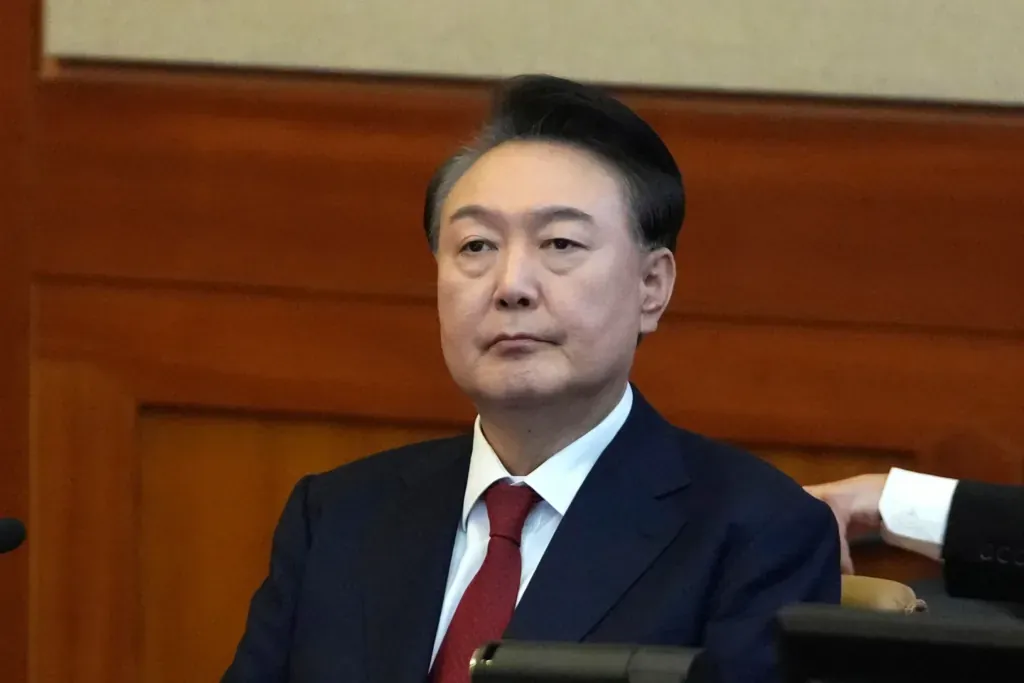
The legislation was prompted by growing frustration among liberal lawmakers over the pace and management of Yoon’s rebellion trial.
Yoon, a former prosecutor-turned-politician, was impeached and removed from office in April following his December 2024 declaration of martial law, a move that lasted only hours before being overturned by lawmakers. He was initially arrested, released pending trial, and then re-arrested in July as investigators expanded their case.
Prosecutors have charged Yoon with rebellion and other serious offenses stemming from what authorities describe as an unlawful attempt to consolidate power. Under South Korean law, rebellion is punishable by life imprisonment or the death penalty, although the country has not carried out an execution in decades.
Yoon’s trial has been overseen by Judge Jee Kui-youn of the Seoul Central District Court, whose handling of the case has drawn sharp criticism from Democratic Party leaders. They have accused him of unnecessarily delaying proceedings by scheduling hearings far apart and questioned his earlier decision to approve Yoon’s release from detention in March.
Wider judicial disputes
Tensions escalated further after courts rejected arrest warrant requests for several figures close to Yoon, including former Prime Minister Han Duck-soo and senior lawmaker Choo Kyung-ho.
Investigators accused Han of aiding Yoon’s declaration of martial law and Choo of obstructing lawmakers from participating in a parliamentary vote to revoke the measure. Judges ruled that the evidentiary threshold for detention had not been met, decisions that liberals cited as evidence of excessive judicial leniency.
In response, Democratic Party leaders argued that cases involving alleged threats to constitutional order should not be left to standard random assignment procedures. They called for a system that reflects the gravity and public impact of such prosecutions.
Opponents countered that random assignment is a cornerstone of judicial independence, designed precisely to prevent political influence over who hears sensitive cases.
Limits of the reform
Despite the political rhetoric surrounding the bill, its practical impact is likely to be limited in the short term.
Because the law does not apply retroactively, Yoon’s trial at the district court level will proceed under its current structure. If the case is appealed, however, it would be transferred to one of the newly created specialized panels at the Seoul High Court.
The revised scope has disappointed some lawmakers within the Democratic Party, who had pushed for more immediate changes. At the same time, the narrowing of the bill was critical to securing its passage amid legal warnings that broader reforms could violate constitutional safeguards.
President Lee, who took office following Yoon’s removal, has not publicly indicated whether he will heed conservative calls for a veto. His office has said only that the bill will be reviewed according to established procedures.
Broader implications
The episode underscores the deep political polarization that has followed Yoon’s failed martial law declaration and impeachment. It has also reopened longstanding debates in South Korea over the balance between judicial independence and democratic accountability, particularly in cases involving alleged abuses of executive power.
While specialized courts are not uncommon internationally—many countries use dedicated benches for constitutional, security or corruption cases—the circumstances surrounding their creation in South Korea have heightened scrutiny.
As Yoon’s trial continues, both supporters and critics of the new law are likely to view upcoming court decisions as a test of whether the judiciary can maintain public confidence amid intense political pressure.
This article was rewritten by JournosNews.com based on verified reporting from trusted sources. The content has been independently reviewed, fact-checked, and edited for accuracy, neutrality, tone, and global readability in accordance with Google News and AdSense standards.
All opinions, quotes, or statements from contributors, experts, or sourced organizations do not necessarily reflect the views of JournosNews.com. JournosNews.com maintains full editorial independence from any external funders, sponsors, or organizations.
Stay informed with JournosNews.com — your trusted source for verified global reporting and in-depth analysis. Follow us on Google News, BlueSky, and X for real-time updates.