


About 15 billion miles from where you sit, two 12-inch golden records are hurtling through outer space with multilingual greetings to the universe from 55 humans and one humpback whale.
With a playlist curated by astronomer Carl Sagan and inspired by the way humpbacks use low frequencies to send messages across entire oceans, they were launched on NASA’s two Voyager probes in 1977.
“As much as the sounds of any baleen whale, it is a love song cast upon the vastness of the deep.” Sagan wrote of the golden records.

And, since 95% of the planet’s biggest species had been harpooned to oblivion at the time, it could’ve easily been the kind of love song that ends in tears.
But almost a half-century later, the comeback of the humpback is arguably the greatest success story in the history of conservation. While artificial intelligence could one day help us understand the lyrics of those songs in space, new science is putting a dollar value on the life of a whale — and finding they provide so much more than blubber and song.
“They’re literally seeding the upper parts of the ocean with the opportunity for plant life to grow,” veteran marine ecologist Ari Friedlaender explained while bobbing on a Zodiac raft off the Antarctic Peninsula. “And that’s what feeds the food for whales, birds, seals — everything. They’re basically farmers recycling nutrients and there’s more food available to them the more they’re around.”
CNN followed an international team of whale experts throughout 2023, from Friedlaender’s lab at the University of California at Santa Cruz to humpback breeding grounds off the Pacific coast of Colombia, and their feeding grounds at the bottom of the world. While Friedlaender has been collecting whale data for more than 25 years, his work found new relevance after a team of economists from the International Monetary Fund estimated a single baleen whale provides about $2 million worth of Earth services, both in life and death.
When baleen whales gulp vital nutrients like iron and nitrogen from the depths of the sea and defecate at the surface, they serve as the ocean’s biggest fertilizer pumps — feeding the tiny phytoplankton which produces half the world’s oxygen and captures as much planet-warming CO2 as four Amazon rainforests while holding up the bottom of the food chain.
“That’s the gold,” smiled Chris Johnson, the global lead of whale and dolphin conservation at the World Wildlife Fund, as he held up a whale stool sample jarred from the chilly Antarctic water.
“We have the poo. Repeat, we have humpback poo,” Eva Prendergast, the British polar scientist at the helm, radioed back to the Ocean Endeavor, the cruise ship serving as base.
The team interacted with dozens of whales over the course of four days in Antarctica. They used specialized camera drones to measure body size and suction-cupped tags slapped onto the animals’ backs with a long pole to record the way they move while capturing whale’s-eye-view video.
But the most useful tools were MacGyvered into existence back at the lab in Santa Cruz. For over a decade, Friedlaender’s team has been using crossbows with hollow-tipped darts to collect biopsy samples. It feels like “a mosquito bite” to the whales, Johnson said, but what they can test for is priceless: from stress hormones to toxins to — most importantly — pregnancy rates.
“What else tells you how a population is growing or shrinking?” Friedlaender said after darting a humpback with a 20-yard shot and securing the tip in a sterile bag. “We can now tell if that whale is pregnant or not.”
He has over 2,500 samples from the same region back in a fridge at UC Santa Cruz, a data set that allows him to compare fertility rates with year-by-year changes in the environment. And as global warming melts sea ice at staggering rates, the habitat for krill is shrinking and humpback pregnancies are dropping.
“In the first year of life, juvenile krill spend the winter under the sea ice and feed on the microbial and algal communities,” Friedlaender explained. “We have a very good understanding that when you have a poor sea ice year, the following year you’re going to have lower reproductive rates. In good ice years, the reproductive rates are very high.”
Since the last two years have been the lowest levels of sea ice on record around Antarctica, the correlation is worrying, and the trend is only expected to accelerate as the planet warms.
21st century threats
But the climate crisis is just one tragic setback in the humpback’s comeback. While on the longest migration routes of any animal, whales must dodge cargo ships on crowded coastlines, “ghost” fishing gear cut loose at sea and floating clouds of plastic pollution.
And because of a global market for omega-3 krill oil supplements and nutraceutical feed for pets and fish farms, whales now compete with humans for their main source of food.
Industrial krill fishing fleets are taking to the Southern Ocean in growing numbers and have been recorded dragging their nets into areas full of feeding whales. After years of challenging whalers, the activist group Sea Shepherd will spend this season tracking krill fishers.
The fishery operation “puts additional pressure on krill and krill predators that, along with growing bycatch of non-target species like the humpback and a lack of transparency across the industry, suggest that the current management framework is outdated and needs to change now,” the WWF’s Johnson told CNN.
Early in a career devoted to marine mammals, Johnson spent five years sailing on the research vessel of Roger and Katy Payne, the married scientists who blew humanity’s minds by releasing Songs of the Humpback Whale in 1970.
While people were familiar with the echolocating clicks of dolphins and orcas, the first baleen whale noises were recorded by Navy engineer Frank Watlington by accident in the 1950s, and after the Paynes worked with fellow cetologist Scott McVay to record more humpback songs around Bermuda, they were played during marine mammal protection hearings in Congress and the United Nations. Ten million copies were inserted into National Geographic magazine in 1979 — the largest single pressing in history — and a global movement to Save The Whales grew big enough to … save the whales.
By 1986, the International Whaling Commission had instituted a global ban on all commercial whaling. While Japan, Norway and Iceland have continued regardless, years of lawsuits and international pressure forced Japan to lower its annual quota of Minke whales from 1,000 to 333, and the two boats of Kristján Loftsson, Iceland’s last whaler, harpooned two dozen fin whales in 2023.
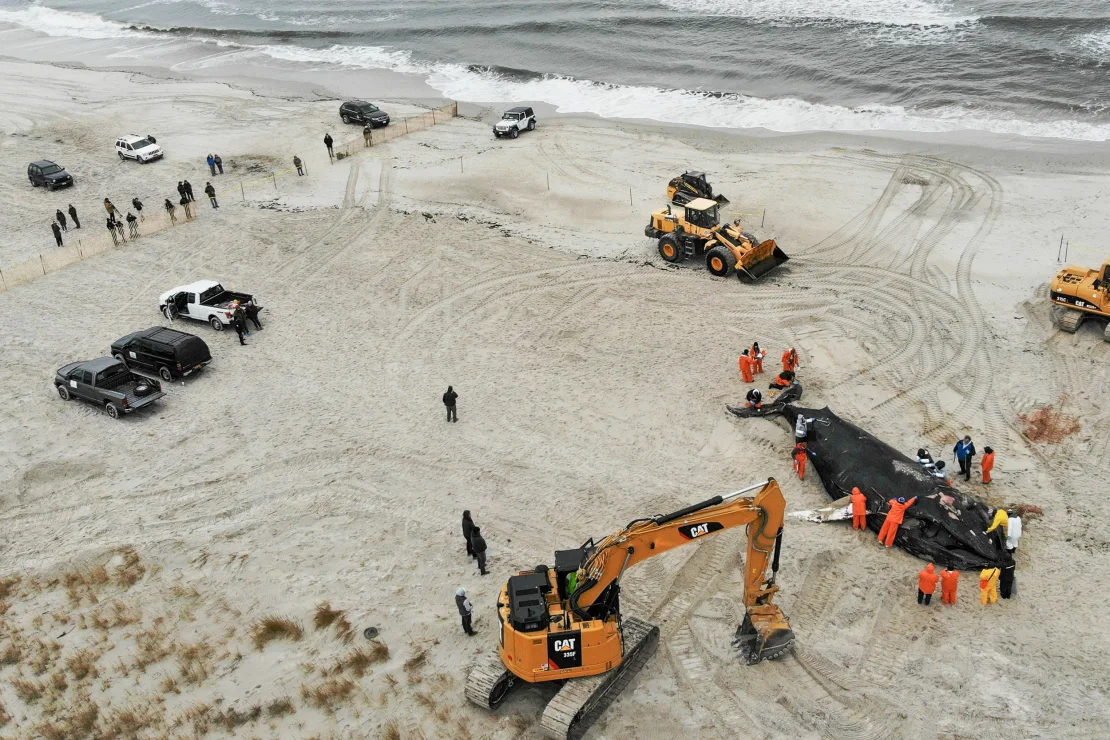
But while the commercial harpoon is critically endangered, other threats remain — especially to whales that aren’t as supremely adaptable as the humpback.
Scientists believe there are only about 360 North Atlantic right whales left on Earth — a species named by whalers who pointed out the “right ones” to hunt. Entanglements with fishing and lobster gear are the main hazard for the species migrating from the Arctic down the Atlantic coast. But concern over the North Atlantic right whale, and a number of other species, found dead on American beaches has galvanized an unusual coalition of environmentalists, fishermen and Republican beach town mayors hoping to stop the development of offshore wind farms.
On a campaign stop in South Carolina, former President Donald Trump mocked a call for ship speed limits during whale migration season while blaming the nascent wind industry for the harm. “Windmills are causing whales to die in numbers never seen before,” Trump said, with no evidence to support the claim.
“I don’t think a wind turbine can kill a whale,” Friedlaender told CNN. “Once you have a structure in the ocean, the animal is not going to just run into it. I think the temporary issue comes in setting up a wind farm when you have a lot of vessel traffic that may co-occur with when whales are there and then the pile driving produces a lot of acoustic pollution, but that’s also going to be relatively temporary. Once those are set up, that disturbance goes away.”
While pursuing its goal of generating 30 gigawatts of offshore wind power by 2030, the Biden administration recently finalized plans to protect whales by limiting leases that could impact key whale habitat, monitoring noise thresholds and helping develop whale-safe fishing gear, like innovative lobster pots which are brought to the surface with remote-controlled air bags instead of ropes.
“It’s a positive sign that the Biden administration is doing this in a collaborative approach involving science, communities, industry and government agencies,” Johnson said, and described how “bubble curtains” around turbine installations can contain acoustic pollution.
A whale’s song
Advances in artificial intelligence are beginning to help experts like Johnson and Friedlaender spot patterns of behavior previously unseen, while others hope to use AI to eventually understand the “lyrics” in humpback song.
In December, a Templeton Foundation-funded team from the University of California at Davis and the Whale SETI Institute had a 20-minute “conversation” with a humpback in Alaska.
When they played a whale’s “thrruup” call recorded in the same spot the day before, a female humpback known as Twain responded 36 times, matching the intervals and waiting for responses from the boat.
“It’s very possible we were either playing back her own call or one of the calls from the individuals that were in that group,” Brenda McCowan, an animal behavior specialist at UC Davis told CNN. “These are a very different class of signals that are called social sounds, kind of a chatty, almost conversational,” whale biologist Fred Sharpe added. “We certainly don’t have evidence to call it language, but it does have language-like qualities in it, that they’re discrete units.”
The Alaska team’s federal permit only allowed it to engage with Twain for 20 minutes, and when they stopped the playback, “she basically called three times as she was moving away and then stopped,” McCowan said.
“It’s like, ‘where’d you go, my new friends? Where’d you go?’” Sharpe speculated.
While female humpbacks communicate in “thrruups” and “bloops,” only males sing in the haunting tones that travel so well through the depths, and there is debate over whether they are more like singers in a seductive boy band or rivals in a rap battle.
Carl Sagan was among the generation who believed they are mating calls like those of birds.
“But then that hypothesis has very little evidence behind it,” researcher Natalia Botero-Acosta told CNN while taking crossbow biopsies off the Pacific coast of Columbia. “So, there’s this whole different set of hypotheses, that it is a mechanism for males to interact with each other and maybe arrange those competitive groups. Or that it can promote ovulation for females.”
“I work with a couple of these projects that are trying to use AI to understand the context and the meaning to animal communication, but I don’t have a need to talk to a whale,” Friedlaender said when asked about the possibilities. “A whale shouldn’t have to tell us ‘Here’s all the things you’re doing to screw us.’”
“If I could talk to a whale, I’d say ‘Sorry,’” Friedlaender added.
While in Antarctica, he was giddy with the news that the first-ever Global Oceans Treaty had passed in the United Nations, creating a framework to protect 30% of the oceans by 2030, including key whale migration corridors. But almost a year later, only one country has ratified it.
“We are seeing countries start to ratify it, but it’s urgent we move fast,” Johnson said. “As soon as 60 countries ratify it, it enters into force. Last week Palau was the first, with Chile and the Maldives soon to do so. We’re hopeful others will ratify soon.”
At times, such diplomacy can feel as whimsical as launching golden records of whale song out of the galaxy.
“Many, if not most of our messages will be indecipherable,” Carl Sagan wrote of the Voyager message. “But it is important to try.”
People saved the whales once. By doing it again, the experts say, humankind will enjoy the added benefit of saving itself.











