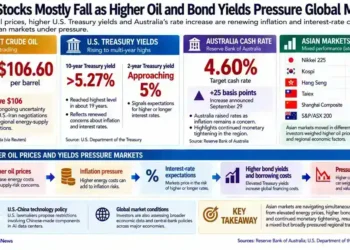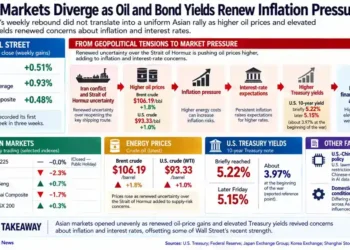
Global energy markets entered a volatile phase this week as oil prices surged past $100 per barrel, underscoring growing economic strain tied to the escalating conflict involving Iran. The spike reflects mounting disruptions to energy production and shipping routes across the Middle East, one of the world’s most critical oil supply corridors.
As first reported by The Associated Press, benchmark crude prices jumped sharply after trading reopened Sunday, with Brent crude climbing to $107.97 per barrel, a 16.5% increase from its previous close. Meanwhile, West Texas Intermediate (WTI) — the primary U.S. crude benchmark — rose to about $106.22 per barrel, marking a similar surge of nearly 17%.
The sudden escalation in energy costs highlights how quickly geopolitical conflict can translate into economic pressure for global markets.

Energy Supply Lines Tighten Across the Persian Gulf
At the center of the price surge lies the Strait of Hormuz, a narrow but vital maritime corridor through which roughly 20% of the world’s oil supply normally passes each day.
According to energy research firm Rystad Energy, around 15 million barrels of crude oil typically move through the strait daily. However, the threat of missile and drone attacks tied to the ongoing war has sharply curtailed tanker traffic through the waterway.
The chokepoint is bordered by Iran and sits along the export routes for oil producers including Saudi Arabia, Kuwait, Iraq, Qatar, Bahrain, and the United Arab Emirates. Reduced tanker movement through the corridor has begun to create logistical bottlenecks for regional exporters.
Producers in Iraq, Kuwait, and the United Arab Emirates have already started cutting output as storage facilities fill due to the inability to ship crude abroad at normal rates.
Energy Infrastructure Strikes Intensify Market Anxiety
Military strikes on energy facilities have further deepened concerns about supply disruptions.




Since the conflict began in early March, attacks involving Iran, Israel, and the United States have targeted oil and gas infrastructure, raising fears that the fighting could expand into a broader energy crisis.
Iranian authorities reported that Israeli strikes on oil depots and a petroleum transfer facility in Tehran killed four people early Sunday. Israeli officials said the sites were used to support Iran’s missile operations.
In remarks reported by regional media, Mohammad Bagher Qalibaf, the speaker of Iran’s parliament, warned that the war’s effects on the oil industry could intensify if hostilities continue.
Iran exports about 1.6 million barrels of crude oil per day, most of which goes to China. Any prolonged disruption to those shipments could force major buyers to seek alternative suppliers, further tightening global supply.
Inflation Risks Reemerge as Energy Costs Climb
The surge in crude prices has quickly filtered into broader economic concerns, particularly in major consumer markets.
Higher oil prices tend to raise transportation and manufacturing costs, which can feed into inflation and reduce consumer spending. Economists warn that sustained prices above $100 per barrel could begin to weigh heavily on global economic growth.
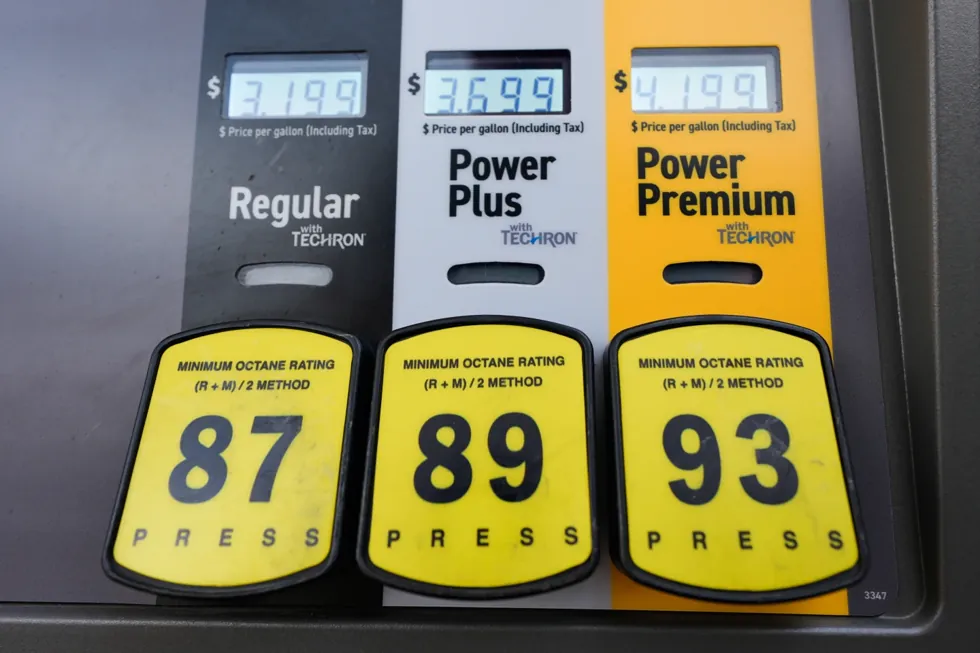
In the United States, gasoline prices have already begun to climb. Data from the AAA motor club shows the national average price for regular gasoline reaching $3.45 per gallon, roughly 47 cents higher than a week earlier. Diesel prices have also jumped, rising about 83 cents to roughly $4.60 per gallon.
Despite the spike, U.S. Energy Secretary Chris Wright said during an interview on CNN’s “State of the Union” that he expects fuel prices to stabilize.
“Look, you never know exactly the time frame of this,” Wright said, adding that in a worst-case scenario the disruption could last weeks rather than months.
Financial Markets React to Energy Volatility
Energy-driven uncertainty has also begun to ripple through financial markets.
Late Sunday trading showed U.S. stock index futures falling, signaling potential declines when markets reopen. Futures for the S&P 500 dropped about 1.6%, while Dow Jones Industrial Average futures fell roughly 1.8%. Futures tied to the Nasdaq Composite were down about 1.5%.
The market reaction follows a difficult session last week in which the S&P 500 slid 1.3%, while the Dow at one point plunged nearly 945 points before recovering slightly by the closing bell.
Natural gas prices have also risen during the conflict, though at a slower pace than oil. Prices climbed to about $3.33 per 1,000 cubic feet, roughly 4.6% higher than Friday’s closing price after gaining about 11% over the past week.
Global Energy Stability Faces a Critical Test
The rapid rise in oil prices reflects a broader structural vulnerability within global energy markets: the heavy reliance on a handful of strategic shipping routes and production centers.
With the conflict now entering its second week, analysts warn that prolonged instability in the Persian Gulf could continue to tighten supply, unsettle financial markets, and revive inflation concerns worldwide.
For governments and investors alike, the trajectory of the conflict — and whether vital energy corridors remain secure — may determine how long the current oil shock reverberates through the global economy.