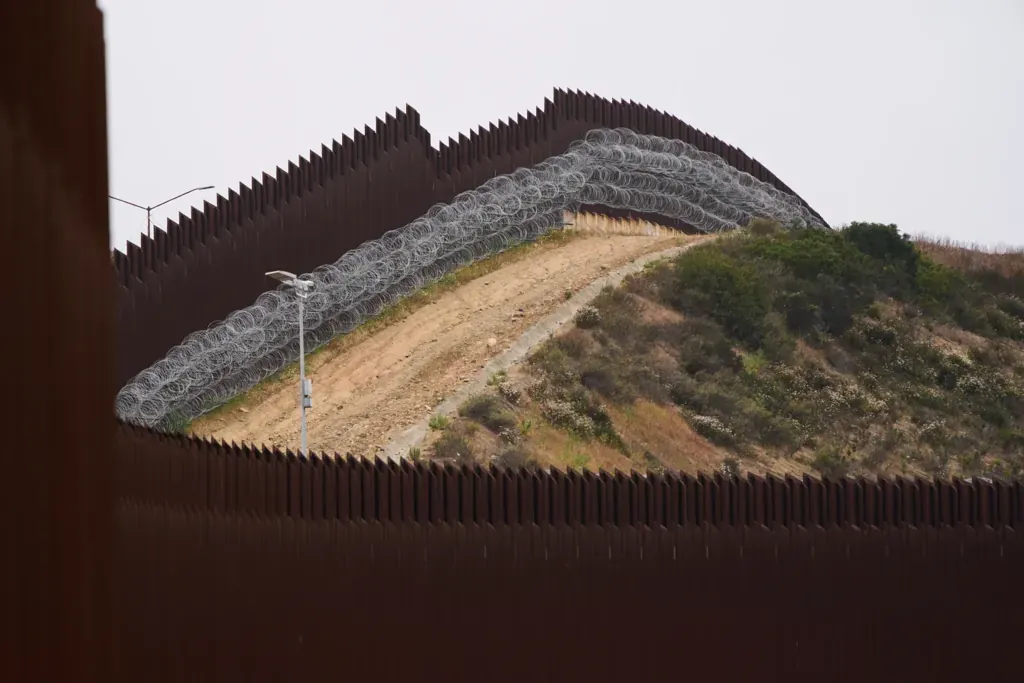
The Trump administration has designated a large portion of California’s southern border as a militarized zone, extending a strategy that has steadily expanded across multiple states since early 2025.
The Trump administration has shifted jurisdiction of much of California’s borderlands to the U.S. Navy, marking the latest step in a sweeping military deployment along the U.S.–Mexico frontier. The move broadens a policy that authorizes troops to detain migrants and enforce trespassing laws on federal lands converted into national defense zones.
It also deepens a legal and political debate over the military’s role in domestic law enforcement, an issue that has drawn scrutiny from civil liberties groups and constitutional experts.
California Borderlands Shift to Navy Control as Military Role Widens
A Rapid Expansion of Military Authority Along the Border
The U.S. Department of the Interior announced that it will transfer jurisdiction of a wide stretch of California’s international boundary—from near the Arizona state line to the edges of the Otay Mountain Wilderness—directly to the Navy. The newly designated zone runs through the Imperial Valley, an agricultural region dotted with rural communities such as Tecate and long-known migration corridors.
Federal officials said the shift is meant to reinforce what they describe as the “historic role public lands have played in safeguarding national sovereignty,” echoing language used in earlier announcements when similar zones were established in New Mexico, Texas, and Arizona.
Under the designation, military personnel gain expanded authority to detain individuals accused of trespassing on military-administered lands, a classification that now covers large tracts of federal property adjacent to the border. Anyone apprehended in these zones can face additional criminal charges, including penalties that carry potential prison sentences.
More than 7,000 active-duty and National Guard troops are currently deployed across the southern border, supported by helicopters, unmanned aerial systems, and surveillance technology. The layered deployment has become one of the most visible elements of President Donald Trump’s immigration policy, which has emphasized accelerated deportations and a drastically reduced threshold for detention.
Previous National Defense Zones
The strategy began in April when the administration designated a 170-mile stretch of New Mexico’s borderlands as a national defense area—marking the first time in decades that military authority was formally expanded over domestic territory for immigration-related purposes. That zone soon became a template for additional military designations in Texas and Arizona.
In each case, the federal government framed the zones as necessary tools to fill what officials called “persistent security gaps.” However, the policy quickly prompted national debate. Legal specialists noted that the Posse Comitatus Act restricts direct military involvement in civilian law enforcement, apart from specific exceptions authorized by Congress. While the administration argues that the designation of national defense areas grants the military authority to protect federal lands, critics warn the approach risks blurring constitutional boundaries.
Border Arrests Hit Record Lows Even as Security Tightens
The Interior Department described the California borderlands as a high-traffic region for unlawful crossings. But government data for 2025 shows that arrests along the southern border have fallen dramatically. U.S. Border Patrol apprehensions have dropped to their slowest pace since the 1960s—a trend attributed to heightened enforcement, migration policy shifts, and changing patterns in regional migration.
Despite the decline, the administration says the militarized zones serve as a deterrent and a means to enforce trespassing laws on federally managed land. The approach is part of Trump’s broader effort to reshape immigration enforcement through executive powers, including emergency declarations that have allowed military resources to be redirected to border security.
Federal Courts Push Back on Deployment of California Guard
The move to expand the militarized zone coincided with a separate legal challenge in California. On Wednesday, a federal judge ordered the administration to halt the deployment of California National Guard troops in Los Angeles, ruling that the federal government must return control of those state troops to Sacramento.
The order follows a contentious dispute between the White House and California Gov. Gavin Newsom. In June, Trump mobilized more than 4,000 California National Guard troops without the governor’s approval, asserting federal authority under emergency powers to bolster immigration enforcement. The Newsom administration argued the federal mobilization violated state authority and set a concerning precedent for deploying state forces without gubernatorial consent.
Administration Defends Use of the Military
Interior Secretary Doug Burgum defended the newest militarized zone, saying the government is “working with the Navy to close long-standing security gaps” and “strengthening national defense” in the process. The administration has consistently framed its strategy as a way to protect public lands and prevent unauthorized crossings in remote areas that remain difficult to patrol.
Officials have also pointed to the history of military presence along the U.S.–Mexico border, noting that the armed forces have periodically supported enforcement efforts during periods of high migration. However, the scale and structure of the current deployment—defined by designated militarized zones and formal land jurisdiction transfers—represent an unusually expansive use of the armed forces.
Legal and Political Landscape
Civil liberties organizations and several academic institutions warn that the strategy could lead to an enduring shift in how federal lands near the border are administered, raising questions about transparency, accountability, and the potential politicization of military resources.
Legal scholars note that while the military can assist civilian authorities under certain circumstances, direct involvement in detentions and enforcement actions remains highly restricted. The administration argues that trespassing laws on military-administered lands fall within existing exceptions, but several legal challenges are now underway in federal courts.
Political reaction has been sharply divided. Supporters of the policy argue that the military’s involvement improves security and compensates for what they view as shortages in federal law enforcement personnel. Critics, including several border-state lawmakers, say the approach risks militarizing civilian life and escalating tensions in communities that have long sought more balanced enforcement strategies.
Communities Adjust as Policy Evolves
Residents along the California border say the increased military presence is visible but not yet disruptive. Local officials in Imperial County have noted increased air traffic from surveillance aircraft and more frequent patrols along rural roads. Some residents express concern about possible long-term impacts on farming operations and land access, while others welcome what they see as strengthened security.
Migration advocates warn that the extension of militarized areas could further complicate humanitarian work in the region, particularly for organizations that provide aid to migrants in remote desert zones where temperatures remain extreme.
For now, the designation marks another step in a policy shift that shows no sign of slowing. With multiple federal court cases underway and additional militarized zones still under consideration, the debate over the role of the U.S. military in immigration enforcement appears poised to intensify throughout the year.
This article was rewritten by JournosNews.com based on verified reporting from trusted sources. The content has been independently reviewed, fact-checked, and edited for accuracy, neutrality, tone, and global readability in accordance with Google News and AdSense standards.
All opinions, quotes, or statements from contributors, experts, or sourced organizations do not necessarily reflect the views of JournosNews.com. JournosNews.com maintains full editorial independence from any external funders, sponsors, or organizations.
Stay informed with JournosNews.com — your trusted source for verified global reporting and in-depth analysis. Follow us on Google News, BlueSky, and X for real-time updates.