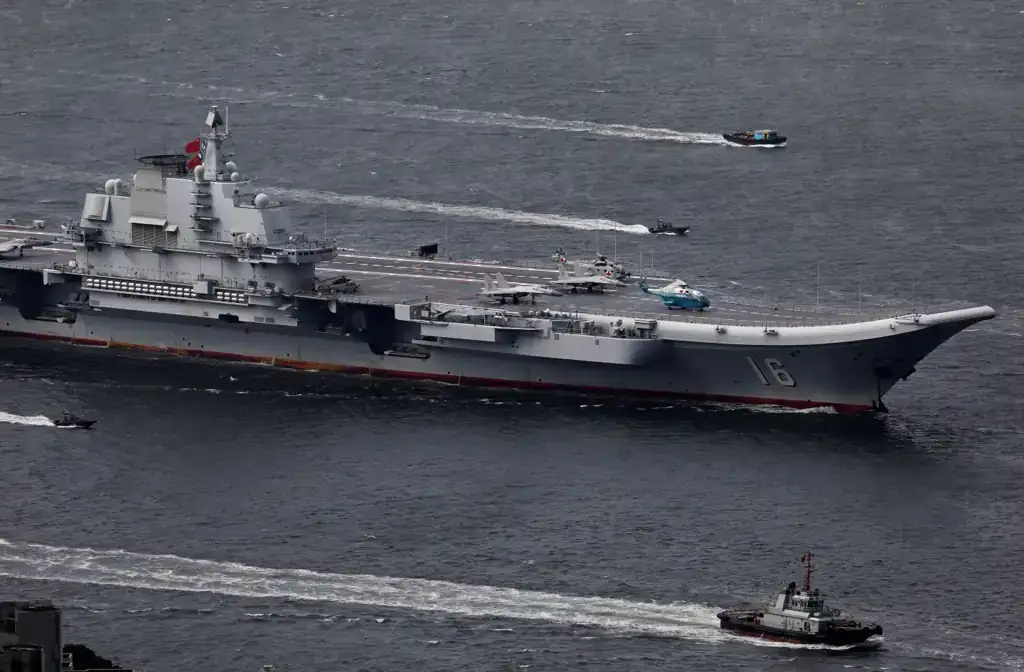
Japan lodged a formal protest with China after a Chinese military aircraft locked its radar on Japanese fighter jets near Okinawa, marking a new flashpoint in bilateral tensions. The incident, which occurred on Saturday, involved Chinese J-15 jets operating from the aircraft carrier Liaoning, Japan’s Defense Ministry said.
According to Japanese officials, the radar lock occurred twice on Saturday. In the late afternoon, the Chinese aircraft targeted Japanese F-15 jets for about three minutes, and again in the evening for roughly 30 minutes. The ministry stressed that no Japanese airspace was violated and no injuries or damage resulted. It remains unclear if the same J-15 aircraft was involved in both incidents.
Japanese Authorities Condemn “Dangerous” Conduct
Japan’s Defense Minister Shinjiro Koizumi described the radar targeting as a “dangerous act that exceeded the scope necessary for safe aircraft operations.” He confirmed that Japan had lodged a strong protest with Beijing and demanded measures to prevent similar occurrences.
“The occurrence of such an incident is extremely regrettable,” Koizumi said in a Sunday briefing. He emphasized that Japanese fighter jets maintained safe distance while responding to the potential airspace violation, highlighting that the Japanese response was defensive and not provocative, according to Kyodo News.
The Chinese government and military did not immediately respond to the protest. On Friday, Foreign Ministry spokesperson Lin Jian asserted that Chinese naval operations comply with international law, and cautioned against exaggerating its activities.
Worsening Relations Over Taiwan Comments
The radar lock incident comes amid heightened diplomatic tensions. Earlier in November, Japanese Prime Minister Sanae Takaichi indicated that Japan’s military could intervene if China acted against Taiwan, the self-governing island Beijing claims as its own. This statement drew sharp criticism from China, straining ties further.
The Liaoning carrier was conducting routine aircraft takeoff and landing drills in the Pacific, passing between Okinawa’s main island and nearby Miyako Island. Japanese F-15 jets were scrambled as a precaution in case of an airspace violation. Radar locking, a standard capability for both search and fire-control purposes, can raise regional alarm when directed at foreign aircraft, as it signals potential targeting for missile launch.
Experts note that this appears to be the first known instance of a Chinese jet locking radar on Japanese fighter jets. A similar confrontation occurred in 2013, when a Chinese warship targeted its radar on a Japanese destroyer.
Parallel Incident in South China Sea
In a related development, the Philippine Coast Guard reported that Chinese forces fired three flares toward a Philippine fisheries patrol aircraft on Saturday over disputed waters in the South China Sea. Such flare warnings are a tactic China uses to enforce its perceived airspace claims over contested maritime zones.
These incidents underscore the rising military and diplomatic friction in East Asia, where territorial disputes, historical tensions, and Taiwan-related security concerns increasingly shape regional dynamics. Analysts warn that even minor incidents, such as radar locks, carry the potential to escalate rapidly if misinterpreted.
This article was rewritten by JournosNews.com based on verified reporting from trusted sources. The content has been independently reviewed, fact-checked, and edited for accuracy, neutrality, tone, and global readability in accordance with Google News and AdSense standards.
All opinions, quotes, or statements from contributors, experts, or sourced organizations do not necessarily reflect the views of JournosNews.com. JournosNews.com maintains full editorial independence from any external funders, sponsors, or organizations.
Stay informed with JournosNews.com — your trusted source for verified global reporting and in-depth analysis. Follow us on Google News, BlueSky, and X for real-time updates.