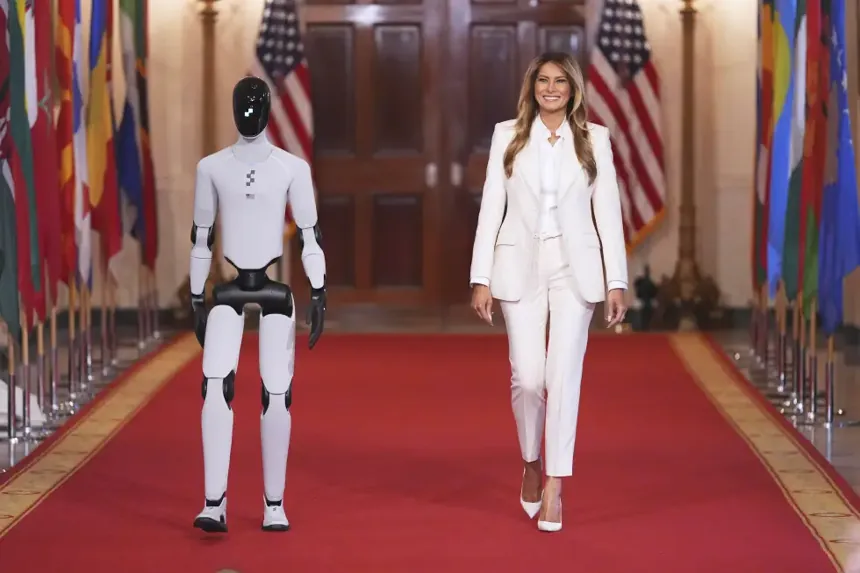
WASHINGTON — The appearance of a humanoid robot alongside Melania Trump at a White House technology summit underscores how humanoid robotics is increasingly being positioned within policy and education frameworks, reflecting broader industry efforts to normalize artificial intelligence in public-facing environments.
According to reporting by the Associated Press, the robot—identified as Figure 03—participated in a global education and technology forum convened under an initiative focused on integrating innovation and AI into child development strategies. The demonstration signals a shift in how emerging AI systems are being showcased beyond industrial or research settings.
The event highlights a widening intersection between AI capability expansion and institutional endorsement, as governments and public figures increasingly provide platforms for next-generation robotics technologies.

AI Deployment Expands Into Public Policy Arenas
The inclusion of a humanoid robot in a high-level policy forum reflects a broader trend in which AI developers seek legitimacy through visibility in governmental and educational initiatives. The robot delivered prepared remarks and multilingual greetings, demonstrating capabilities aligned with natural language processing and human interaction design.
Developed by Figure AI, Figure 03 represents the company’s third-generation humanoid system, designed for domestic assistance tasks such as cleaning and household support. While still early in deployment, such demonstrations increasingly serve as proof-of-concept for broader societal integration, particularly in education and care sectors.
Executives have framed these appearances as milestones. CEO Brett Adcock said in remarks published on social media that the robot’s presence marked a historic first for humanoid systems in the White House, signaling ambitions to position the company at the forefront of the emerging category.
Competitive Pressure Intensifies in Humanoid Robotics
The demonstration also reflects intensifying competition within the humanoid robotics sector, where companies are racing to commercialize systems capable of performing human-like tasks. Figure AI is competing with established players such as Boston Dynamics and Tesla, led by Elon Musk, alongside a growing number of Chinese robotics firms.
Industry analysts note that visibility and narrative positioning are becoming as important as technical capability, particularly as companies seek investment, partnerships, and regulatory goodwill. Public demonstrations in government settings can help shape perception around safety, utility, and long-term adoption.




At the same time, the sector faces unresolved challenges, including scalability, cost efficiency, and real-world reliability—factors that will ultimately determine whether humanoid robots transition from demonstration environments into widespread deployment.
Institutional Endorsement Signals Market Direction
The summit itself, focused on education and innovation, suggests policymakers are increasingly viewing AI as a foundational component of future workforce development. By integrating humanoid robotics into these discussions, organizers are implicitly endorsing the role of embodied AI systems in long-term technological ecosystems.
While the demonstration remained largely symbolic, it highlights how AI is moving beyond software into physical, interactive systems that require new governance frameworks. Questions around safety standards, ethical deployment, and labor impact are expected to grow as humanoid robots become more visible.
For the robotics industry, the event reinforces a key strategic reality: public-sector alignment may become a critical lever in accelerating adoption, particularly as governments shape the regulatory and economic conditions that will define the next phase of AI expansion.