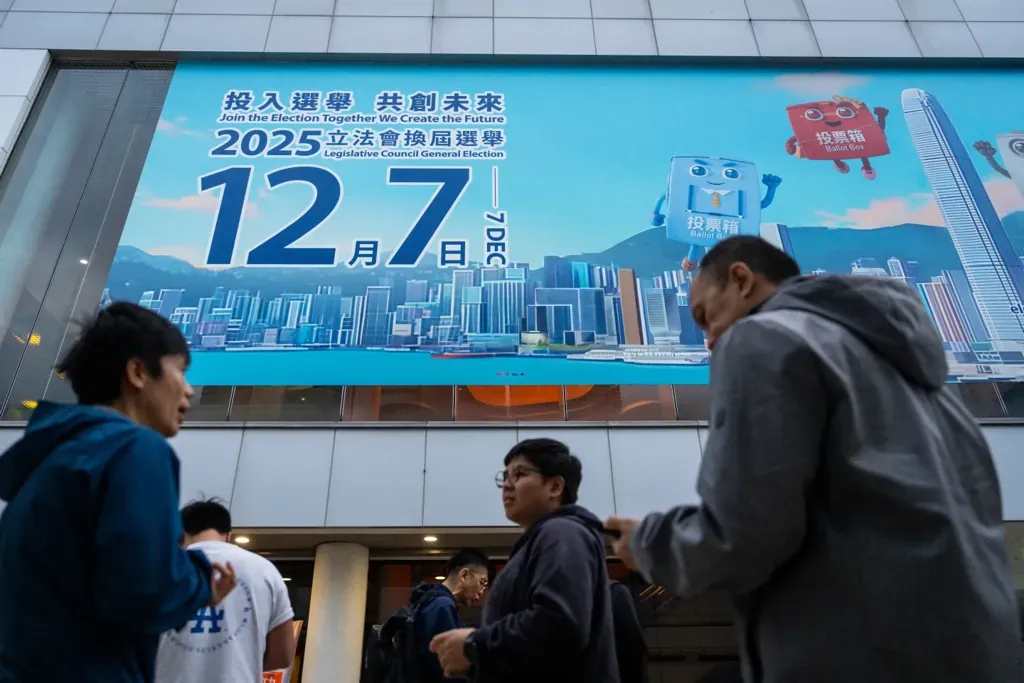
Voters in Hong Kong headed to the polls on Sunday for the city’s second legislative election since a sweeping 2021 overhaul reshaped the political landscape and removed pro-democracy opposition figures from formal participation. The Hong Kong vote 2025 comes less than two weeks after a fatal apartment fire that left at least 159 people dead, placing the government’s crisis response and political credibility under renewed scrutiny.
Turnout — historically seen as a signal of public sentiment in the Chinese territory — has emerged as the defining metric of this year’s contest. The government faces questions about accountability in the aftermath of the blaze, while analysts warn that simmering public frustration could further depress participation in a system where competition is tightly managed.
Turnout Becomes Key Metric in Hong Kong Vote 2025
Officials acknowledged that voter participation will be closely watched, particularly after the previous legislative election recorded the lowest turnout since the city’s return to Chinese rule in 1997. In 2021, roughly 30 percent of eligible voters cast ballots, reflecting widespread disengagement following the overhaul that sharply curtailed the role of opposition parties.
This time, some analysts argue the fire — Hong Kong’s deadliest in decades — may push turnout even lower. The tragedy triggered emotional public debate over government oversight, building safety, and alleged bid-rigging in maintenance contracts at the 1980s-era apartment complex where the blaze occurred.
Chief Executive John Lee has urged residents to vote, describing participation as a way to “promote reforms” and support the city’s recovery. He pledged to submit a proposal to the incoming legislature to provide assistance for fire victims, many of whom have been left without permanent housing.
Campaigning Stalls After Devastating Blaze
Election activities were largely halted after the disaster, and campaigning remained subdued in the final days before the vote as candidates sought to demonstrate respect for victims. Prior to the fire, authorities had invested considerable effort into driving up turnout, viewing participation as a measure of public confidence in the revised electoral system.
Officials held candidate forums, extended polling hours by two hours, added voting stations, and offered subsidies to elderly care centers and disability institutions to help residents reach the polls. Banners and posters promoting the election were placed across the city.
Police also arrested individuals accused of encouraging others to avoid voting or to cast invalid ballots, part of a broader enforcement campaign targeting actions deemed to undermine the electoral process.
Despite these efforts, the blaze shifted public attention away from political messaging. Commentators say the somber atmosphere has limited candidates’ ability to connect with voters and may discourage supporters who are dissatisfied with the government’s handling of the tragedy.
Government Chooses to Proceed Despite Criticism
Some critics questioned whether the vote should be postponed in light of the scale of the fire and the ongoing investigation into structural and administrative failures. However, Lee defended the decision to move forward, arguing that delaying the election would not assist survivors or improve the government’s response.
He said legislators who “shared the pain” of the incident would be better positioned to accelerate reforms, approve recovery funding, and pass related legislation once seated. The administration has emphasized unity and resilience, framing the election as part of Hong Kong’s effort to rebuild confidence after a difficult period.
A System Designed for “Patriots”
This election is the second held under the 2021 overhaul, which introduced new vetting procedures to ensure candidates are “patriots” loyal to Beijing. The reforms significantly reduced the number of directly elected seats and strengthened the role of pro-Beijing committees in shaping the legislature.
Before the overhaul, half of the seats in the 70-member Legislative Council were chosen by the general electorate. Under the current system, only 20 of the 90 seats are directly elected. Forty are selected by a pro-Beijing Election Committee, and the remaining 30 are filled through “functional constituencies” representing sectors such as finance, real estate, and health care.
The candidate pool reflects Beijing’s push for lawmakers seen as aligned with national priorities, according to several political observers. They argue that even among traditionally loyal groups, central authorities are increasingly assertive in shaping the ideological orientation of the legislature.
Lee has dismissed concerns about tightened control, saying personnel changes are normal in any election cycle. He criticized efforts to “distort” the selection process or portray the reforms in a negative light.
Public Sentiment Remains Difficult to Gauge
Many of Hong Kong’s 4.1 million eligible voters — particularly those who previously supported the city’s pro-democracy camp — have withdrawn from local politics following the 2019 protest movement and subsequent security crackdown. Numerous activists, former lawmakers, and civil society leaders have been jailed, disqualified, or relocated abroad.
Political scientists note that reduced engagement does not necessarily indicate support for the government; rather, many residents see little incentive to participate in an electoral process in which political competition is heavily constrained.
John Burns, honorary professor of politics and public administration at the University of Hong Kong, said a drop in turnout could show that even some government supporters are choosing not to vote. He added that while some may cast ballots to endorse the administration’s handling of the fire, others may harbor deep reservations due to the high death toll and reports of systemic issues in the building maintenance sector.
“It is a reflection of public sentiment,” Burns said.
Challenges Ahead for the New Legislature
The incoming Legislative Council will face a broad set of policy challenges, including housing shortages, economic diversification, and rebuilding international confidence after years of political upheaval. The fire has heightened expectations for reforms in building safety, regulatory oversight, and community support structures.
Policymakers also face pressure to address demographic concerns, including an aging population and a shrinking workforce, as well as economic vulnerabilities linked to rising global competition and shifting investment patterns in the Asia-Pacific region.
While the government maintains that the revamped political system ensures “stability and efficiency,” critics argue that reduced opposition voices may limit public accountability at a time when confidence in official institutions remains fragile.
This article was rewritten by JournosNews.com based on verified reporting from trusted sources. The content has been independently reviewed, fact-checked, and edited for accuracy, neutrality, tone, and global readability in accordance with Google News and AdSense standards.
All opinions, quotes, or statements from contributors, experts, or sourced organizations do not necessarily reflect the views of JournosNews.com. JournosNews.com maintains full editorial independence from any external funders, sponsors, or organizations.
Stay informed with JournosNews.com — your trusted source for verified global reporting and in-depth analysis. Follow us on Google News, BlueSky, and X for real-time updates.