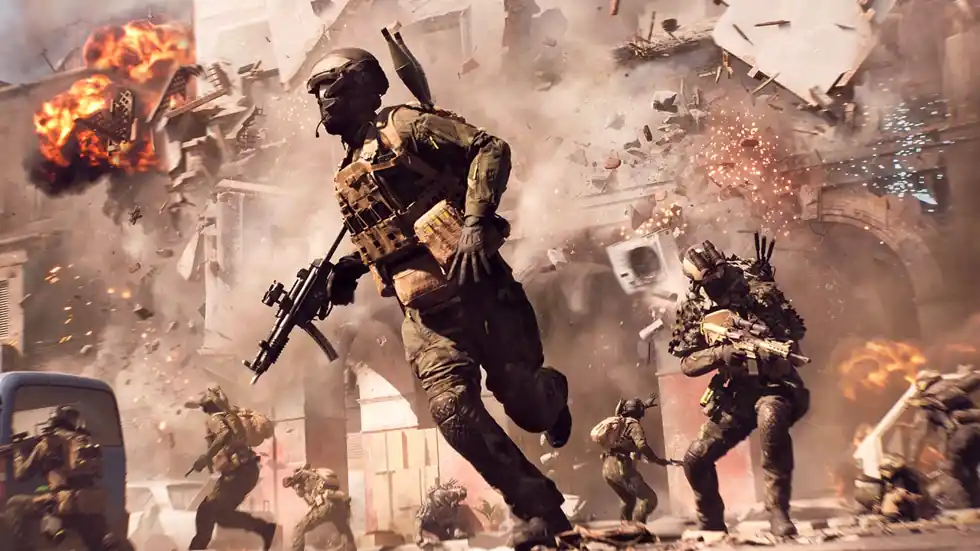
How does Battlefield 6 reposition the franchise after years of experimentation? By refining its core pillars—class identity, vehicle warfare, and environmental destruction—while recalibrating the scale that defined its past.
Following the uneven reception of Battlefield 2042, expectations around the next installment in EA and DICE’s long-running military shooter franchise were shaped as much by caution as by anticipation. Earlier titles such as Battlefield 1 and Battlefield V had leaned into historical settings with varying degrees of commercial and critical success, while 2042’s near-future pivot introduced large-scale 128-player matches and a controversial Specialist system that diluted traditional class roles.
Battlefield 6 represents a strategic correction. Rather than pursuing maximal scale or systemic reinvention, it focuses on layered combat: infantry engagements, armored warfare, and aerial dominance operating simultaneously within the same battlespace. The result suggests a franchise recalibrating toward its structural strengths rather than chasing novelty.

The central analytical question is whether this layered design meaningfully enhances tactical depth—or whether it simply repackages familiar mechanics with improved production values. The answer lies in how these systems interact.
Reasserting the Infantry Core
At the foundation is infantry combat. Moment-to-moment gunplay functions as the anchor of the experience, with weapons calibrated to reward mechanical precision without alienating less experienced players. Modest recoil patterns and bullet drop mechanics encourage deliberate shooting, but they stop short of demanding hyper-specialized skill.
This balance matters. In prior entries, particularly 2042, the expansion of player counts sometimes diffused combat clarity. By contrast, Battlefield 6’s standard 64-player Conquest and Breakthrough modes re-center infantry engagements within readable frontlines. The scale remains expansive, but it avoids the overcrowded chaos that characterized 128-player matches.
The sound design and environmental feedback reinforce immersion. Bullet impacts chip away at surfaces, debris accumulates, and cover deteriorates dynamically. These aesthetic elements are not merely decorative; they subtly affect sightlines and survivability. In this respect, Battlefield 6 suggests a return to the systemic destructibility that once distinguished the series from competitors such as Call of Duty.
Yet the infantry layer is not without tension. Class boundaries, while restored compared to 2042’s Specialist system, are partially softened by flexible loadouts. Any class can equip any primary weapon, reducing the friction between archetypes. Although bonuses exist for class-aligned weapons—Recon units handling sniper rifles more effectively, for example—the incentives are modest.
■ Related News




This design signals a philosophical compromise: encouraging player freedom while retaining role-based utility. Engineers remain necessary for vehicle repairs; Medics sustain team longevity. But the porous weapon system suggests an ongoing negotiation between identity and customization.
Progression as Structural Friction
If the core combat loop is refined, progression pacing introduces friction. Unlocking advanced equipment, including tactical tools such as deployable spawn beacons, requires extended playtime and level thresholds. Class-specific specialization paths remain inaccessible until higher ranks.
From a systems perspective, this structure serves retention logic common in modern multiplayer design. However, it also delays access to the deeper strategic options that define Battlefield’s sandbox. Early matches emphasize basic gunplay before the broader tactical toolkit becomes available.
The effect is cumulative. While experienced players may tolerate the progression curve, newcomers encounter a narrower version of the game during their first dozens of hours. The broader question is whether gated depth enhances long-term engagement at the expense of early dynamism. Battlefield 6 does not fully resolve that trade-off.
Vehicles as Strategic Catalysts
Where the game most clearly distinguishes itself is in its vehicle integration. Tanks and armored vehicles operate not merely as powerful tools but as focal points that reshape entire engagements.
A tank advancing down an urban corridor forces recalibration. Infantry must seek cover, Engineers become essential, and aerial threats gain relevance. The presence of armor introduces asymmetry—temporary dominance balanced by vulnerability to coordinated counters.
Importantly, vehicles are accessible but not trivial to master. Effective tank operation requires situational awareness, timing defensive measures, and coordination with support players. This skill ceiling reinforces the layered model: dominance in one layer depends on interaction with others.
Such interplay underscores a longstanding Battlefield principle: no single role should remain unchallenged. Tanks may command streets, but air power can neutralize them; infantry with rockets can ambush them; engineers can sustain them. The design’s coherence rests on this cyclical balance.
The Air Layer and Skill Barriers
Aerial combat represents the most demanding layer. Jets and helicopters offer outsized influence, capable of strafing ground forces and contesting air superiority. Mastery requires familiarity with complex controls and spatial awareness.
However, the absence of a dedicated training environment for pilots introduces a structural barrier. While a firing range exists for weapon testing, comparable tools for learning flight mechanics are limited. This asymmetry potentially narrows the pool of effective pilots, concentrating air dominance among experienced players.
From a design perspective, the tension is clear: high-impact roles benefit from high skill ceilings, but accessibility shapes ecosystem health. If fewer players engage with the air layer, its balance dynamics may skew.
Modes and Map Ecology
Battlefield 6’s mode selection reflects conservative refinement. Conquest and Breakthrough return as central pillars, preserving the tug-of-war territorial dynamics that have defined the franchise for two decades. Smaller modes, including Rush and the new Escalation variant, provide shorter session alternatives and shifting objective structures.
Map design further illustrates the layered thesis. Urban environments such as New Sobek City combine tight infantry corridors with destructible infrastructure, while larger spaces emphasize vehicle mobility. Learning vertical sightlines and structural weaknesses becomes a tactical advantage.
Yet map balance varies. Certain environments have developed reputations for sniper overconcentration, particularly in elevated or sparsely covered terrain. When long-range dominance overshadows class interplay, the intended equilibrium falters.
Similarly, dense anti-vehicle mine placement in some maps can neutralize armor too quickly, undermining the very layer meant to diversify combat. These issues do not invalidate the design philosophy but highlight how delicate systemic balance remains at scale.
Destruction as Strategic Variable
Destructibility is more than spectacle. Entire buildings can collapse under sustained fire or tank bombardment, permanently altering defensive positions. Cover is temporary; choke points can be erased; sightlines evolve mid-match.
This dynamism differentiates Battlefield from more static competitors. While other shooters rely on fixed architecture, Battlefield’s mutable terrain introduces uncertainty. The battlefield is not simply contested; it is reshaped.
However, destruction also raises performance and clarity considerations. Excessive debris can obscure visibility, and large-scale collapses may temporarily overwhelm situational awareness. The challenge lies in balancing spectacle with readability.
A Franchise Recalibration
In comparative terms, Battlefield 6 appears less interested in radical innovation than in systemic coherence. Where 2042 experimented with player count expansion and hero-style Specialists, the new entry re-centers class identity, scale management, and environmental interactivity.
This recalibration reflects broader industry patterns. Large multiplayer franchises increasingly oscillate between expansion and consolidation. Battlefield 6 suggests that consolidation—refining what historically worked—may offer more durable engagement than experimental overreach.
Whether this strategy secures long-term relevance depends on post-launch support, balance updates, and content cadence. But at launch, the structural integrity of its layered warfare indicates a franchise rediscovering its design logic.
Rather than redefining the genre, Battlefield 6 strengthens its niche within it. The infantry, vehicle, and air layers do not compete for attention; they intersect, creating moments of emergent complexity that remain uncommon at this scale.
The result points less to reinvention than to recalibration—a recognition that Battlefield’s distinctive value lies not in novelty alone, but in the interplay of systems operating simultaneously across land, sky, and rubble-strewn streets.
Source: IGN – Untitled Battlefield Game – Review