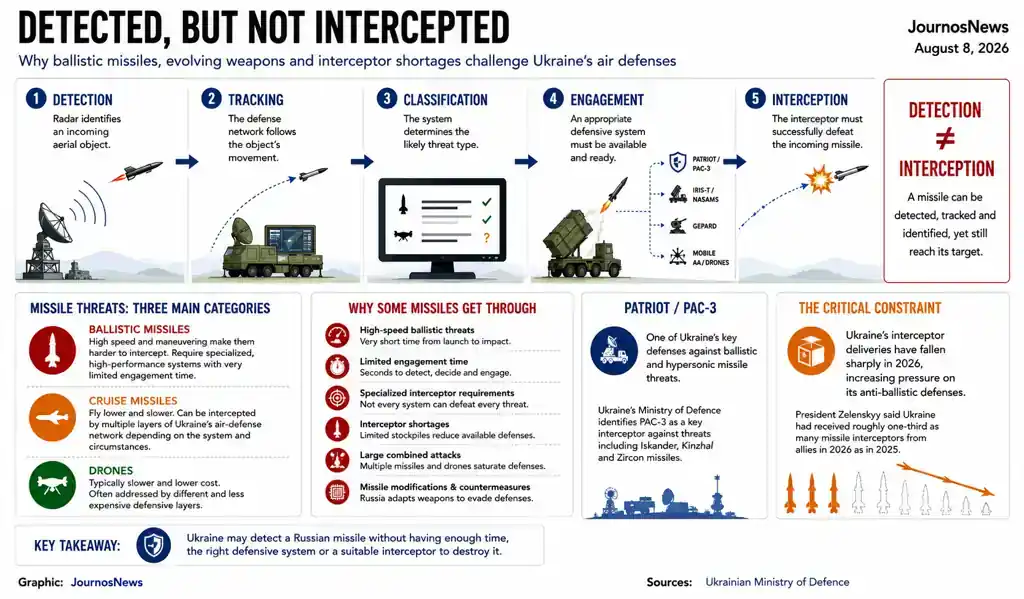
Ukraine has built a layered air-defense network capable of detecting and destroying large numbers of Russian drones and missiles. Yet some of the most dangerous Russian weapons continue to reach their targets even after they are detected. The gap lies between seeing an incoming weapon and having the right system, time and interceptor available to stop it.
The question is not simply whether Ukraine can see a Russian missile coming.
Increasingly, the more important question is whether its air-defense network has the right combination of technology and available interceptors to destroy that missile before it reaches its target.

That distinction has become increasingly important as Russia has expanded its use of ballistic missiles and continued modifying some cruise missiles to complicate Ukrainian defenses. Ukraine’s air-defense forces have demonstrated high interception rates against many categories of Russian aerial weapons, but ballistic missiles remain among the most difficult threats to defeat. Ukrainian officials say the shortage of specialized interceptors has become a major constraint.
The problem is therefore not accurately described as Russian missiles simply “passing” Ukrainian radar.
A missile can be detected, tracked and identified as a threat and still reach its target.
Air defense is a chain of processes. Detection is the beginning of that chain, not the end.
Detection Is Only the First Step
Modern air-defense networks rely on radar and other sensors to identify objects approaching protected areas. Ukraine operates a mixture of systems supplied by its own defense industry and international partners.
■ Related News



The Swedish Giraffe radar family, for example, is among the systems integrated into Ukraine’s broader air-defense architecture. Ukraine’s Ministry of Defence describes radar as a critical component because it provides the information necessary to detect hostile aerial targets in time.
But radar detection does not automatically mean that a missile can be destroyed.
Once an aerial object is detected, the defense network must determine what kind of threat it represents and which available defensive system is capable of engaging it. The network then has to coordinate the engagement and, if an interceptor is launched, achieve a successful interception.
That creates several potential points of failure.
A system may detect a threat but lack a suitable interceptor. An interceptor may be available but not designed for that particular class of missile. A target may be moving on a trajectory that leaves defenders with very little time to respond. Or multiple incoming weapons may place more demands on the defensive network than the available interceptors can handle.
This is why an interception percentage cannot be interpreted simply as a measure of whether Ukrainian radar is working.
It is a measure of how effectively the entire defensive chain is functioning against a particular attack.
Ballistic Missiles Create a Different Problem
The greatest challenge comes from ballistic and aeroballistic missiles.
Ukraine’s president, Volodymyr Zelenskyy, has repeatedly identified ballistic missiles as a priority for additional air-defense support, saying they are objectively harder to intercept.
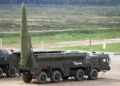
Ukraine’s Ministry of Defence identifies Patriot systems equipped with PAC-3 interceptors as a key capability against ballistic and hypersonic threats, including Russian Iskander, Kinzhal and Zircon missiles.
This distinction matters because Ukraine does not rely on a single air-defense system for every threat.
Different systems are designed for different combinations of range, altitude and target type. Some are particularly useful against aircraft and cruise missiles, while specialized systems are needed for harder ballistic threats.
The result is a layered network rather than a universal shield.
When a cruise missile enters an area covered by an appropriate system, Ukraine can sometimes achieve very high interception rates. The country’s Defence Ministry reported that its air defenses intercepted about 88% of Kh-101, Kh-55 and Kh-555 cruise missiles launched during the first part of 2026.
The same network can face a very different problem when confronted by a concentrated attack involving ballistic missiles.
Speed Shrinks the Margin for Error
One of the basic difficulties of ballistic-missile defense is time.
A missile traveling at very high speed gives defenders a smaller window between detection and impact. That places greater demands on the radar network, command system and interceptor.
This does not mean that a ballistic missile is necessarily invisible or impossible to track.
The problem is that a successful track must be converted into a successful engagement within a limited period.
That requires an interceptor capable of reaching the target and a defensive system positioned and supplied well enough to conduct the engagement.
The Patriot’s PAC-3 interceptor was specifically developed for missile-defense missions and uses hit-to-kill technology. Ukraine has relied heavily on Patriot systems for some of the most difficult Russian missile threats. Reuters reported in August that Ukraine had used Patriots extensively against Russian ballistic missiles, including a hypersonic missile.
The technology therefore exists.
The difficulty is availability.
The Interceptor Shortage Is Becoming Central
Ukraine’s recent battlefield experience has demonstrated the difference between having a capable system and having enough interceptors to use it consistently.
Reuters reported on August 5 that Ukraine had received only about one-third as many missile interceptors from allies in 2026 as it received in 2025, according to Zelenskyy. The shortage has been particularly serious for Patriot systems, which Ukraine depends on for protection against ballistic threats.
That shortage can have an immediate effect on the outcome of a Russian attack.
On July 31, Reuters reported that Russia launched an attack involving 35 missiles, including 27 ballistic missiles. Ukrainian officials said only one ballistic missile was intercepted, while hundreds of drones were also involved in the attack.
On August 4, another major attack demonstrated the same vulnerability. Reuters reported that Russia launched 24 ballistic missiles and four Zircon cruise missiles during an attack on Kyiv and the surrounding region. None of those missiles were intercepted, according to Ukrainian officials, while Ukraine shot down the overwhelming majority of the drones used in the same attack.
The contrast is revealing.
Ukraine’s defenses can remain highly effective against one class of threat while struggling against another.
That does not indicate that radar has failed.
It indicates that the defensive network lacks sufficient specialized capacity for some of the most difficult targets.
Russia Is Also Changing Its Missiles
The problem is not static.
Russia has continued modifying its missile systems, forcing Ukrainian defenses to respond to changing characteristics.
Ukraine’s Ministry of Defence said in May that Russian Kh-101 cruise missiles had undergone four major modernization stages since the full-scale invasion. Ukrainian specialists identified changes involving the missile’s warhead configuration, navigation system and a self-protection suite that the ministry says includes an active jamming function and passive decoys.
These modifications illustrate a broader pattern in modern air warfare.
An air-defense system is not confronting a fixed weapon.
The attacker can modify navigation, electronic protection and other characteristics, while the defender has to adapt detection, tracking and interception capabilities in response.
This creates a continuing competition between offense and defense.
It is also why claims that a particular missile is simply “unstoppable” should be treated carefully.
The performance of a missile-defense system can change depending on the weapon, the attack configuration, the number of simultaneous targets, the available defensive systems and the supply of interceptors.
Saturation Changes the Equation
Large Russian attacks often combine different categories of aerial weapons.
Drones can be launched alongside cruise missiles and ballistic missiles, creating a more complicated defensive environment than a single incoming weapon would present.
Ukraine’s Defence Ministry reported that a May attack involved more than 1,500 drones and dozens of missiles over a period lasting more than 30 hours. The ministry described the use of multiple waves as an attempt to wear down Ukraine’s air defenses.
This is important because air-defense capacity is finite.
Every engagement consumes resources. Interceptors have to be manufactured, transported and positioned. Radar and command systems must remain operational. Crews and equipment must be available.
A large attack can therefore create a resource problem even when individual defensive systems are highly capable.
The objective from the attacker’s perspective is not necessarily to make every weapon invisible.
It can be enough to create more incoming threats than defenders can economically and operationally engage.
Why Cruise Missiles Are Different
The distinction between cruise and ballistic missiles helps explain why Ukraine’s reported interception rates can vary so dramatically.
Ukraine’s Defence Ministry said that during May, its forces intercepted more than half of the ballistic and cruise missiles launched during large-scale attacks, while achieving much higher rates against some individual categories. It reported interceptions of Kh-101 cruise missiles, Iskander-M and KN-23 ballistic missiles, Kalibr missiles and other weapons.
Cruise missiles and ballistic missiles present different defensive challenges.
A cruise missile generally flies through the atmosphere toward its target rather than following the characteristic high-speed trajectory of a ballistic weapon. Its route and speed characteristics can make it vulnerable to different defensive systems.
That does not mean cruise missiles are easy targets.
Russia has repeatedly modified systems such as the Kh-101, including changes intended to improve navigation and survivability against air defenses.
But Ukraine’s experience shows that the country can achieve relatively high interception rates against some cruise-missile categories when sufficient defensive capabilities are available.
The most serious weakness has emerged around the weapons that require specialized anti-ballistic defenses.
Patriot Has Become a Critical Layer
Patriot has become central to Ukraine’s ability to defend against the most difficult Russian missiles.
Ukraine’s Ministry of Defence describes PAC-3 as a key interceptor for ballistic and hypersonic threats. Germany has supplied additional PAC-3 missiles to Ukraine, while Kyiv has repeatedly asked partners to accelerate further deliveries.
The importance of Patriot creates a vulnerability of its own.
If Ukraine has too few Patriot systems or too few suitable interceptors, the country’s ability to defend against the most demanding threats is constrained regardless of how effective its other air-defense layers may be.
This is why recent Ukrainian requests have focused not only on additional radar or general air-defense systems, but specifically on anti-ballistic capabilities and interceptor supplies.
Reuters reported that Ukraine’s interceptor deliveries have fallen sharply in 2026 while other global conflicts have also consumed interceptor inventories. The United States has been working to expand production of Patriot and other missile-defense components, reflecting shortages that extend beyond Ukraine.
The problem is therefore partly technological and partly industrial.
A missile defense system cannot protect a city with interceptors that do not exist.
The Industrial Bottleneck Behind the Battlefield Problem
Missile defense is an industrial system as much as a military one.
Advanced interceptors require specialized components, production capacity and testing. Replacing them is not as simple as replacing conventional ammunition.
Reuters reported in August that the United States had signed agreements worth more than $3 billion to expand production of components for Patriot and THAAD interceptors. The arrangements are intended to substantially increase production capacity as global demand rises.
The pressure is being felt internationally.
The same Reuters reporting noted that interceptor inventories have been depleted by the demands of multiple conflicts. Ukraine is therefore competing within a global market for a limited class of highly sophisticated weapons.
That helps explain why battlefield requirements and industrial output are increasingly linked.
Ukraine can identify a vulnerability in its air-defense network, but fixing that vulnerability may depend on production schedules established months or years earlier.
What “Detected but Not Intercepted” Really Means
The phrase can sound contradictory.
If radar detected the missile, why was it not destroyed?
The answer is that detection and interception are separate capabilities.
Consider the simplified sequence:
Detection → Tracking → Classification → Engagement → Interception
A failure at any later stage can result in the missile reaching its target.
Detection tells defenders that an object is present.
Tracking provides information about its movement.
Classification helps determine what kind of threat it may represent.
Engagement requires a suitable defensive system and an available interceptor.
Interception requires the defensive weapon to successfully defeat the incoming missile.
A radar can therefore perform its job correctly while the overall air-defense system still fails to stop the weapon.
This distinction is essential for understanding recent Russian attacks on Ukraine.
It also explains why improving radar coverage alone cannot solve the entire problem.
Ukraine Is Trying to Expand the Defensive Architecture
Ukraine’s response has increasingly focused on both obtaining more foreign systems and developing additional domestic capabilities.
The country and its partners are working on additional radar and missile-defense technologies. In August, Reuters reported that Ukrainian defense manufacturer Fire Point had begun integrating European technology into its Freyja missile-defense project, with the stated goal of developing a lower-cost interceptor capable of addressing Russian ballistic threats. The project involves European companies providing technologies including radar, seeker and command-system components.
The significance of such efforts extends beyond a single weapon.
Ukraine needs a broader system in which expensive high-end interceptors can be reserved for the threats that genuinely require them, while other threats are addressed by other layers.
That is an engineering and economic challenge as much as a military one.
The Defense Problem Is Also a Supply Problem
The recent attacks show that Ukraine’s vulnerability cannot be explained solely by Russian missile technology.
Supply constraints matter.
Ukraine has demonstrated that when the appropriate capabilities are available, its air defenses can achieve substantial interception rates. Zelenskyy said in July that Ukrainian forces had intercepted all six Kalibr missiles and 31 of 33 cruise missiles during one large attack, while also intercepting a high percentage of drones.
The same statement illustrates the central issue: performance depends heavily on the type of threat and the capabilities available to counter it.
A country can have an effective air-defense network and still experience devastating attacks when the attacker concentrates weapons against a defensive layer that is scarce.
This is why the current debate around Ukraine’s air defense increasingly centers on interceptor stocks.
The Broader Strategic Problem
Russia’s continued reliance on ballistic missiles creates a difficult strategic calculation for Ukraine and its allies.
The more frequently Russia uses ballistic weapons, the greater the demand for specialized interceptors.
But these interceptors are among the most expensive and technically demanding elements of the air-defense network.
Ukraine therefore faces a difficult balance: protect major population centers and critical infrastructure against the hardest threats while maintaining enough defensive capacity to deal with drones, cruise missiles and other weapons.
The answer cannot be unlimited interceptor production alone.
A sustainable defense architecture requires multiple layers, better early warning, appropriate systems for different threats and sufficient stocks of the weapons required at each layer.
It also requires continued adaptation as Russia modifies its missile systems.
What Remains Unresolved
The central unanswered question is how quickly Ukraine and its partners can expand anti-ballistic defense capacity.
The immediate shortage of Patriot interceptors is already affecting Ukraine’s ability to counter some Russian missile attacks. Kyiv has requested additional systems and has also sought greater involvement in domestic production.
At the same time, Russia continues developing and modifying its missile arsenal.
That creates a moving target for Ukraine’s defense planners.
Even if additional interceptors become available, Russia can alter attack patterns, combine different weapons and continue improving missile survivability.
The defense therefore cannot be measured by whether Ukraine intercepts every incoming weapon.
No air-defense network can guarantee that outcome.
The more meaningful question is whether Ukraine can maintain a sufficiently layered system to reduce the number of weapons that reach their targets while preserving enough specialized capability for the most dangerous threats.
The Difference Between Seeing the Threat and Stopping It
Russian missiles do not necessarily reach Ukrainian targets because Ukrainian air defenses failed to detect them.
In many cases, the problem occurs after detection.
A missile can be tracked but require an interceptor Ukraine does not have available. It can belong to a category that demands a specialized defensive system. It can arrive as part of a large attack that places pressure on limited stocks. Or the weapon itself may have been modified to make the defensive task more difficult.
The result is a fundamental reality of modern air warfare: seeing an incoming missile is only the beginning of the problem.
Ukraine has demonstrated that its layered defenses can destroy large numbers of Russian drones and many cruise missiles. But its most difficult challenge remains the combination of ballistic threats, limited specialized interceptors and Russia’s continuing adaptation of its strike arsenal.
That is why the future of Ukraine’s air defense will depend on more than additional radar coverage.
It will depend on whether Ukraine can obtain, produce and sustain enough of the right interceptors for the threats it faces — while continuing to build a layered system capable of responding to an increasingly diverse Russian missile campaign.
For civilians under the flight path, the distinction between detection and interception is ultimately stark.
A warning can tell people that a missile is coming.
Only an effective defense can stop it.