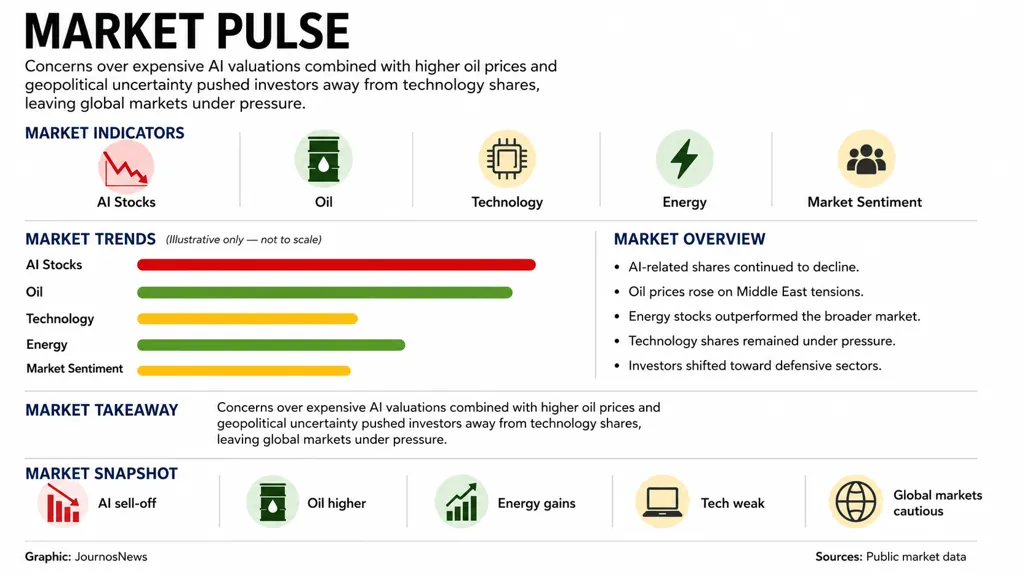
NEW YORK — Global stock markets fell sharply Friday as another wave of selling in artificial intelligence-related companies combined with rising oil prices to pressure investors, sending major U.S. indexes lower and extending recent volatility across financial markets.
The sell-off reflected two of Wall Street’s biggest concerns: growing doubts over lofty AI valuations and renewed fears that higher energy prices could reignite inflation after the United States expanded military operations against Iran.
The S&P 500 fell 1% to close at 7,457.69, marking its first weekly decline in three weeks and only its third weekly loss since late March. The Dow Jones Industrial Average dropped 406.55 points, or 0.8%, to 52,146.42, while the technology-heavy Nasdaq Composite slid 1.4% to 25,520.24.

AI Stocks Extend Recent Declines
Technology shares once again led the market lower as investors continued reassessing the outlook for companies that have fueled the artificial intelligence boom.
Nvidia fell 2.2%, briefly surrendering its position as the world’s most valuable publicly traded company to Apple before recovering by the closing bell.
The weakness spread across the semiconductor sector.
Applied Materials declined 5.6%, trimming its gains for the year to 106%, while Micron Technology fluctuated between gains and losses before ending the session down 0.5%.
Investor sentiment also weakened following news surrounding Chinese startup Moonshot’s Kimi K3 artificial intelligence model. The announcement revived concerns that lower-cost AI alternatives could reduce future demand for premium processors and memory chips produced by established semiconductor companies.




Global Technology Shares Retreat
The selling extended well beyond Wall Street.
Taiwan’s benchmark stock index dropped 6.5%, Japan’s market fell 4%, and China’s Shanghai Composite declined 3% as investors sold technology shares across the region.
Taiwan Semiconductor Manufacturing Co., the world’s largest contract chipmaker, fell 7.3%.
South Korea’s financial markets were closed for a public holiday after the technology-heavy Kospi index experienced sharp swings earlier in the week.
European markets also finished lower, although losses were more modest because technology companies account for a smaller share of regional indexes.
Corporate Earnings Add Pressure
Several high-profile earnings reports also weighed on investor sentiment.
Netflix shares fell 7.3% after quarterly revenue narrowly missed Wall Street expectations despite stronger-than-expected earnings. The company’s revenue and profit guidance for the current quarter also disappointed investors.
Medical technology company Intuitive Surgical dropped 14.1% even after reporting quarterly earnings above analysts’ forecasts. Investors instead focused on concerns that procedure growth could slow as enhanced tax credits that lowered health insurance costs for many Affordable Care Act enrollees expire.
SpaceX shares declined 5.4%, extending losses since the company’s Nasdaq debut just over a month ago.
Investors also reacted to the cancellation of a Starship test flight shortly before liftoff on Thursday, while broader weakness in AI-related investments continued to weigh on companies linked to Elon Musk’s expanding artificial intelligence business.
Oil Rally Revives Inflation Fears
Energy markets added another layer of uncertainty.
Brent crude, the international benchmark, climbed 4.6% to settle at $88.10 per barrel after trading near $76 only a week earlier.
Oil prices rose after the United States expanded airstrikes against Iran, targeting additional infrastructure near the Strait of Hormuz. The escalation renewed concerns that disruptions to one of the world’s busiest oil shipping routes could tighten global supplies.
Higher energy prices have pushed government bond yields higher in recent weeks, increasing borrowing costs for consumers and businesses. Rising fuel prices have also renewed concerns that inflation could remain elevated, complicating future interest rate decisions by the Federal Reserve.
Even so, Treasury yields eased modestly Friday. The yield on the benchmark 10-year Treasury note slipped to 4.55% from 4.57% the previous day.
Consumer Confidence Shows Signs of Improvement
Investors received one encouraging signal from fresh economic data.
A new survey showed U.S. consumer sentiment improved by more than economists had expected while households’ inflation expectations eased.
Those expectations remain closely watched by Federal Reserve officials because they can influence consumer spending, wage demands and business pricing decisions. Stable inflation expectations may reduce pressure on policymakers as they consider the future path of interest rates.
Although markets ended the week under pressure, investors continue balancing resilient consumer spending and economic growth against concerns over expensive AI valuations, rising energy costs and escalating geopolitical tensions in the Middle East.
This report is based on reporting by The Associated Press.
Article Topics: Artificial Intelligence | Stock Markets | Nvidia | Oil Prices | Wall Street | Semiconductors | Inflation | Federal Reserve