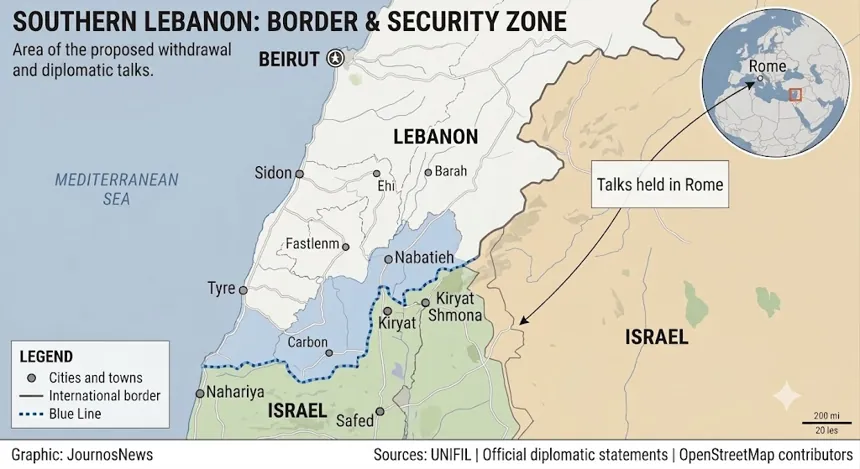
BEIRUT, Lebanon – Lebanon and Israel moved closer Wednesday to implementing a key stage of their withdrawal agreement after two days of U.S.-mediated negotiations in Rome produced a framework for pilot zones in southern Lebanon where Israeli forces would transfer control to the Lebanese army.
The U.S. State Department said Wednesday that the discussions were “productive” and that both sides agreed on the structure and guidelines for the pilot zone process, with final details expected to be with final details expected to be completed in the coming days before the plan is put into effect in the coming days. If successful, the initiative could revive efforts to reduce tensions along the Israel-Lebanon border and lay the groundwork for broader negotiations between the two countries.
Neither the Lebanese nor Israeli governments immediately commented publicly on the outcome of the talks.

Pilot Zones Mark First Step
The pilot zones form the first phase of a framework agreement announced by Lebanon and Israel on June 26. The agreement calls for Israeli forces to withdraw from designated areas while the Lebanese army assumes control and removes any Hezbollah presence., Israeli forces would withdraw from designated areas in southern Lebanon while the Lebanese army assumes control and removes any Hezbollah presence.
The agreement also outlines steps toward a broader peace process between the neighboring countries, which have technically remained in a state of war since Israel’s establishment nearly 80 years ago.
Implementation had stalled before this week’s negotiations. Ahead of the Rome talks, Lebanese President Joseph Aoun said the country’s delegation had been instructed to seek the immediate withdrawal of Israeli forces from the proposed pilot zones before discussing additional measures.
Although the State Department did not identify the locations on Wednesday, Lebanese and Israeli officials had previously indicated the pilot areas would include the towns of Froun, Ghandouriyeh and Zawtar.
The proposed zones have drawn criticism inside Lebanon because Israeli forces were reportedly absent from much of the selected territory.


Critics have questioned how a withdrawal would be implemented. The Lebanese army had instead advocated larger pilot areas that included more territory currently occupied by Israeli forces.
Ceasefire faces continued political and military obstacles
The State Department said successful implementation of the pilot zones would be followed by broader technical negotiations aimed at reaching a comprehensive agreement., implementation of the pilot zones would be followed by expanded technical negotiations aimed at reaching a comprehensive agreement between Israel and Lebanon.
The current conflict began after Hezbollah launched rockets into Israel several days after Israel and the United States began military operations against Iran on Feb. 28. Israel subsequently invaded southern Lebanon and continues to occupy a significant portion of the area.
The Lebanese government has sought to separate negotiations with Israel from broader U.S.-Iran diplomacy as it attempts to reduce Iran’s influence over Lebanese affairs. Hezbollah and Iran, by contrast, have sought to link any settlement in Lebanon to wider negotiations involving Tehran and Washington.
Hezbollah has rejected the agreement, saying it does not intend to disarm or abide by its provisions. Israeli officials have also stated publicly that they expect to maintain an extended military presence in southern Lebanon.
Trump calls for Israeli redeployment
U.S. President Donald In an interview with Fox News that aired Wednesday, Trump said he would like, that he would like to see Israeli forces withdraw or redeploy from parts of southern Lebanon and southern Syria.
“Southern Syria and from parts of Lebanon, yeah, it would be good to get out, I think, and I think you might see things get a little bit calmer,” Trump said. “We have to focus our energy on the big leagues. The big leagues are Iran.”
Trump also repeated his proposal that Syrian President Ahmad al-Sharaa deploy Syrian forces into Lebanon to confront Hezbollah, arguing that al-Sharaa “would be more precise” than Israel.
Al-Sharaa has previously stated publicly that Syria intends to remain outside the regional conflict and Al-Sharaa has repeatedly said Syria intends to remain outside the regional conflict and has no plans to intervene militarily in Lebanon, underscoring the competing visions among regional leaders as negotiations continue. to intervene militarily in Lebanon.
This report is based on reporting by The Associated Press.
Article Topics: Lebanon | Israel | Hezbollah | United States | Border Security | Middle East Diplomacy | Ceasefire