DUBAI, United Arab Emirates – The United States launched a new wave of strikes against Iran early Tuesday after President Donald Trump announced that Washington would reinstate a blockade on Iran in the Strait of Hormuz, escalating a conflict that is increasingly threatening one of the world’s busiest maritime trade routes.
Hours later, Iran retaliated by attacking Bahrain and two tankers linked to the United Arab Emirates as they transited the Strait of Hormuz. Emirati officials said one mariner was killed and eight others were injured, raising concerns that another Gulf state could be drawn directly into the conflict.
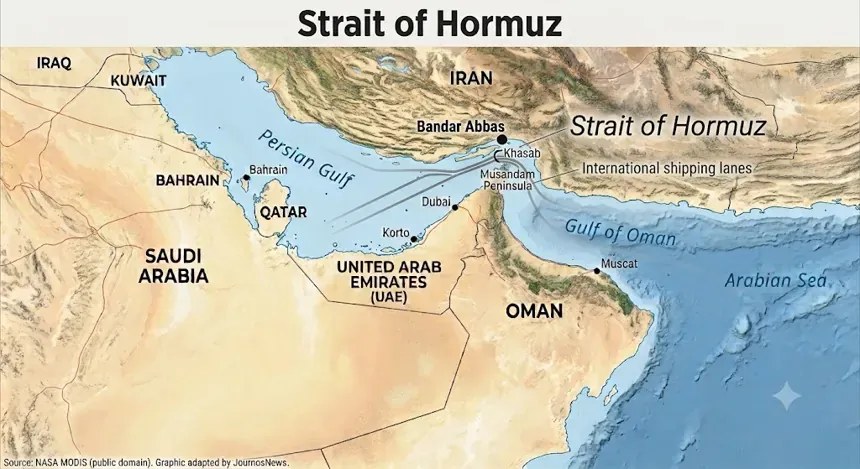
The renewed fighting comes as Washington and Tehran compete for control of the strategic waterway, through which roughly one-fifth of the world’s crude oil and natural gas shipments moved before the conflict. Markets reacted quickly, with Brent crude rising above $84 a barrel in early Tuesday trading amid concerns over global energy supplies.

U.S. Expands Military Campaign
U.S. Central Command said American forces struck targets near Abu Musa, Bandar Abbas, Bushehr, Chabahar, Jask and Konarak.
According to the military, the operation targeted Iranian coastal defense systems, missile and drone facilities, and maritime assets.
Iran confirmed strikes had occurred around those locations but did not immediately report casualties or provide details on the extent of the damage.
Central Command said the operation was intended to reduce Iran’s ability to attack commercial shipping and civilians operating in the Strait of Hormuz.
Speaking at the White House, Trump described the operation as “another major attack.” He said U.S. forces were “hitting them very hard” and warned that the campaign would continue.
■ Related News




The president also announced that the United States would restore the maritime blockade after temporarily lifting it under last month’s interim peace agreement.
Trump added that his administration plans to recover the cost of maritime security operations by charging vessels that transit the strait. He argued that the United States should be compensated for protecting international shipping.
The proposal represents a major shift from longstanding U.S. policy supporting unrestricted freedom of navigation through international waterways. Before fighting escalated following U.S. and Israeli strikes on Iran on Feb. 28, commercial traffic moved through the strait without tolls. Any effort by Washington or Tehran to impose transit fees would challenge established maritime practice and could further increase regional tensions.
Iran Targets Tankers and Bahrain
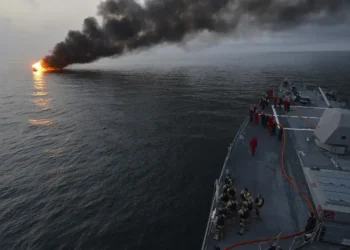
The United Arab Emirates’ Defense Ministry said Iran fired two cruise missiles at the tankers Mombasa and Al Bahiyah while they were transiting the Strait of Hormuz.
Both vessels caught fire after the strikes, although authorities said firefighters later brought the blazes under control.
Iran’s Islamic Revolutionary Guard Corps claimed responsibility for the attack. It alleged the ships ignored repeated warnings and entered what it described as a minefield before they were targeted.
According to Emirati officials, one Indian national was killed. Six other Indian nationals and two Ukrainians were injured.
The ministry warned that the UAE “reserves its full right to respond to this escalation and to take all necessary measures to protect its territory, its citizens and residents.”
Officials noted that similar language preceded the UAE’s earlier entry into military operations against Iran. Fighter aircraft were also reported over Dubai on Tuesday morning.
Meanwhile, Bahrain came under renewed Iranian attack following the latest U.S. strikes. Authorities activated missile warning sirens twice and urged residents to seek shelter.
Officials had not reported casualties or damage by the time of publication.
The U.S. Embassy in Abu Dhabi and the U.S. Consulate in Dubai canceled consular appointments through Wednesday because of the deteriorating security situation.
Trump Defends Maritime Policy Shift
Earlier Monday, Trump told conservative radio host Hugh Hewitt that last month’s interim agreement had been a test of Iran’s intentions.
He said Tehran had failed that test and argued that agreements have little value if they are not honored.
Iran maintains that the interim agreement gives it authority to regulate shipping through the Strait of Hormuz and potentially collect transit fees. The United States rejects that interpretation.
According to The Associated Press, the United States military and the International Maritime Organization have worked to establish an alternative shipping corridor closer to Oman’s coastline. Iran has repeatedly attacked vessels using that route, accusing Washington of violating the interim agreement. In turn, U.S. military operations have prompted additional Iranian attacks against Gulf allies.
Maritime Tensions Deepen
The latest military exchanges have further weakened the interim agreement reached last month, under which both sides committed to reopening the Strait of Hormuz after Washington suspended an earlier blockade.
In a social media post, Trump announced that the United States was “reinstating the Iranian blockade” while saying all other countries would continue to have access to the waterway.
He also said the United States would seek reimbursement equal to 20% of cargo values to cover maritime security costs.
Separately, the U.S. military said its blockade of Iranian ports would resume at midnight Wednesday local time in Dubai.
The Strait of Hormuz remains at the center of the expanding conflict. With military operations continuing and both sides signaling further action, uncertainty persists over commercial shipping, global energy markets and regional security.
This report is based on reporting by The Associated Press.
Article Topics: United States | Iran | Strait of Hormuz | Gulf Security | Maritime Trade | Bahrain | United Arab Emirates | Oil Markets