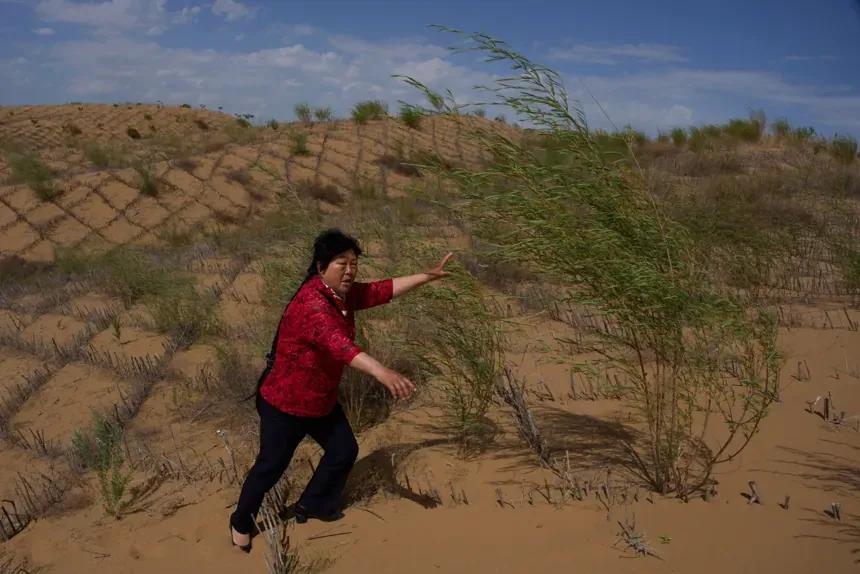
KUBUQI DESERT, China – China’s decades-long effort to halt the spread of deserts across its northern regions has produced measurable environmental gains, with scientists crediting sustained government investment and large-scale restoration while warning that preserving those achievements will require continued commitment for generations.
Since 1978, the Three-North Protective Forest Program—commonly known as the “Green Great Wall”—has sought to combat desertification by planting forests and stabilizing sand dunes across nearly half of China’s territory.
One of the project’s most recognizable techniques involves workers arranging forearm-length straw into crisscrossed checkerboard patterns across shifting sand before planting saplings at the center of each square. The method helps anchor dunes, reduce wind erosion and improve conditions for vegetation to take root with the aid of irrigation.

Decades of restoration show measurable progress
China’s campaign was launched after years of drought, overgrazing and excessive farming stripped vegetation from northern landscapes, leaving large areas vulnerable to expanding deserts and frequent sandstorms.
According to figures cited by Chinese state media, the country’s desertified land peaked around 2000 and has since shrunk by more than 1,000 square kilometers (about 400 square miles) annually.
The Chinese government says forests established through the program now cover a cumulative 500,000 square kilometers (approximately 200,000 square miles), transforming vast areas from landscapes where “desertification advanced and people retreated” into regions where vegetation has gradually reclaimed degraded land.
Barron Joseph Orr, chief scientist at the U.N. Convention to Combat Desertification, said the initiative demonstrates the importance of sustained political commitment.
“The broad significance of the Three-North Program is not only the scale of restoration, but the long-term political commitment behind it,” Orr told The Associated Press.




He said reversing desertification is achievable when environmental restoration becomes part of long-term national development strategies.
Scientists credit both planning and favorable weather
Zhu Jiaojun, a scientist at the Institute of Applied Ecology under the Chinese Academy of Sciences, said the progress reflects decades of coordinated planning, major public investment and the efforts of millions of workers.
He added that increased rainfall in some regions in recent years has also contributed to successful vegetation recovery.
“The achievement of desertification combat is due to people’s hard work and a bit of luck with climate,” Zhu said.
Long-term monitoring by Zhu’s research team indicates China’s desertified land has declined by roughly 10% since 2000, while areas classified as severely or extremely desertified have fallen by more than 40%.
Forest coverage across the program area increased from approximately 5% in 1978 to 14% by 2022.
Zhu estimated that more than 300 million rural laborers have participated in the restoration campaign over the decades, largely through paid, part-time work.
Workers witness transformation firsthand
Among those workers is 60-year-old Yin Yuzhen, who has spent four decades restoring land near the Mu Us Desert.
Speaking during a government-organized media tour of the Kubuqi Desert in Inner Mongolia, about 800 kilometers (500 miles) west of Beijing, Yin described how isolated the landscape once was.
“Even the passing of a bird across the sky made me happy,” she recalled.
She said blowing sand once reduced visibility to only a short distance.
“But now we can see the sun. We can see the green in the distance. We can see the road,” Yin said.
She and her husband continue tending trees each morning, repairing damaged straw checkerboards and replacing those worn by time. Their children and local volunteers occasionally join the work.
Long-term sustainability remains the next challenge
Despite the gains, researchers caution that restored dryland ecosystems still require careful monitoring and management.
Orr said restoration efforts are more likely to endure when communities receive economic benefits alongside environmental improvements.
The environmental organization Green Camel Bell, based in Gansu province, works with farmers and herders to restore vegetation while promoting livelihoods that support long-term conservation.
Founder Zhao Zhong said ecological restoration should not force communities to choose between environmental protection and economic development.
Orr agreed that restoration programs are significantly more successful when local residents benefit directly from them.
Zhu said one of the project’s biggest unanswered questions is whether restored ecosystems can remain healthy if government investment and human intervention eventually decline.
“This is what we are very concerned with and this is also the biggest challenge,” he said.
Yin said she hopes younger generations will continue the work.
“We need to teach young people to love this Earth. If we love it with all our hearts, nature will love us in return,” she said.
A Model With Global Implications
China’s program is among the world’s largest anti-desertification initiatives.
Elsewhere, African nations launched the Great Green Wall initiative in 2007, aiming to restore degraded landscapes across the Sahel and slow the southward expansion of the Sahara Desert through large-scale tree planting and land restoration.
Scientists say both projects highlight the importance of sustained investment, scientific planning and community participation in confronting land degradation driven by climate pressures and human activity.
This report is based on reporting by The Associated Press.
Article Topics: China | Environment | Desertification | Green Great Wall | Climate | Reforestation | Conservation | Asia