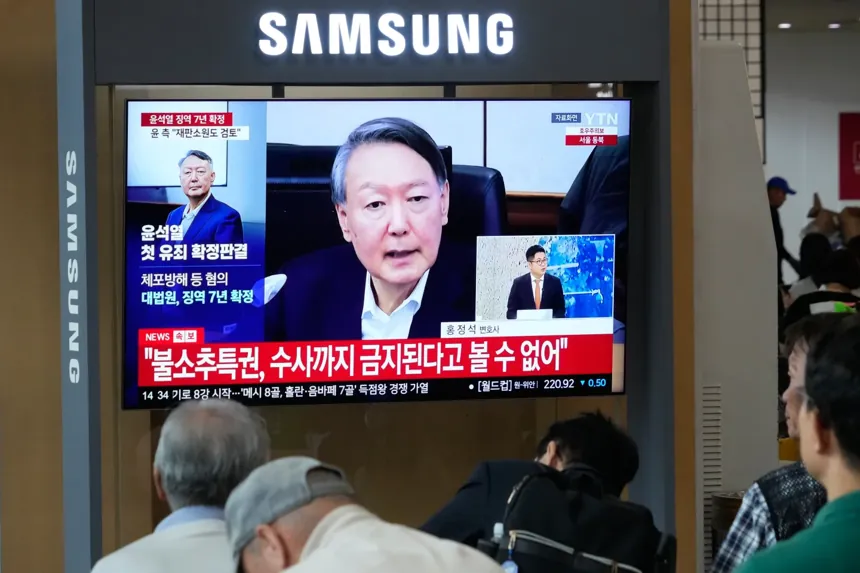
SEOUL, South Korea – South Korea’s Supreme Court on Thursday upheld a seven-year prison sentence for former President Yoon Suk Yeol, issuing the first final judgment among several criminal cases stemming from his brief declaration of martial law in December 2024.
The ruling affirmed an April decision by the Seoul High Court, which found Yoon guilty of violating Cabinet members’ right to deliberate before declaring martial law, falsifying the official proclamation to conceal procedural shortcomings, destroying the document afterward, and unlawfully deploying presidential security forces to resist law enforcement officers attempting to arrest him following his impeachment.
Yoon remains in detention and did not attend Thursday’s hearing. The Supreme Court’s decision is final, although the former president continues to face other criminal proceedings, including an appeal of a life sentence imposed in a separate rebellion case.

Court affirms procedural violations
The Supreme Court’s decision aligns with findings by South Korea’s Constitutional Court, which removed Yoon from office in April 2025 after concluding that his martial law declaration lacked legal justification and failed to comply with constitutional procedures.
According to court findings, Yoon summoned 11 Cabinet members shortly before announcing martial law in a late-night televised address on Dec. 3, 2024. Several participants, including then-Prime Minister Han Duck-soo, later testified that Yoon informed them of his decision rather than allowing meaningful deliberation.
The Seoul High Court also ruled that Yoon violated the rights of nine additional Cabinet members by either failing to notify them of the meeting or informing them too late to participate.
Martial law triggered political crisis
Yoon’s declaration of martial law lasted only a few hours before lawmakers entered the National Assembly despite blockades by heavily armed soldiers and police. Parliament voted to revoke the emergency order, forcing the Cabinet to lift martial law.
Although short-lived, the declaration plunged South Korea into one of its most significant political crises in decades, disrupting government operations, complicating high-level diplomacy and unsettling financial markets.
■ Related News

Political stability gradually returned after liberal candidate Lee Jae Myung won the snap presidential election held in June 2025.
Multiple criminal cases remain
Thursday’s ruling resolves only one of several criminal cases facing the former president.
Yoon has appealed a life sentence handed down after his conviction on rebellion charges, the most serious case arising from the martial law declaration.
He is also challenging a separate 30-year prison sentence in another case accusing him of ordering drone flights in 2024 to deliberately increase tensions with North Korea in an effort to create conditions that could justify imposing martial law domestically.
Yoon’s legal team has argued that the drone operations were intended as a response to North Korea’s campaign of sending thousands of trash-filled balloons across the border into South Korea.
Following Thursday’s ruling, Yoon’s lawyers expressed “deep regret” over the Supreme Court’s decision, arguing that the justices reached their conclusion without conducting a sufficiently thorough review of the case.
The ruling leaves the former president’s remaining appeals pending as South Korea continues to address the legal consequences of the country’s brief but unprecedented martial law crisis.
This report is based on reporting by The Associated Press.
Article Topics: South Korea | Yoon Suk Yeol | Supreme Court | Martial Law | Politics | Criminal Trial | Constitutional Court | Asia