NEW YORK – Global financial markets turned volatile on Wednesday after U.S. President Donald Trump cast doubt on the durability of the temporary ceasefire in the conflict involving Iran, sending oil prices higher and pushing stocks lower as investors weighed the risk of renewed disruptions to global energy supplies.
Wall Street recovered from steeper early losses as Trump later suggested that the latest fighting did not necessarily signal a return to full-scale war. Even so, the renewed uncertainty highlighted how developments in the Middle East continue to influence investor sentiment, inflation expectations and monetary policy outlooks.
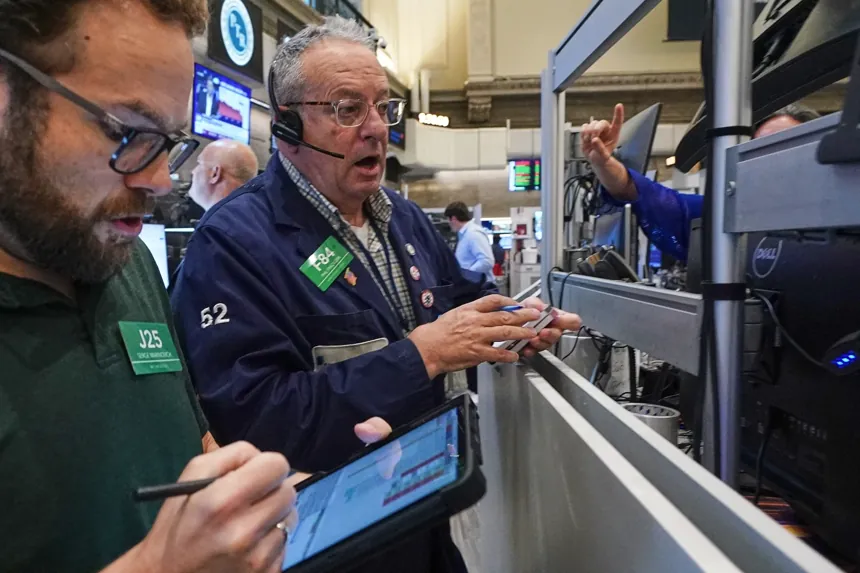
The benchmark S&P 500 closed down 21.14 points, or 0.3%, at 7,482.71 after falling as much as 1.1% during the session. The Dow Jones Industrial Average dropped 576.76 points, or 1.1%, to 52,348.39, while the Nasdaq Composite edged up 51.96 points, or 0.2%, to 25,870.65.

Oil market reacts to renewed geopolitical concerns
The sharpest market move occurred in energy trading, where Brent crude rose 5.2% to settle at $78.02 per barrel after briefly climbing above $80.
Although oil prices remain well below the nearly $120 peak reached earlier during the conflict, the rebound reversed much of the decline seen after hopes emerged that hostilities were easing.
Markets remain focused on the Strait of Hormuz, a critical shipping route for global crude exports. Investors fear that prolonged fighting could disrupt oil shipments from the Persian Gulf, tightening supplies and placing renewed upward pressure on energy costs.
Higher oil prices could complicate efforts to bring inflation lower, potentially forcing the Federal Reserve and other central banks to keep interest rates elevated for longer. While higher borrowing costs help contain inflation, they also tend to slow economic growth and weigh on financial markets.
Housing and travel stocks come under pressure
Rising Treasury yields added pressure to sectors sensitive to borrowing costs, particularly housing-related companies.



Builders FirstSource, a supplier of building materials including countertops and windows, fell 5.4%. Homebuilders PulteGroup also declined 5.4%, while D.R. Horton lost 4.6% as investors anticipated that higher mortgage rates could weaken housing demand.
Travel-related companies also retreated as rising fuel prices threatened to increase operating costs. American Airlines fell 4%, and cruise operator Carnival dropped 3.9%.
AI shares provide support for Wall Street
Technology stocks helped limit broader market losses after several leading artificial intelligence companies recovered from recent weakness.
The sector has faced increased scrutiny in recent weeks as investors questioned whether heavy spending on AI infrastructure, including chips and data centers, will generate sufficient long-term returns.
Nvidia climbed 3.7%, making it the strongest contributor to gains in the S&P 500 due to its large market value.
Broadcom advanced 4.8% after Apple announced a multiyear agreement under which Broadcom will design and manufacture custom components for the technology company’s products. Apple said the deal could exceed $30 billion in value.
Bond yields climb alongside oil prices
The bond market also reflected growing inflation concerns.
The yield on the benchmark 10-year U.S. Treasury briefly approached 4.60% before easing to 4.57%, compared with 4.55% late Tuesday. Before the conflict involving Iran began, the yield had stood at 3.97%.
Higher Treasury yields generally translate into increased borrowing costs for consumers and businesses, affecting mortgages, corporate financing and other forms of credit.
European and Asian markets post mixed performances
European equity markets declined sharply after Trump’s comments raised fresh doubts about the ceasefire.
Germany’s DAX index fell 2.2%, while France’s CAC 40 also lost 2.2%.
Asian markets produced mixed results. South Korea’s Kospi dropped 5.3%, extending recent volatility driven largely by swings in artificial intelligence-related stocks.
Hong Kong’s Hang Seng Index bucked the broader regional trend, gaining 3%.
Among the strongest performers was Chinese artificial intelligence startup Zhipu, also known as Z.ai and traded as Knowledge Atlas Technology, whose shares surged 13.4%.
China National Radio reported that nearly 70% of the company’s cornerstone investors intend to retain their holdings even as a six-month lock-up period following Zhipu’s January market debut expires this week, easing concerns that the event could trigger significant selling pressure.
The company’s share price has risen more than 1,300% since its initial public offering in Hong Kong.
This report is based on reporting by The Associated Press.
Article Topics: Oil Prices | Global Markets | Donald Trump | Iran Ceasefire | Inflation | Federal Reserve | AI Stocks | Wall Street