NEW YORK – Wall Street ended lower on Tuesday as renewed selling in artificial intelligence-related stocks dragged major U.S. indexes lower, outweighing gains across much of the broader market. The latest pullback extended recent volatility in AI-linked shares as investors continued to question whether soaring valuations can be justified by future returns on billions of dollars invested in chips and data center infrastructure.
The S&P 500 slipped 0.4%, despite most companies within the benchmark index posting gains. The technology-heavy Nasdaq Composite dropped 1.2%, while the Dow Jones Industrial Average fell 130 points, or 0.2%, from its record high.
AI Stocks Lead Market Decline
Selling pressure spread across global technology stocks after Samsung Electronics tumbled 6.9% in Seoul. The decline came despite the company releasing preliminary second-quarter results indicating operating profit is expected to surge roughly 1,800% from a year earlier.

Although analysts described Samsung’s earnings preview as stronger than expected, investors continued to take profits after the company’s shares had already more than doubled this year.
The cautious sentiment carried over to U.S. markets, where investors continued reassessing whether rapid advances in AI-related companies will ultimately generate enough productivity gains and profits to justify heavy industry spending.
Advanced Micro Devices fell 6.5%, Intel dropped 9.7%, and Micron Technology lost 4.7%, making them among the largest contributors to the market’s decline.
SpaceX also fell 6.8% in its first trading session after being added to the Nasdaq 100 index. The company owns the artificial intelligence business xAI.
Corporate Movers Beyond Technology
Outside the technology sector, Vertex Pharmaceuticals slipped 1.4% after agreeing to acquire Crinetics Pharmaceuticals for $85 per share in cash. Crinetics, which develops therapies for endocrine diseases, surged 98.7% following the announcement.


Rivian Automotive tumbled 18.1% after the electric vehicle manufacturer announced plans to sell 75 million shares, a move that will dilute existing shareholders’ ownership stakes.
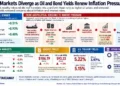
By the closing bell, the S&P 500 had fallen 33.58 points to 7,503.85. The Dow Jones Industrial Average lost 130.76 points to 52,925.15, while the Nasdaq Composite dropped 302.47 points to 25,818.69.
Oil Prices Add to Market Pressure
Investor sentiment was further weakened by higher oil prices after the British military said three tankers were struck by projectiles in the Strait of Hormuz. The United States later revoked a license that had authorized the sale of Iranian oil under an interim agreement intended to end hostilities between the United States and Iran.
Those developments reduced expectations that shipping through the strategic waterway would fully resume, raising concerns about global crude supplies.
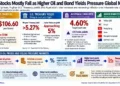
Brent crude, the international benchmark, rose 3% to settle at $74.16 per barrel.
Inflation and Bond Yields Remain in Focus
Higher energy prices added to inflation concerns and pushed government bond yields higher. The yield on the benchmark 10-year U.S. Treasury note rose to 4.54% from 4.48% late Monday and remained well above the 3.97% level recorded before the conflict with Iran began.
Bond yields have remained elevated since oil prices surged above $100 per barrel during the conflict in March. Investors remain concerned that persistent inflation could prompt the Federal Reserve and other central banks to raise interest rates further, increasing borrowing costs while weighing on economic growth and financial markets.
Global Markets Follow Wall Street Lower
The sell-off extended across overseas markets. South Korea’s Kospi index fell 4.9%, with Samsung Electronics accounting for more than one-quarter of the benchmark. Japan’s Nikkei 225 declined 2.1%, while Germany’s DAX lost 1.4%, marking some of the steepest declines among major global markets.
This report is based on reporting by The Associated Press (AP).
Topics: AI Stocks | Wall Street | Stock Market | Technology Stocks | Oil Prices | Inflation | Global Markets | Semiconductor Industry