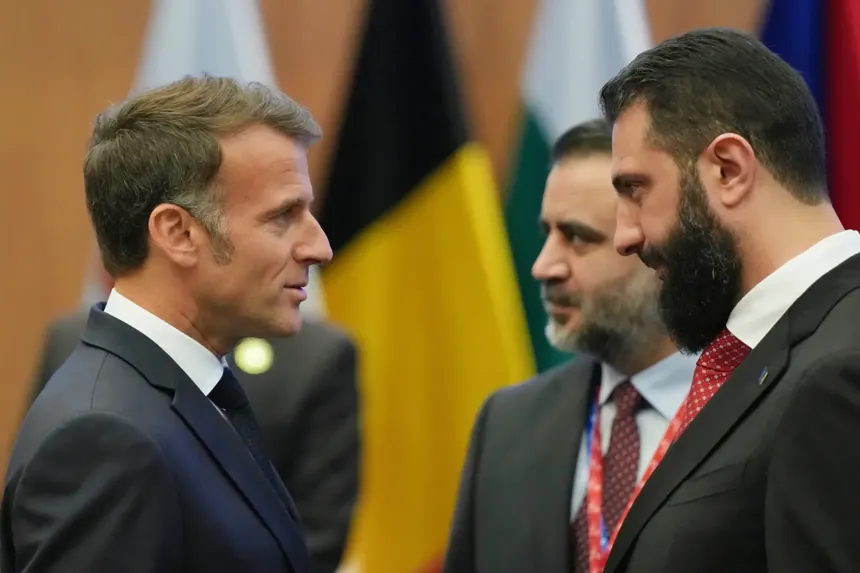
DAMASCUS, Syria – French President Emmanuel Macron arrived in Damascus on Monday, becoming the first major Western leader to visit Syria since the overthrow of former President Bashar al-Assad in 2024, as international engagement with the country’s new leadership continues to expand.
The visit comes during a period of relative calm in the Middle East following the recent conflict involving Iran and Lebanon. After concluding his trip to Syria, Macron is expected to travel to Ankara, Turkey, for the NATO summit, where Syrian President Ahmad al-Sharaa is also scheduled to attend and is expected to meet U.S. President Donald Trump.
Syria’s state-run SANA news agency reported that Macron is accompanied by a business delegation focused on regional security discussions as well as potential investment and economic cooperation.

Macron was welcomed at Damascus International Airport by Syrian Foreign Minister Asaad al-Shibani.
“I have come to express France’s commitment to the Syrian people. For a sovereign Syria, united in its diversity and at peace with its neighbors,” Macron wrote on X. “Together, let us open a new chapter of stability and peace.”
France Backs Syria’s Political Transition
Macron’s office said France supports those working to build a new Syria in line with the aspirations expressed during the 2011 Arab Spring, the wave of uprisings that swept across the Middle East seeking political reform and change.
The French president is expected to meet President Ahmad al-Sharaa at the presidential palace and engage with representatives from across Syrian society during his visit.
According to Macron’s office, Tuesday’s schedule begins with meetings involving members of Syrian civil society before talks with al-Sharaa. The leaders are also expected to oversee economic discussions, sign memorandums of understanding and hold a joint news conference.
■ Related News

Growing International Recognition
The visit reflects France’s continued support for Syria’s new leadership following Assad’s removal from power.
Macron hosted al-Sharaa in Paris in May 2025, where he called on European and U.S. leaders to lift longstanding sanctions imposed on Syria. According to the report, most of those sanctions have since been removed.
France maintained support for Syria’s transitional authorities even while some Western governments remained cautious because of al-Sharaa’s Islamist-led administration and his previous leadership of the Hayat Tahrir al-Sham militant group, which had earlier been linked to al-Qaida.
Western governments have also closely monitored how Syria’s new leadership addresses the rights and political participation of women and minority communities, as well as whether the country moves toward more democratic governance.
Reconstruction Remains a Major Challenge
Although Syria has largely avoided becoming directly involved in the region’s most recent conflicts, the country continues to face the consequences of more than a decade of civil war.
The 13-year conflict devastated much of Syria’s infrastructure, displaced millions of people and pushed large sections of the population into poverty. Rebuilding the country is expected to require hundreds of billions of dollars in investment.
While Syrian authorities have signed several memorandums of understanding with governments and major companies covering large-scale investment projects, those agreements have yet to produce significant reconstruction on the ground.
Macron’s visit highlights increasing diplomatic and economic engagement with Syria’s new government as international partners assess opportunities to support the country’s recovery while monitoring its political transition.
Article Topics: Syria | Emmanuel Macron | Ahmad al-Sharaa | France | Middle East | Reconstruction | Diplomacy | International Relations
This report is based on reporting by The Associated Press.