This report is based on reporting by The Associated Press.
ANKARA, Turkey – NATO Secretary-General Mark Rutte enters this week’s alliance summit in Turkey facing renewed pressure to keep the United States committed to the military alliance after U.S. President Donald Trump signaled that increased defense spending alone is no longer enough to satisfy Washington.
For much of his tenure leading the 32-member alliance, Rutte has focused on persuading Trump to remain engaged with NATO by emphasizing allies’ growing investments in defense. However, Trump’s recent remarks indicate that he now expects stronger political support from allies in addition to greater military spending.

Speaking during a White House meeting with Rutte last month, Trump said he remained dissatisfied with several NATO members that declined to participate in the recent conflict involving Iran, despite increased defense commitments across the alliance.
“We don’t need their money — we don’t need anything,” Trump said. “I just want loyalty.”
Defense spending no longer the alliance’s only challenge
Trump has long criticized NATO members for failing to devote sufficient portions of their national budgets to defense. Those concerns appeared to ease after last year’s NATO summit, when allied governments committed to significantly increasing military spending to levels closer to those of the United States.
The alliance’s current challenge has shifted toward translating those financial commitments into stronger military capabilities, particularly as European governments continue to assess the security risks posed by Russia.
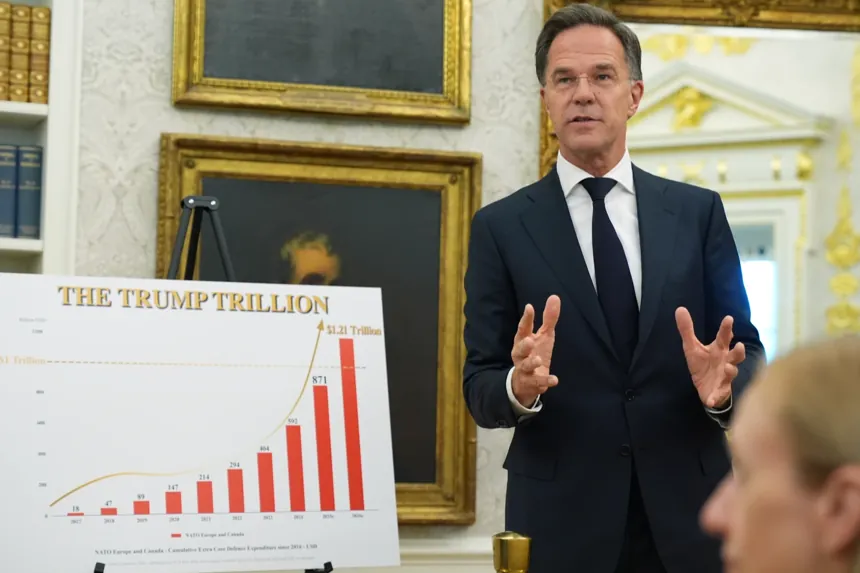
During the White House meeting, Rutte presented Trump with a chart labeled “The Trump Trillion,” highlighting approximately $1.2 trillion in additional defense spending by European allies and Canada since 2017. The presentation also emphasized expanding orders for American-made military equipment and the jobs created in the United States through allied defense purchases.
Despite those efforts, Trump’s response suggested that financial commitments alone would not resolve broader political concerns within the alliance.
■ Related News



Rutte continues delicate balancing act
Since assuming NATO’s top civilian post, Rutte has devoted considerable effort to maintaining U.S. engagement in the alliance, a task that also defined the tenure of his predecessor, Jens Stoltenberg.
The NATO secretary-general traditionally serves as a consensus builder among member states while representing the alliance collectively. Under Trump’s leadership, however, the role has increasingly involved reassuring Washington amid repeated criticism of NATO.
Trump has previously threatened to withdraw the United States from the alliance, questioned whether Washington should defend members that spend too little on defense and suggested taking control of Greenland, the autonomous Danish territory belonging to fellow NATO member Denmark.
Those statements have fueled concerns among European allies about the long-term reliability of U.S. security commitments.
Questions grow over America’s military role in Europe
Uncertainty surrounding Washington’s military posture has intensified after the Pentagon announced last month that it would reduce the number of U.S. troops, aircraft, warships and drones available for NATO operations if an alliance member came under attack.
Trump has also issued conflicting statements about whether overall U.S. troop levels in Europe would ultimately be reduced or expanded.
The mixed messaging has complicated NATO’s efforts to project unity at a time when many European governments view Russia as an increasingly serious security challenge. According to a study released Thursday, Russia has continued probing European defenses through drone activity near military installations across several countries.
Turkey summit carries heightened significance
Each NATO summit is intended to reaffirm the alliance’s collective defense commitment under Article 5, which states that an attack on one member is considered an attack on all. The provision has been invoked only once, following the Sept. 11, 2001, terrorist attacks in the United States.
Last year’s summit in The Hague, Rutte’s home city, concluded with agreement on increased defense spending and a positive response from Trump, who described NATO partners as “a nice group of people.”
This year’s gathering will be hosted by Turkish President Recep Tayyip Erdogan, one of the few foreign leaders Trump has publicly praised. While Erdogan’s relationship with Trump may help ensure U.S. participation, analysts continue to watch whether the summit can overcome persistent disagreements over the alliance’s future direction.
Rutte has argued that higher European defense spending will allow the United States to devote more attention to strategic competition with China while European allies assume greater responsibility for supporting Ukraine’s security.
Trump’s latest emphasis on political loyalty, however, introduces a new challenge that extends beyond defense budgets and military capabilities.
In his memoir, former NATO Secretary-General Jens Stoltenberg recalled concerns during the 2018 NATO summit that Trump’s dissatisfaction could undermine the alliance’s credibility.
He wrote that if a U.S. president abandoned NATO’s collective defense commitment, the alliance’s security guarantee would lose much of its value.
Article Topics: NATO | Donald Trump | Mark Rutte | Turkey Summit | European Security | Russia | Defense Spending | Transatlantic Alliance
This report is based on reporting by The Associated Press.