NEW YORK – Most U.S. stocks finished higher on Wednesday, but steep losses among several major technology companies dragged Wall Street’s benchmark indexes into negative territory, offsetting broader market strength.
The S&P 500 slipped 0.2% for its eighth decline in the past 11 trading sessions, while the Dow Jones Industrial Average edged down less than 0.1%. The technology-heavy Nasdaq Composite posted the sharpest loss, falling 0.7%, as several artificial intelligence-related stocks retreated after their recent rallies.
Despite the market’s overall decline, roughly three-fifths of companies in the S&P 500 ended the session in positive territory, highlighting the outsized influence of large technology firms on the broader market.

AI Leaders Pull Major Indexes Lower
The day’s biggest drag came from semiconductor and artificial intelligence stocks, which have been among the market’s strongest performers this year.
Micron Technology fell 10.6%, while Advanced Micro Devices (AMD) dropped 6.9%. Nvidia, another heavyweight in the AI sector, declined 1.3%.
The recent volatility reflects growing concerns among investors that some AI-focused companies may have become highly valued following months of strong gains. Because these companies carry significant weight in major stock indexes, their declines had a disproportionate impact on overall market performance.
Manufacturing Data Offers Some Relief on Inflation
Markets recovered part of their early losses after the Institute for Supply Management (ISM) reported that U.S. manufacturing expanded in June, although at a slightly slower pace than economists had anticipated.
The report also showed that manufacturing prices continued to rise but at a slower rate, suggesting inflationary pressures may be easing.



That helped reduce expectations that the Federal Reserve would need to raise interest rates multiple times this year.
Following the report, the yield on the benchmark 10-year U.S. Treasury note retreated from an intraday high near 4.50% to 4.47%.
Lower Treasury yields generally ease borrowing costs for businesses and consumers while also making equities relatively more attractive to investors.
Yields had climbed in recent weeks amid concerns that the conflict involving Iran could disrupt energy supplies and fuel higher inflation through rising oil prices.
Corporate Earnings Drive Individual Stock Moves
Several companies outperformed the broader market after releasing quarterly updates or announcing strategic transactions.
General Mills surged 8.5% after the maker of Cheerios and Progresso products reported quarterly earnings that exceeded analysts’ expectations. The company also unveiled plans to reduce operating costs by $3 billion over the next four years.
Nike gained 4.9% after posting stronger-than-expected quarterly results. The athletic apparel company continues efforts to improve performance under CEO Elliott Hill, who acknowledged ongoing challenges affecting revenue despite encouraging financial results.
Meanwhile, grocery chain Kroger reversed early losses to close 1.3% higher after announcing an agreement to acquire food and pharmacy retailer Giant Eagle for $1.25 billion in cash while assuming approximately $400 million in liabilities.
Market Performance
By the closing bell:
- S&P 500: Fell 16.13 points to 7,483.23
- Dow Jones Industrial Average: Lost 13.96 points to 52,305.24
- Nasdaq Composite: Dropped 173.69 points to 26,040.03
Gold and Oil Move in Opposite Directions
Commodity markets also reflected shifting investor sentiment.
Gold prices recovered after falling below $3,980 per ounce overnight. As Treasury yields eased following the manufacturing report, gold regained strength and settled 1.1% higher at $4,082.40 per ounce.
Higher bond yields typically reduce the appeal of gold because the precious metal does not generate interest income.
Oil prices, meanwhile, declined as investors remained hopeful that tensions between the United States and Iran could eventually ease, allowing the Strait of Hormuz to reopen fully for crude shipments.
Brent crude, the international oil benchmark, fell 1.9% to close at $71.57 per barrel.
Mixed Performance Across Global Markets
International markets delivered mixed results.
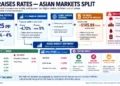
South Korea’s Kospi index dropped 2%, marking one of the weakest performances among major global markets. The decline followed recent strong gains driven largely by enthusiasm surrounding AI-related companies such as SK Hynix, although the benchmark remains up 97% for the year.
In Japan, the Nikkei 225 rose 0.6% after the Japanese yen weakened to its lowest level against the U.S. dollar in four decades, providing support for the country’s export-oriented companies.
Tags: Wall Street, S&P 500, Nasdaq, Dow Jones, Nvidia, AMD, Micron Technology, Federal Reserve, Treasury Yields, Stock Market