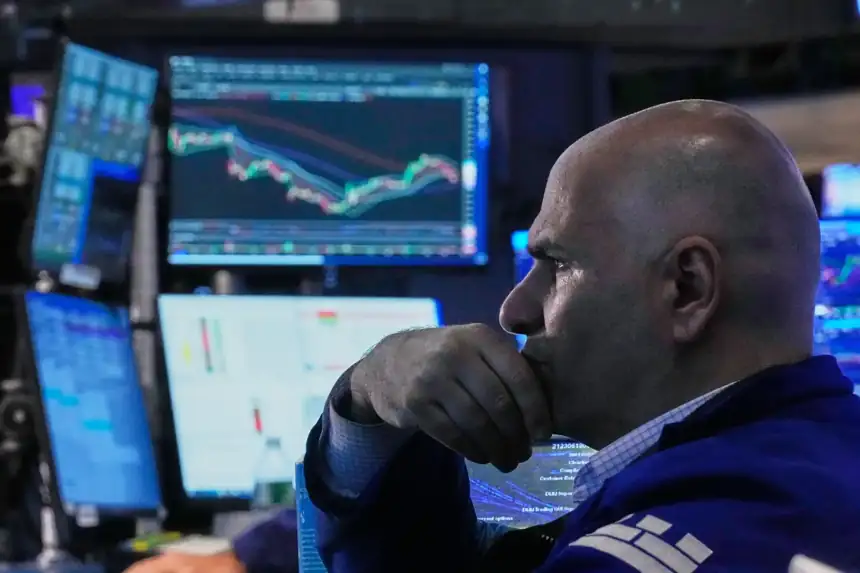
NEW YORK – U.S. stocks advanced Monday, recovering part of the previous week’s losses as artificial intelligence-related companies led a broad market rebound, while investors balanced optimism over technology demand against ongoing geopolitical tensions and rising energy prices.
The S&P 500 gained 1.2% to end a five-session losing streak after recording only its second weekly decline in the past 13 weeks. The Dow Jones Industrial Average rose 306.63 points, or 0.6%, while the Nasdaq Composite surged 2.1%, supported by strong gains across semiconductor and AI-related stocks.
The rally came as South Korean technology companies Samsung Electronics and SK Hynix announced plans to invest approximately $518 billion in a new semiconductor manufacturing hub, reflecting growing global investment aimed at meeting rising demand for artificial intelligence computing.

Semiconductor and AI companies power market gains
Applied Materials was among the strongest performers, climbing 10.8% after the South Korean investment announcement. The semiconductor equipment manufacturer has now gained more than 170% since the beginning of the year.
Artificial intelligence stocks have experienced heightened volatility in recent weeks as investors weigh whether future earnings can justify the sector’s substantial market valuations. Because many AI companies rank among the largest publicly traded firms, their price movements have an outsized influence on major U.S. stock indexes.
Nvidia contributed significantly to Monday’s gains, rising 1.3%. The chip designer remains Wall Street’s most valuable publicly traded company, with a market capitalization exceeding $4.7 trillion.
SpaceX also posted strong gains, climbing 7.2% after Nasdaq announced the company will join the Nasdaq-100 Index before trading begins on July 7. The inclusion will require index-tracking investment funds to purchase shares.
The aerospace company’s valuation has surpassed $2 trillion following its widely watched Nasdaq debut earlier this month.



Corporate developments move individual stocks
Outside the technology sector, Comcast gained 4.5% after announcing plans to separate its NBCUniversal and Sky media operations into an independent publicly traded company while retaining its broadband and wireless business.
The move helped offset year-to-date losses for Comcast shares, which had declined more than 17% before Monday’s rally.
Verizon Communications moved in the opposite direction, falling 5.2% after announcing a $625 million agreement to combine its international wireline connectivity and managed network services business with selected subsidiaries of London’s BT Group in a joint venture.
By the closing bell, the S&P 500 had added 86.41 points to finish at 7,440.43. The Dow closed at 52,182.74, while the Nasdaq Composite rose 522.53 points to end at 25,820.14.
Rising oil prices remain a key market concern
The stock market’s gains came despite another increase in oil prices as investors continued monitoring developments in the Middle East.
Brent crude, the international oil benchmark, rose 1.8% to $73.91 per barrel, climbing above levels seen before the conflict involving Iran began. U.S. benchmark West Texas Intermediate crude for August delivery gained 2.2% to settle at $70.75 per barrel.
The price movements followed renewed tensions across the Persian Gulf after attacks over the weekend. The United States and Iran separately announced plans to send delegations to Qatar this week, although Tehran said it had not agreed to meet U.S. officials at any level.
Financial markets continue to watch the Strait of Hormuz closely because it serves as one of the world’s most important oil shipping routes. Investors hope any easing of regional tensions would allow energy exports to flow without disruption, helping reduce global oil prices.
Treasury yields ease as investors monitor inflation outlook
Lower oil prices could help contain inflationary pressures, potentially allowing the Federal Reserve and other central banks to maintain current interest rates or eventually consider reductions instead of additional increases.
Higher borrowing costs are generally used to control inflation but can also slow economic growth and weigh on corporate earnings and financial markets.
The yield on the benchmark 10-year U.S. Treasury note edged down to 4.37% from 4.38% on Friday and remained below the 4.56% level reached earlier this month.
International markets delivered mixed results. European indexes posted modest declines, while Asian markets finished with varied performances. Hong Kong’s benchmark index rose 1.6%, Shanghai gained 1.2%, and South Korea’s Kospi slipped 0.2%.
Tags: Stock Market, S&P 500, Nasdaq, Dow Jones, Nvidia, Applied Materials, SpaceX, Oil Prices, Federal Reserve, AI Stocks