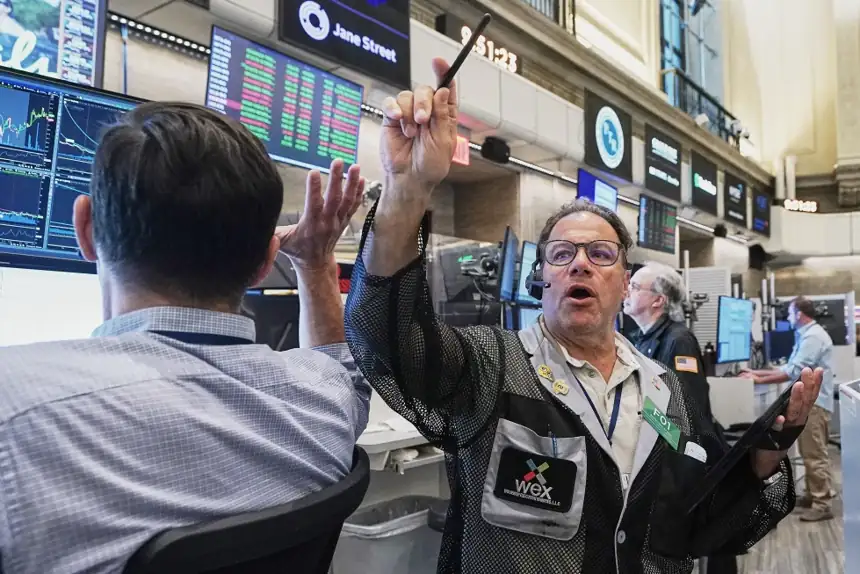
U.S. stocks finished mostly lower on Tuesday as a broad sell-off in technology companies extended across global markets, reflecting growing investor concerns that interest rates could remain elevated or move higher later this year.
The benchmark stock market indexes came under pressure as many of the companies that have driven recent gains tied to artificial intelligence enthusiasm posted sharp declines. Market participants also continued to assess the potential impact of persistent inflation and tighter monetary policy on economic growth.
The S&P 500 dropped 1.4% to close at 7,365.46, while the Nasdaq Composite fell 2.2% to 25,587.04. The Dow Jones Industrial Average, which has less exposure to major technology companies, slipped 45.87 points, or 0.1%, ending the session at 51,666.84.

Technology Stocks Lead Market Decline
The latest weakness centered on technology and semiconductor companies that have experienced significant valuation gains during the artificial intelligence investment boom.
Micron Technology fell 13.2%, while Nvidia declined 4.1%. In Asia, Samsung Electronics dropped 12.3%, contributing to a broader decline across regional markets.
The technology-heavy sell-off outweighed strength elsewhere in the market. Although more companies within the S&P 500 advanced than declined during the session, losses among large-cap technology stocks had a greater impact on the overall index because of their substantial market weight.
Market weakness extended beyond the United States. South Korea’s Kospi index plunged 10%, while major European stock markets also moved lower as investors reassessed the outlook for AI-related investments.
Interest Rate Concerns Weigh on Growth Stocks
Investor sentiment has shifted in recent days as expectations for additional monetary tightening have increased.



Technology companies are among the sectors most sensitive to interest-rate movements because many rely heavily on future growth projections. Higher borrowing costs can reduce corporate spending and lower the present value of future earnings, making richly valued growth stocks more vulnerable to market corrections.
According to CME Group data cited in the report, traders now see an 85% probability that the Federal Reserve will raise its benchmark interest rate before the end of the year, up from roughly 60% a week earlier.
The prospect of higher rates has helped cool enthusiasm that fueled a strong rally in AI-related shares throughout much of 2026.
Massive AI Rally Faces Period of Consolidation
Despite the recent pullback, technology stocks remain among the market’s strongest performers this year.
Within the S&P 500, the technology sector has gained 25.5% over the past three months and remains up 16.6% for the year. South Korea’s Kospi index has nearly doubled in value during 2026 even after Tuesday’s steep decline.
Brock Weimer, an investment strategy analyst at Edward Jones, said a pause in the sector’s rally may not be surprising after such rapid gains.
“Viewed through this lens, a period of consolidation is reasonable, in our view, after such a sharp move higher,” Weimer wrote in a research note.
SpaceX Gains Despite Volatile Trading
Shares of SpaceX fluctuated during the trading session before finishing 1% higher.
The company, which recently made its market debut, has announced plans to raise additional capital through a bond offering. Part of the proceeds are expected to support artificial intelligence-related development initiatives.
Inflation Remains a Key Market Concern
Investors are also closely monitoring inflation trends as policymakers evaluate the next steps for monetary policy.
Inflation pressures have remained elevated throughout the year. Tariff-related costs have contributed to price increases, while energy markets experienced additional volatility following the recent conflict involving the United States and Iran.
Higher fuel costs have increased transportation and shipping expenses, creating additional challenges for businesses and consumers.
Market attention is now turning toward a closely watched inflation report scheduled for release on Thursday. Economists expect the measure favored by the Federal Reserve to show annual inflation reached 4.1% in May.
Oil Prices Ease as Iran Talks Continue
Energy prices moved lower as negotiations aimed at ending hostilities between the United States and Iran continued.
U.S. crude oil for August delivery fell 0.9% to settle at $73.21 per barrel. Brent crude, the international benchmark, also declined 0.9%, ending at $76.80 per barrel for September delivery.
Although prices have retreated from recent highs, they remain above the levels seen before the conflict began, when crude traded near $70 per barrel.