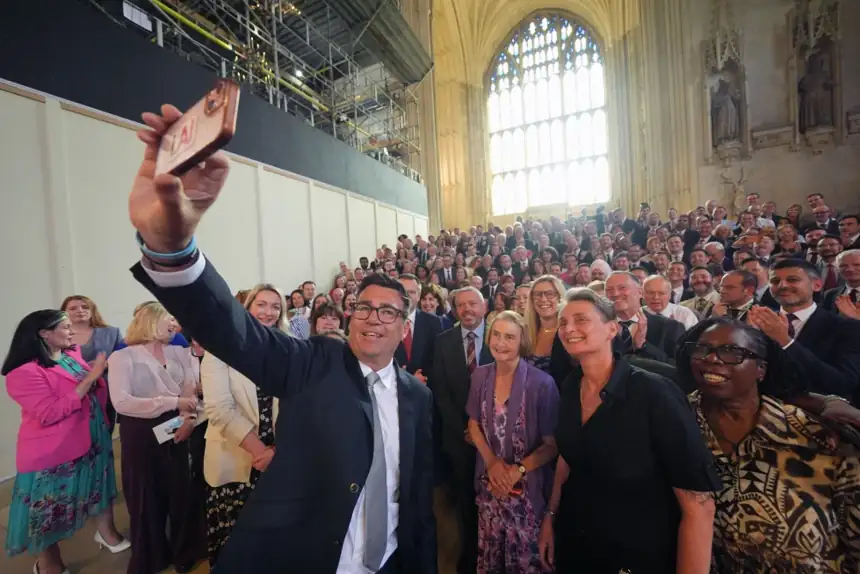
LONDON – British lawmaker Andy Burnham moved closer to becoming the United Kingdom’s next prime minister on Tuesday as he intensified efforts to secure support for a Labour Party leadership bid following Keir Starmer’s decision to step down.
Burnham, who recently returned to Parliament after winning a special election, is widely viewed as the leading candidate to succeed Starmer, whose resignation came after two turbulent years in office marked by declining public support and growing dissatisfaction within his party.
The Labour Party is expected to begin the formal leadership nomination process next month, with Burnham currently holding a significant advantage over potential rivals.

Burnham Gains Momentum After Key Endorsement
Burnham’s position strengthened considerably after former Health Secretary Wes Streeting, regarded as his most prominent potential challenger, announced his support on Monday.
The endorsement reduced the likelihood of a competitive leadership contest and raised speculation that Burnham could secure the position without facing a major opponent.
On Tuesday, Burnham met Starmer for the first time since winning last week’s parliamentary by-election. Neither side disclosed details of their discussions.
The former Greater Manchester mayor also spent the day meeting Labour lawmakers as he sought to build further backing ahead of the nomination period.
Leadership Timeline Could Move Quickly
Under Britain’s parliamentary system, governing parties can replace their leader without holding a general election.
■ Related News




Labour nominations are scheduled to open on July 9 and close on July 16. If Burnham is the sole candidate, he could become party leader and prime minister immediately after nominations close.
Should multiple candidates enter the race, a wider party contest would follow, with a new leader expected before Parliament returns from its summer recess on Sept. 1.
The next national election is not required until 2029.
Starmer Oversees Transition Period
While preparing to leave office, Starmer has pledged to support a smooth transfer of power.
His office said the prime minister told Cabinet ministers he wanted an orderly transition and hoped his successor would succeed in government.
Although Starmer continues to carry out official duties, convention limits his ability to introduce major policy initiatives or significant spending commitments during the leadership transition.
The political uncertainty has already affected international scheduling. The European Union has postponed a planned U.K.-EU summit set for July 22 while awaiting clarity on Britain’s next leader.
Defense Policy Remains a Key Issue
One major decision expected before Starmer leaves office is the publication of the government’s defense investment strategy.
The issue has attracted significant political attention following the resignation of Defense Secretary John Healey on June 11.
The plan is expected to be released before a NATO summit in Turkey on July 7 and 8, which Starmer is likely to attend.
Defense spending has also become a prominent issue in the Labour leadership debate.
Former Armed Forces Minister Al Carns, who resigned this month over concerns about military funding, said Britain needs a broader discussion about its national priorities. Carns has not ruled out entering the leadership race but has yet to make a formal decision.
Burnham Promises a Different Leadership Style
Burnham built his reputation during eight years as mayor of Greater Manchester, where he oversaw a period of economic development and urban regeneration.
He has pledged to expand elements of what he calls “Manchesterism” across the country, presenting it as a model for national renewal.
Supporters believe his more approachable public style could help Labour reconnect with voters after Starmer’s difficult period in office.
However, some Labour lawmakers argue that Burnham should face challengers to ensure greater scrutiny of his plans. They note that many of his policy positions have yet to be fully outlined.
Burnham is expected to deliver a major speech next week setting out elements of his economic agenda.
Questions Over Potential Rivals
Despite Burnham’s strong position, some senior Labour figures continue to encourage additional candidates to enter the race.
Among the names mentioned is Darren Jones, a Cabinet minister and close ally of Starmer, though he has not publicly commented on whether he intends to run.
Potential candidates must secure the support of at least 81 Labour lawmakers, equivalent to one-fifth of the parliamentary party, to qualify for the contest.
Many Labour members argue that a prolonged leadership battle could deepen internal divisions and extend uncertainty at a time when the government is already under pressure.
Starmer’s Premiership Ends After Rapid Decline
Starmer announced his resignation on Monday after days of speculation about his political future.
He acknowledged that Labour no longer believed he was the best person to lead the party into the next general election.
His departure comes just two years after leading Labour to a decisive election victory in July 2024.
Despite entering office with a strong parliamentary majority, Starmer struggled to deliver promised economic growth, improve public services and address cost-of-living concerns.
His government was also damaged by a series of political controversies and policy setbacks that weakened public confidence.
Labour now faces growing competition from both the Green Party and Reform UK, the anti-immigration party led by Nigel Farage, which continues to perform strongly in national opinion polls.
For Burnham, the challenge will be not only securing the Labour leadership but also rebuilding support for a government that has seen its political standing decline rapidly since entering office.
Tags: United Kingdom, Labour Party, Andy Burnham, Keir Starmer, British Politics, Leadership Election, Parliament, Greater Manchester, NATO, Reform UK, Wes Streeting, Europe