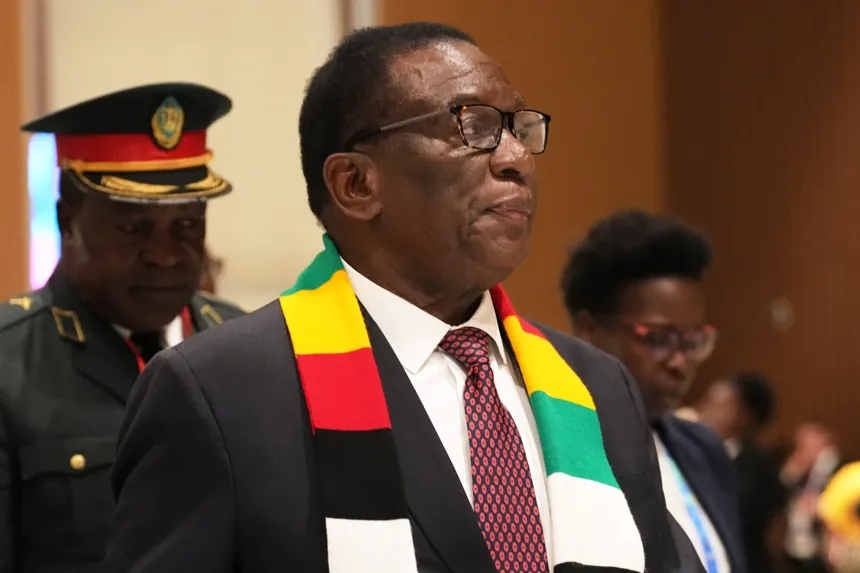
HARARE, Zimbabwe — Zimbabwe’s National Assembly has approved constitutional amendments that would postpone the country’s next elections and extend the tenure of President Emmerson Mnangagwa, a move that has intensified scrutiny of leadership longevity and constitutional governance across Africa.
Lawmakers voted Thursday in favor of measures that would delay elections currently scheduled for 2028 until 2030 and extend Mnangagwa’s term from five years to seven years. The legislation must still be approved by Zimbabwe’s Senate, where it is also expected to pass.
The proposed amendments would additionally replace direct presidential elections with a system in which lawmakers select the country’s president.

Mnangagwa, 83, assumed office in 2017 following the military-backed removal of former president Robert Mugabe. At the time of his removal, Mugabe was among the world’s oldest serving heads of state.
Constitutional Changes Reflect Wider Regional Trend
The vote has renewed attention on the age and tenure of political leaders across Africa, a continent that has the world’s youngest population but remains home to several of its longest-serving rulers.
According to analysis by the Pew Research Center, 16 of the world’s 186 national leaders are older than U.S. President Donald Trump, who turned 80 last week. The analysis found that seven of the world’s 10 oldest leaders govern African countries.
Meanwhile, data from the United Nations shows that Africa’s median age is about 20, with more than 60% of the continent’s population under the age of 30.
Blessing Vava, a democracy and governance researcher and director of the Johannesburg-based Southern Africa Coalition for Democracy and Accountability, said the developments in Zimbabwe reflect a broader regional pattern.
■ Related News


“The population in Africa is getting younger, but the average age of presidents is rising, and tenures are getting longer,” Vava said.
“Zimbabwe is not an exception. It’s the continental norm,” he added. “Zimbabwe is just one data point in a much broader story of constitutional erosion for political survival.”
Several African Leaders Have Remained in Power for Decades
Zimbabwe’s constitutional debate comes amid continued discussion about leadership succession across the continent.
In Cameroon, President Paul Biya, 93, remains the world’s oldest serving head of state and has been in power since 1982.
Neighboring Equatorial Guinea has been led by President Teodoro Obiang Nguema Mbasogo for 47 years. At 84, he is Africa’s longest-serving ruler and has appointed his son as vice president.
In Ivory Coast, President Alassane Ouattara was sworn in for a fourth term in December 2025 following an election that was marked by unrest and low voter turnout.
Malawi last year elected Peter Mutharika, now 85, returning him to office after a previous term that ended in 2020.
In Uganda, President Yoweri Museveni, 81, was sworn in for a seventh consecutive term in May, extending his rule to four decades.
According to the report, Mnangagwa, Museveni, Ouattara, Biya and Obiang have all altered or removed constitutional restrictions during their time in power.
Younger Leaders Have Also Emerged
Despite the prominence of long-serving leaders, Africa has also seen the rise of a younger generation of political figures in recent years.
Bassirou Diomaye Faye became one of Africa’s youngest elected leaders after winning Senegal’s 2024 presidential election at age 44.
Abiy Ahmed, 49, has led Ethiopia since 2018.
Other younger leaders have come to power through military takeovers. In Chad, President Mahamat Idriss Deby assumed power after the death of his father in 2021 and later won elections in 2024.
In Burkina Faso, military leader Ibrahim Traoré took power following a 2022 coup and is currently Africa’s youngest ruler at age 38.
Military coups have also brought younger leaders to power in Mali and Guinea.
Even with those changes, analysts say political influence across much of the continent remains concentrated among older governing elites.
“So you get 25-year-olds making up the majority of a country’s population, but 75-year-olds decide the candidate or rule,” Vava said. “Youth are mobilized for votes and not for power.”
Tags: Zimbabwe, Emmerson Mnangagwa, Constitutional Reform, Africa Politics, Governance, Elections, Leadership Tenure, Democracy