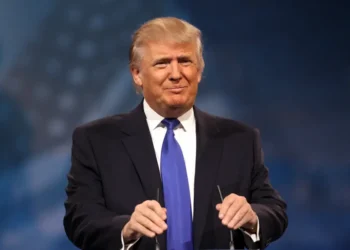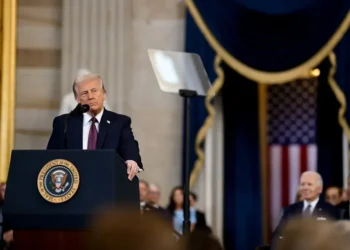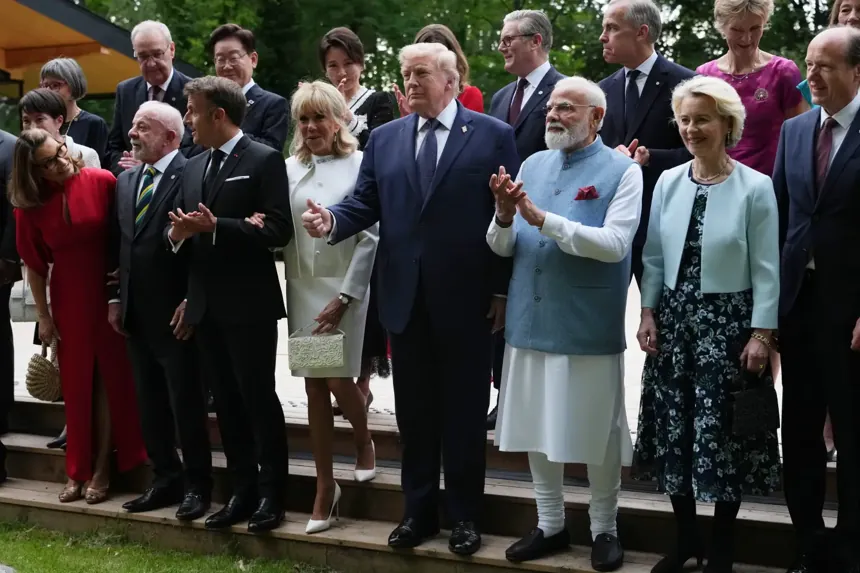
EVIAN-LES-BAINS, France — U.S. President Donald Trump is concluding discussions with fellow leaders at the Group of Seven (G7) summit amid mounting questions about a newly announced agreement with Iran that he says will prevent Tehran from obtaining a nuclear weapon.
The summit, held in the French Alps, has brought together leaders of the world’s leading industrialized nations to discuss global economic growth, artificial intelligence, energy security and geopolitical stability. However, attention has increasingly centered on Trump’s efforts to defend the Iran agreement, the details of which have not yet been publicly released by either Washington or Tehran.
Speaking to reporters during the summit, Trump described the memorandum as a major achievement, saying the agreement would ensure Iran would neither acquire nor develop a nuclear weapon. U.S. and Iranian officials are expected to formally sign the document during a ceremony scheduled for Friday in Switzerland.

The absence of a publicly available text has fueled skepticism among political allies, international observers and regional partners. Questions remain over how the agreement would be enforced and whether it adequately addresses concerns surrounding Iran’s nuclear ambitions.
Uncertainty Surrounds Implementation
Differing interpretations from U.S. and Iranian officials have added to uncertainty over the agreement’s practical implications.
Iranian Foreign Minister Abbas Araghchi stated that Israel’s continued military presence in parts of southern Lebanon could conflict with the understanding reached between the parties. He argued that the conflict could not be considered fully resolved while Israeli forces remained in territories occupied during the war.
Trump offered a different assessment, suggesting that future Israeli military actions against Hezbollah would not necessarily jeopardize the agreement. At the same time, he voiced frustration with the prolonged conflict in Lebanon, saying too many lives had been lost and expressing dissatisfaction with Israel’s broader strategy toward Hezbollah.
According to information cited during the summit, Israeli military operations in Lebanon since early March have resulted in thousands of deaths and displaced more than one million people. Independent verification of all casualty figures was not immediately available.
■ Related News



Energy Security Remains a Global Concern
Beyond the nuclear agreement itself, international attention remains focused on the Strait of Hormuz, a critical maritime corridor for global energy supplies.
Before the outbreak of the Iran conflict, roughly one-fifth of globally traded oil and natural gas moved through the strategic waterway. Disruptions linked to the conflict have intensified concerns among governments and energy markets worldwide.
French Foreign Ministry spokesperson Pascal Confavreux said summit discussions included proposals to finance and develop alternative infrastructure routes that could reduce dependence on the strait and provide greater resilience for global energy transportation networks.
The issue was also discussed during a working lunch attended by Egyptian President Abdel-Fattah el-Sissi, Qatar’s ruling emir and the president of the United Arab Emirates, all of whom were invited to the summit by French President Emmanuel Macron.
U.S.-India Relations Face New Strains
Trump is also expected to hold talks with Indian Prime Minister Narendra Modi during the final day of the summit as bilateral relations face renewed challenges.
The meeting comes after three Indian sailors were killed during a U.S. military strike on a tanker in the Gulf of Oman amid operations connected to the American blockade targeting oil shipments through the Strait of Hormuz. India’s Foreign Ministry has formally protested the incident.
Relations between Washington and New Delhi have also been affected by trade disputes and concerns over energy supplies. India has faced pressure over its reliance on discounted Russian oil, while regional instability linked to the Iran conflict has raised broader questions about future energy security.
Additional concerns in New Delhi stem from recent U.S. diplomatic engagement with China, with some policymakers worried that improving relations between Washington and Beijing could weaken India’s position as an alternative manufacturing destination.
Macron Hosts Trump at Versailles
Following the conclusion of the summit, Trump is expected to travel to the Palace of Versailles near Paris for a state dinner hosted by Macron.
The French landmark, historically associated with the reigns of Louis XIV through Louis XVI, has long served as a venue for major diplomatic events and visits by foreign leaders.
Trump welcomed the invitation during remarks at the summit, describing Versailles as one of the world’s most notable historic sites. The visit will take place ahead of events marking the 250th anniversary of the United States next month.
Despite progress claimed by both Washington and Tehran, significant questions remain unanswered about the Iran agreement’s enforcement mechanisms, its effect on regional conflicts and its ability to restore stability to global energy markets. Those uncertainties are likely to remain at the center of international attention even after G7 leaders depart France.
Tags: Iran Nuclear Deal, Donald Trump, G7 Summit, United States, Iran, France, Energy Security, Strait of Hormuz