BUNIA, Democratic Republic of Congo — An Ebola outbreak in eastern Democratic Republic of Congo has claimed more than 100 lives less than a month after health authorities officially declared the emergency, highlighting the challenges of containing a rapidly spreading disease in a region affected by armed conflict and population displacement.
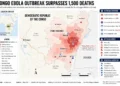
Health authorities reported 550 confirmed Ebola cases as of Sunday, including 101 deaths and 19 recoveries. The outbreak, declared on May 15, is concentrated in Ituri province, which accounts for more than 90% of recorded infections. Cases have also been identified in North Kivu and South Kivu provinces, while infections have crossed the border into neighboring Uganda.
The World Health Organization reported Tuesday that 137 samples were tested over the previous 24 hours, with 35 returning positive results. Officials have cautioned that the true number of infections may be higher because the outbreak was detected weeks after transmission had begun and contact tracing remains incomplete.

Conflict Complicates Containment Efforts
Health officials say insecurity continues to undermine efforts to contain the outbreak.
Eastern Congo has long been affected by violence involving multiple armed groups, limiting access to some communities and disrupting disease surveillance operations. Front-line health workers have also faced attacks from residents in several areas, while skepticism toward public health measures remains a challenge.
Since the outbreak was declared, more than 520 incidents affecting the work of health professionals have been recorded, according to Marie Roseline Darnycka Belizaire, the World Health Organization’s emergency director for Africa.
The World Health Organization said ongoing violence is disrupting surveillance and response activities, increasing the risk that cases could go undetected.
Rare Ebola Strain Adds Challenge
The outbreak is being driven by the Bundibugyo virus, a rare Ebola strain for which there is currently no approved vaccine or treatment.
■ Related News



Unlike the Zaire strain of the Ebola virus, which was responsible for most of Congo’s previous outbreaks and has available countermeasures, the Bundibugyo virus presents additional challenges for health authorities seeking to limit transmission.
Officials stated that part of the recent increase in confirmed cases reflects expanded diagnostic capacity, allowing laboratories to process previously collected samples that had not yet been tested.
Daily Life Disrupted in Ituri
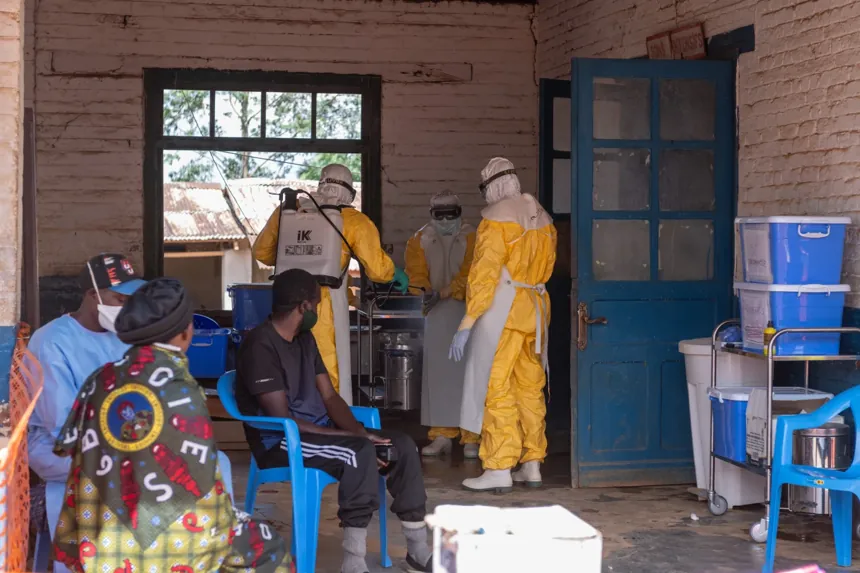
Measures introduced to curb transmission have altered daily routines in Bunia, the capital of Ituri province and the center of the outbreak.
Residents have faced restrictions aimed at reducing contact and limiting the spread of infection. Some survivors of Congo’s devastating 2018 Ebola outbreak have warned that failure to follow health measures could contribute to avoidable deaths.
Contact tracing remains particularly difficult because of large-scale displacement across the region. The United Nations humanitarian office estimates that nearly one million people have been displaced by conflict in Ituri, forcing many families to move frequently and making it harder for health teams to monitor potential exposure.
The region’s geography also presents obstacles. Dense forests, poor road networks and remote villages can delay access for medical teams, while thousands of artisanal miners regularly travel between isolated mining sites.
Regional Concerns Extend Beyond Congo
Although cases have spread into Uganda, the World Health Organization currently assesses the risk of wider international transmission across Africa and globally as low.
During a visit to Uganda on Monday, WHO Director-General Dr. Tedros Adhanom Ghebreyesus emphasized that Ebola patients can recover when they receive appropriate medical care and support.
Regional concerns have also surfaced in Kenya, where plans by the United States to establish an Ebola quarantine facility near a military air base sparked protests and legal challenges.
Kenyan police used tear gas on Tuesday to disperse demonstrators in Nanyuki, where the proposed facility was to be located. U.S. officials had announced plans to quarantine Americans exposed to Ebola abroad at the center rather than transporting them directly to the United States.
A Kenyan court subsequently suspended construction of the facility and prohibited the arrival of foreign patients pending legal proceedings. Petitioners cited concerns over transparency and the capacity of Kenya’s healthcare system.
Kenya has not reported any Ebola cases, while Uganda has confirmed 19 infections linked to the regional outbreak.
Tags: Congo, Ebola, WHO, Uganda, Public Health