LONDON – European leaders meeting in London on Sunday called for urgent action to strengthen Ukraine’s defenses against Russia’s increasingly sophisticated missile attacks, including the deployment of new capabilities to counter Moscow’s Oreshnik ballistic missiles.
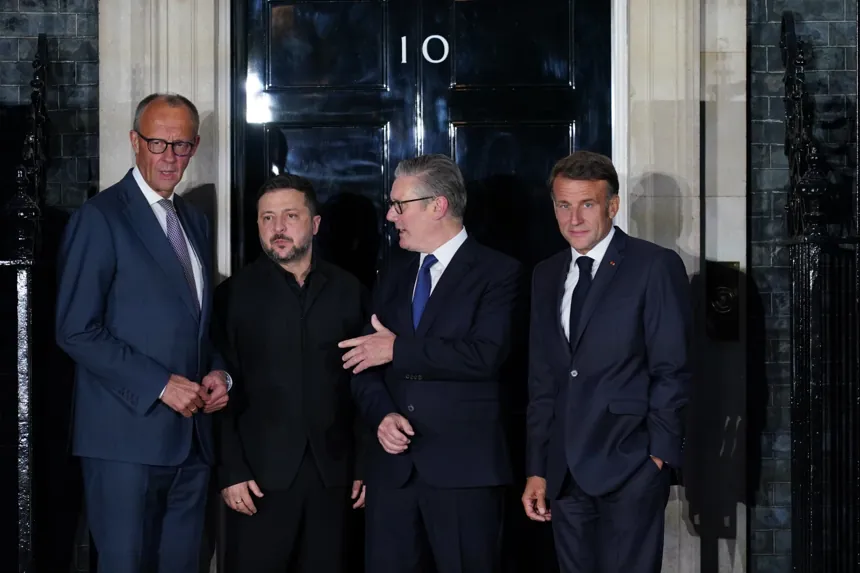
British Prime Minister Keir Starmer hosted Ukrainian President Volodymyr Zelenskyy, French President Emmanuel Macron and German Chancellor Friedrich Merz at Downing Street for talks focused on security, military support and the ongoing war in Ukraine.
According to a statement released by the British government after the meeting, the leaders emphasized the need to accelerate the production of missile interceptors and pursue joint development of anti-ballistic missile systems and long-range strike capabilities.

Growing Concern Over Advanced Russian Missiles
The discussions reflected mounting concern among Ukraine’s allies over Russia’s intensified aerial campaign, which has included repeated use of Oreshnik ballistic missiles against Ukrainian targets.
In their joint statement, the leaders condemned what they described as large-scale Russian missile and drone attacks on Ukrainian cities that have resulted in civilian casualties. They also criticized drone incursions into NATO territory, including an incident reported in Romania last month.
While the leaders outlined the need for enhanced military production and cooperation, no specific financial commitments or implementation plans were announced following the meeting.
Ukraine’s air defense network has come under increasing strain as Russia expands its long-range strike campaign. Although Ukrainian forces continue to intercept many incoming drones, ballistic missiles remain a significant challenge, particularly as supplies of advanced air defense systems remain limited.
Wider Security Concerns Shape Discussions
The London meeting took place against a backdrop of broader international uncertainty, including renewed tensions in the Middle East.
■ Related News

European officials are closely monitoring developments after Iran launched missiles at Israel on Sunday, marking the first such attack since a ceasefire took effect earlier this year. Any escalation could complicate diplomatic efforts and place additional pressure on global defense resources.
Ukraine and its allies have expressed concern that competing international security crises could affect the availability of military support and equipment needed to sustain Kyiv’s defenses.
Calls for a Ceasefire Continue
Following their talks, the four leaders renewed calls for Russian President Vladimir Putin to agree to what they described as an immediate and complete ceasefire along the current front line as a basis for future negotiations.
The United Kingdom, France and Germany—often referred to as the E3—have remained among Ukraine’s most significant European supporters since Russia launched its full-scale invasion in February 2022.
Britain and France have also played leading roles in the “coalition of the willing,” an initiative designed to provide long-term security guarantees for Ukraine as part of any future peace arrangement.
Drone Strikes Highlight Ongoing Risks
The meeting came shortly after a Russian drone strike reportedly killed three civilians waiting at a bus stop in southeastern Ukraine.
Ukrainian military officials also reported that a separate drone attack damaged a spent nuclear fuel storage facility in the Kyiv region, located approximately 15 kilometers from the Chernobyl nuclear power plant. Authorities said a fire triggered by the strike was quickly extinguished and that radiation levels remained within safe limits.
The head of the International Atomic Energy Agency, Rafael Grossi, described the incident as deeply concerning because of the amount of nuclear material stored at the site. The agency said it intends to send experts to inspect the facility.
The attacks followed a large Ukrainian drone operation targeting Saint Petersburg, Russia’s second-largest city, highlighting Kyiv’s expanding ability to conduct strikes deep inside Russian territory.
As battlefield gains remain limited and drone warfare increasingly shapes the conflict, both Russia and Ukraine continue to rely heavily on long-range attacks to pressure military and civilian infrastructure far from the front lines.