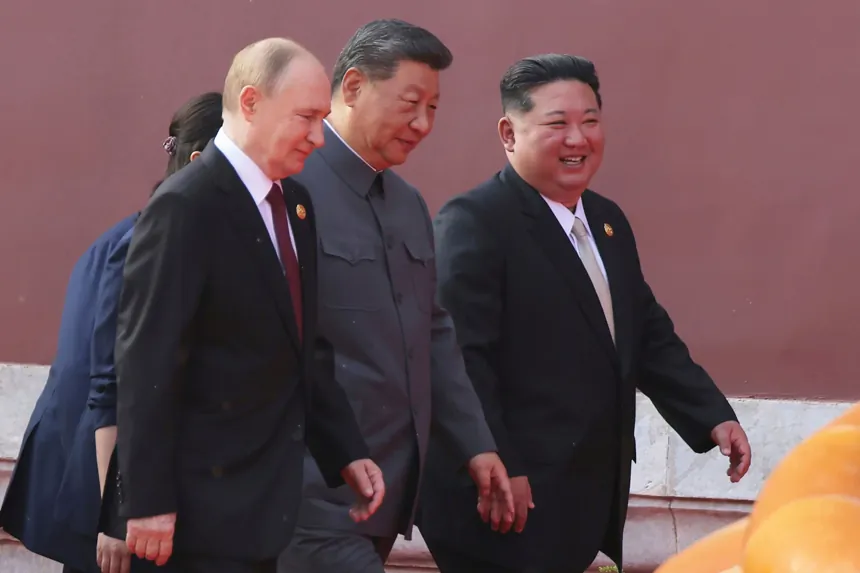
SEOUL, South Korea – Chinese President Xi Jinping arrived in North Korea on Monday for a closely watched visit that is expected to reinforce ties between Beijing and Pyongyang amid growing geopolitical competition in Northeast Asia.
Xi’s two-day trip marks his first visit to North Korea in seven years and comes as both countries seek to strengthen their traditional partnership while navigating separate disputes with the United States. During the visit, Xi is scheduled to hold talks with North Korean leader Kim Jong Un, their first face-to-face meeting since a summit in Beijing last September.
Although neither government publicly outlined a detailed agenda, analysts view the meeting as an opportunity for both leaders to deepen strategic cooperation and reaffirm a relationship that has long played a central role in regional security.

Beijing Seeks to Reinforce Regional Influence
Xi’s visit follows recent meetings with U.S. President Donald Trump and Russian President Vladimir Putin in Beijing. With another meeting between Xi and Trump expected during a planned U.S. visit later this year, the Chinese leader appears eager to demonstrate Beijing’s continuing influence on the Korean Peninsula.
China remains North Korea’s largest trading partner and most important diplomatic supporter. The two countries have maintained close ties for decades, and this year marks the 65th anniversary of their mutual defense treaty.
However, observers have questioned whether China’s influence over North Korea has weakened in recent years as Pyongyang expanded cooperation with Russia. North Korea has provided military support for Russia’s war in Ukraine, while Moscow has offered economic and defense-related assistance in return.
A stronger relationship with Pyongyang could provide Beijing with additional diplomatic leverage as Washington continues to express interest in reengaging North Korea.
In an article published Monday by North Korea’s Rodong Sinmun newspaper, Xi said China and North Korea should strengthen strategic coordination, oppose what he described as hegemonism and coercive politics, and work toward a multipolar international order.
■ Related News


Economic Cooperation Expected to Feature Prominently
Analysts expect economic issues to be a key focus of the discussions between Xi and Kim.
Potential areas of cooperation could include increased Chinese assistance in agriculture, expanded tourism, and joint economic projects that would help support North Korea’s struggling economy.
North Korean state media signaled the importance of the visit, with Rodong Sinmun describing Xi as “the most honored state guest” and portraying the atmosphere in Pyongyang as one of friendship and solidarity.
For North Korea, maintaining strong ties with China remains strategically important despite its growing partnership with Russia. Beijing provides economic opportunities and diplomatic backing that Moscow alone cannot fully replace.
Nuclear Issue Remains a Sensitive Topic
The talks are also likely to be closely watched for any signals regarding North Korea’s nuclear weapons program.
Analysts say Xi may avoid publicly emphasizing denuclearization during his meetings with Kim, instead focusing on broader themes such as regional stability and peace. Such an approach could align with North Korea’s long-standing efforts to gain international acceptance as a nuclear-armed state.
Recent developments have underscored Pyongyang’s determination to expand its military capabilities. Last week, Kim unveiled a new facility producing materials for nuclear weapons and pledged to accelerate the growth of the country’s nuclear forces. He also inspected sea trials of a new destroyer and called for faster development of a nuclear-capable navy.
On Sunday, Kim’s sister, senior official Kim Yo Jong, dismissed U.S. calls for North Korea’s denuclearization, describing such expectations as unrealistic.
Future Diplomacy Remains Uncertain
Relations between Washington and Pyongyang have remained largely frozen since the collapse of nuclear negotiations between Kim and Trump in 2019.
While Kim has previously spoken positively about his personal interactions with Trump, he has continued to reject U.S. and South Korean proposals for renewed talks unless longstanding disagreements over North Korea’s nuclear program are addressed.
Experts believe Pyongyang may eventually seek future negotiations focused on arms control measures rather than complete denuclearization, hoping to secure sanctions relief and other concessions in exchange for limits on parts of its nuclear arsenal.
The outcome of Xi’s visit may offer important clues about how China and North Korea intend to coordinate their policies as regional tensions and great-power competition continue to shape Northeast Asia’s security landscape.