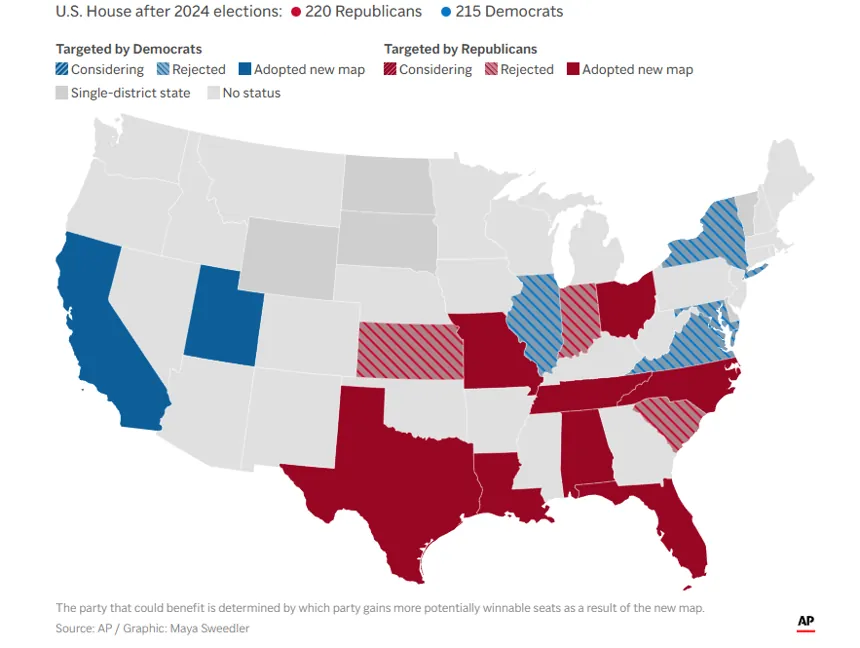
Republicans have largely prevailed in an unprecedented mid-decade redistricting battle that has redrawn congressional districts across much of the United States ahead of the 2026 midterm elections. The outcome has strengthened the party’s position in the fight for control of the U.S. House of Representatives, though the final verdict will rest with voters in November.
The redistricting campaign began after President Donald Trump encouraged Republican-led states to revisit congressional maps outside the traditional post-census process. Voting districts are typically redrawn once every decade following the national census, but several states moved forward with new maps designed to reshape the electoral landscape before the next census cycle.
Republican strategists believe the newly enacted maps could create opportunities to gain as many as 16 House seats, while Democrats estimate Republicans may realistically secure around 10 additional seats if the districts perform as intended. Democrats, meanwhile, have identified potential gains of up to six seats through redistricting efforts in California and Utah.

Control of Congress Remains Uncertain
Despite the GOP’s success in the redistricting fight, control of the House remains far from guaranteed.
Republicans currently hold a narrow majority in the chamber, and Democrats need only a small number of seat gains to reclaim control. Historical trends have generally favored the opposition party during midterm elections. Over the past two decades, the party holding the White House has consistently lost House seats during midterm contests.
Political conditions may also create challenges for Republicans. President Trump’s approval ratings remain underwater in many national surveys, potentially increasing pressure on Republican candidates in competitive districts.
As a result, analysts expect national political dynamics, voter turnout and candidate performance to play a significant role in determining whether redistricting advantages translate into electoral victories.
Millions of Americans Affected by New Districts
The map changes have affected a substantial portion of the country.




Nearly 145 million people — roughly two-fifths of the U.S. population — now live in states operating under newly drawn congressional districts for the 2026 elections.
Eight Republican-led states adopted new House maps that could improve GOP prospects: Texas, Missouri, North Carolina, Ohio, Florida, Tennessee, Louisiana and Alabama.
Democratic efforts produced revised congressional districts in California and Utah, where party leaders hope to create additional opportunities in competitive races.
Texas Leads Republican Redistricting Push
Texas represents the largest prize in the redistricting battle.
Republican Gov. Greg Abbott signed a revised congressional map into law in August 2025. The new districts could help Republicans gain as many as five additional House seats, although Democrats argue some of those districts remain competitive.
Florida also emerged as a major Republican opportunity. A map signed by Gov. Ron DeSantis in May is expected to improve GOP chances in several districts and could potentially add four seats to the party’s House total if Republicans perform strongly statewide.
Republican lawmakers also approved new congressional maps in North Carolina, Ohio, Missouri, Tennessee, Louisiana and Alabama, each aimed at improving the party’s electoral prospects.
Democratic Counteroffensive Faces Setbacks
Democrats pursued their own redistricting strategy but encountered a series of political and legal obstacles.
California voters approved revised congressional districts that Democrats believe could generate up to five additional seats. In Utah, a court-ordered map could improve Democratic chances in the Salt Lake City region.
However, several Democratic initiatives failed to advance. Efforts to redraw maps in Illinois stalled despite pressure from party leaders, while proposals in Maryland did not survive the legislative process.
Court decisions also complicated Democratic plans. The Virginia Supreme Court invalidated voter-approved districts that Democrats hoped would improve their House prospects, and the U.S. Supreme Court blocked a lower-court ruling that could have aided Democratic efforts in New York.
Legal Challenges Continue
Several of the newly enacted maps remain subject to legal scrutiny.
Court challenges are pending in Florida and Tennessee, while some of the new districts in Louisiana and Alabama stem from litigation involving racial gerrymandering claims and voting-rights disputes.
The legal battles highlight the increasingly aggressive use of redistricting as a political tool by both parties. What was once largely confined to the years immediately following the census has become an ongoing struggle for electoral advantage.
Voters Hold Final Decision
Although redistricting has reshaped the electoral map, the ultimate impact remains uncertain.
Republicans enter the midterms with a structural advantage from newly drawn districts, but history suggests midterm elections often become referendums on the sitting president and governing party.
Whether the GOP’s gains from redistricting are enough to offset broader political headwinds will become clear only after voters cast their ballots in November.